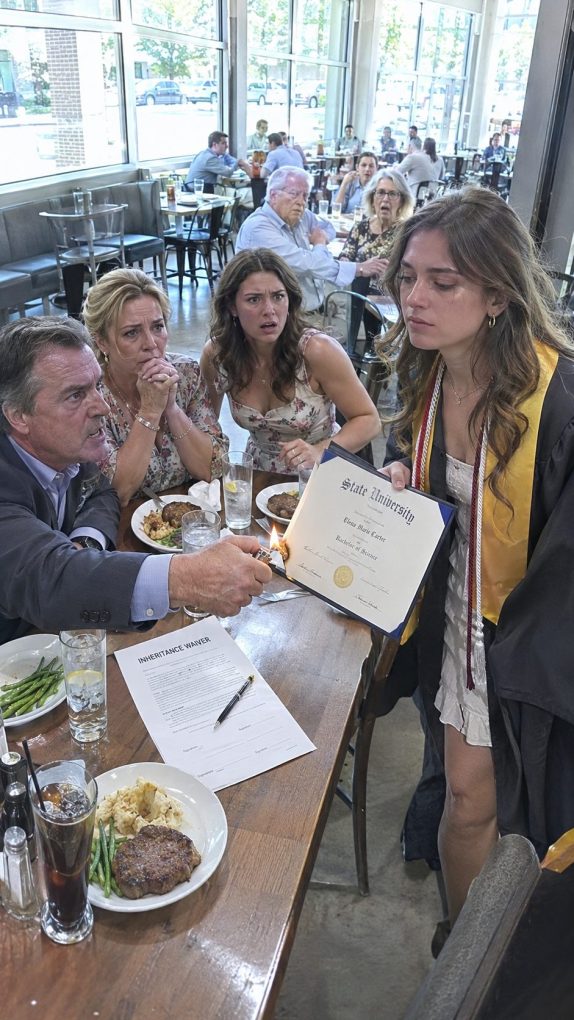
At my graduation dinner, Dad pushed a waiver across the restaurant table. “Give your inheritance to your sister.” When I refused, he held a lighter to my diploma while Mom watched. I left without screaming. Seven days later, the probate attorney opened a letter Dad had never seen…
“Sign the waiver, Leah. Your sister needs Grandma’s inheritance more than you do.”
Dad pushed a folded document across the restaurant table before the waiter had even brought my graduation cake. My nursing-school diploma rested in its blue folder beside my plate, and for one foolish moment, I’d believed my parents had come to celebrate me.
I was twenty-six, exhausted from three years of clinical rotations and overnight shifts at a Dayton hospital, but I’d passed my boards and accepted a position in the emergency department. Grandma Eleanor had been the one person who never asked why I was still studying when my younger sister Mallory already had a husband, two children, and a beauty salon.
Grandma had died seven weeks earlier, leaving behind a farmhouse, ten acres of land, and savings accumulated over forty years of careful living. Dad had already told me that her house “belonged with the family,” by which he meant Mallory, whose salon was struggling after its second expansion.
“I’m not signing away whatever Grandma left me,” I said, keeping my voice low.
Mom set down her fork. “Mallory has children to think about, Leah. You have a job and no real responsibilities.”
I looked at Mallory, who was examining a diamond bracelet she’d received for her birthday the previous month. I remembered coming home from a twelve-hour hospital shift to find Grandma waiting on my porch with a thermos of chicken soup, too proud to say she’d driven forty minutes because she worried I wasn’t eating.
Dad picked up my diploma. “You think that piece of paper makes you better than your sister?”
“Give it back.”
Instead, he flicked his cigarette lighter beneath one corner, holding it there until the paper caught. Mallory gasped, a waiter rushed over with a glass of water, and the edge of my diploma curled into black ash before Dad finally let it fall onto an empty plate.
For several seconds, nobody spoke. My hands were trembling under the table, but I remembered Grandma pressing a cream-colored envelope into my palm during our last visit, telling me, “When they try to make you feel small, don’t mistake their noise for the truth.”
I stood, thanked the waiter for helping, and walked past the untouched cake. Outside, I sat in my car until I could breathe without shaking, then took the envelope from my glove compartment.
Inside was a note from Grandma’s attorney confirming next week’s estate meeting, along with a single page Grandma had insisted I keep.
Across the top, in her careful handwriting, were five words:
“Transfers I never authorized — Thomas.”
The following Thursday, I entered attorney Denise Mercer’s office with a photograph of my burned diploma. Dad sat at the head of the conference table, looking ready to divide furniture rather than discuss Grandma.
Denise explained that Grandma had appointed her as independent executor and that her most recent will had been filed with the probate court. Dad interrupted before she could finish, insisting Grandma had always planned for him to manage the estate and that I was only there to sign a disclaimer.
“That was an earlier plan,” Denise replied. “Your mother changed her will in February, after consulting me privately.”
Dad laughed. “She was confused after surgery.”
Denise laid out the witnesses’ signatures and a medical assessment Grandma had requested to counter that accusation. I remembered visiting her after the appointment, when she was sitting in the garden trimming dead leaves from her roses and complaining that the lawyer had made her repeat the date three times.
Under the updated will, Grandma left me the farmhouse and its ten acres, while the remaining savings would cover estate expenses, several modest gifts, and a $25,000 trust for Mallory’s children. Dad received family photographs and Grandpa’s woodworking tools; Mallory received no additional personal inheritance because Grandma had previously paid $110,000 toward her salon, an intentional gift documented in writing.
Mom’s face hardened. “She gave Leah the whole house because Leah manipulated her.”
“I brought her groceries,” I said. “I listened when she talked. I didn’t tell her what to sign.”
Denise turned to the ledger Grandma had entrusted to both of us. A year earlier, while Grandma recovered from hip surgery, Dad had been granted limited financial power of attorney so he could pay her bills and manage the rental income.
Instead, eight transactions totaling $186,400 had left Grandma’s accounts without her authorization. Bank records traced $96,400 to Dad’s overdue commercial-property loan and another $90,000 to invoices for Mallory’s salon, which Dad had paid while describing them to her as gifts from Grandma.



