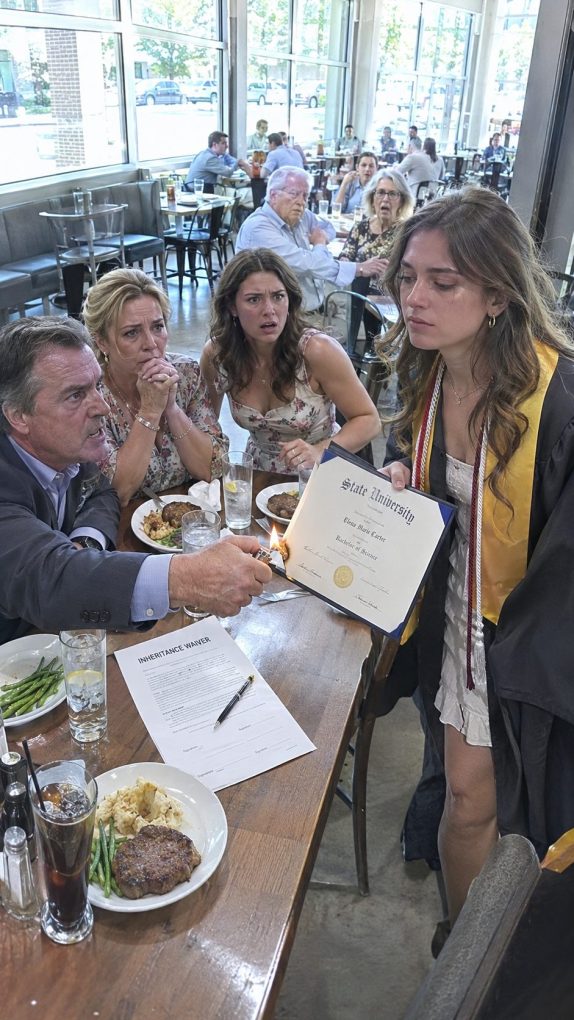
Mallory stared at the figures. “Dad told me she offered to help.”
“And she did help you, before this,” Denise explained. “The earlier $110,000 was a gift; these later payments weren’t, and your grandmother expressly disputed them.”
In January, Grandma had noticed the missing funds, revoked Dad’s power of attorney, and sought legal advice. Denise preserved bank statements, Dad’s unanswered requests to postpone repayment, and Grandma’s signed account of what she’d discovered.
Dad shoved his chair backward. “You’re turning private family business into a courtroom spectacle.”
“You transferred money you weren’t authorized to take,” Denise answered. “The estate has a duty to recover it.”
For a moment, I wanted him to look at me, to see the woman whose graduation he’d turned into another punishment for refusing him. But Dad was already whispering to Mom, asking whether the farmhouse could still be sold before the court ruled on the will.
Denise heard him.
“Mr. Bennett, that property is subject to the estate administration, and you have no authority to sell it.”
He went pale, which frightened me more than his shouting had.
After they left, Denise opened one last email from a local real estate agent. Dad had signed a listing agreement for Grandma’s farmhouse three days after her funeral, falsely identifying himself as executor.
The agent had been told the house would be vacant and available immediately.
Dad hadn’t only demanded that I surrender my inheritance. He’d already started trying to sell it.
The next morning, Denise sent the real estate brokerage a copy of her court appointment and demanded that the listing be withdrawn. The agent confirmed Dad had falsely represented himself as the estate’s executor.
Dad called me eleven times that weekend. I saved his final voicemail: “You think a little nursing degree makes you important? Everything your grandmother owned came from this family.”
I almost deleted it because hearing his voice made my stomach turn. Instead, I forwarded it to Denise and went to my next hospital shift, where a frightened elderly patient asked me to hold her hand during an examination.
That small request brought me closer to tears than Dad’s threats had. Grandma used to squeeze my fingers exactly that way when I brought her soup, and I suddenly understood that keeping her house meant protecting more than the property.
Dad challenged the will, alleging Grandma had lacked the mental capacity to understand what she was signing. For months, the estate remained in probate while Denise gathered the attorney’s notes, witness testimony, medical records, and bank documents.
At the hearing, Dad described himself as a devoted son who had sacrificed years caring for his mother. Then Denise’s lawyer presented the eight unauthorized transfers and asked why $96,400 had gone toward Dad’s commercial loan.
Dad stared at the table.
He claimed the payments had been gifts, but Grandma’s contemporaneous written objections, her revocation of his financial authority, and his own emails about delaying repayment told a different story. The judge found the will valid, rejected Dad’s challenge, and directed that his handling of Grandma’s money receive a full fiduciary accounting.
Following that accounting, Dad faced a separate claim from the estate for the missing $186,400. Rather than continue litigation, he signed a court-approved settlement agreeing to repay the full amount after selling a lake cottage he and Mom owned.
The farmhouse was never sold.
Mallory learned that the $90,000 she believed Grandma had freely given her had actually come through Dad’s unauthorized transfers. She kept her distance from him afterward, although she never apologized to me for sitting quietly while he burned my diploma.
Sixteen months after graduation, the estate was finally settled, its expenses and obligations paid, and the farmhouse transferred into my name under Grandma’s will. I returned to find her gardening gloves still hanging from a nail in the mudroom, with a packet of rose seeds tucked into one finger.
Denise also gave me a letter Grandma had written after changing her will, a personal note she hadn’t wanted read aloud in court. In it, she explained that I hadn’t earned her love by becoming a nurse, and that Mallory hadn’t lost it by struggling.
“I wanted to leave you a place,” Grandma wrote, “where nobody can make you apologize for the life you’ve built.”
I sat on the kitchen floor and cried until the afternoon light moved across the tiles. Then I called my nursing-school registrar and ordered a replacement diploma, because the paper Dad had destroyed was not the degree I’d worked to earn.
Dad never asked to visit the farmhouse again, and I stopped inviting him into decisions that belonged to me. I planted roses beside Grandma’s porch, kept my hospital job, and began spending Sunday mornings with people who came because they loved me, not because they wanted something signed.



