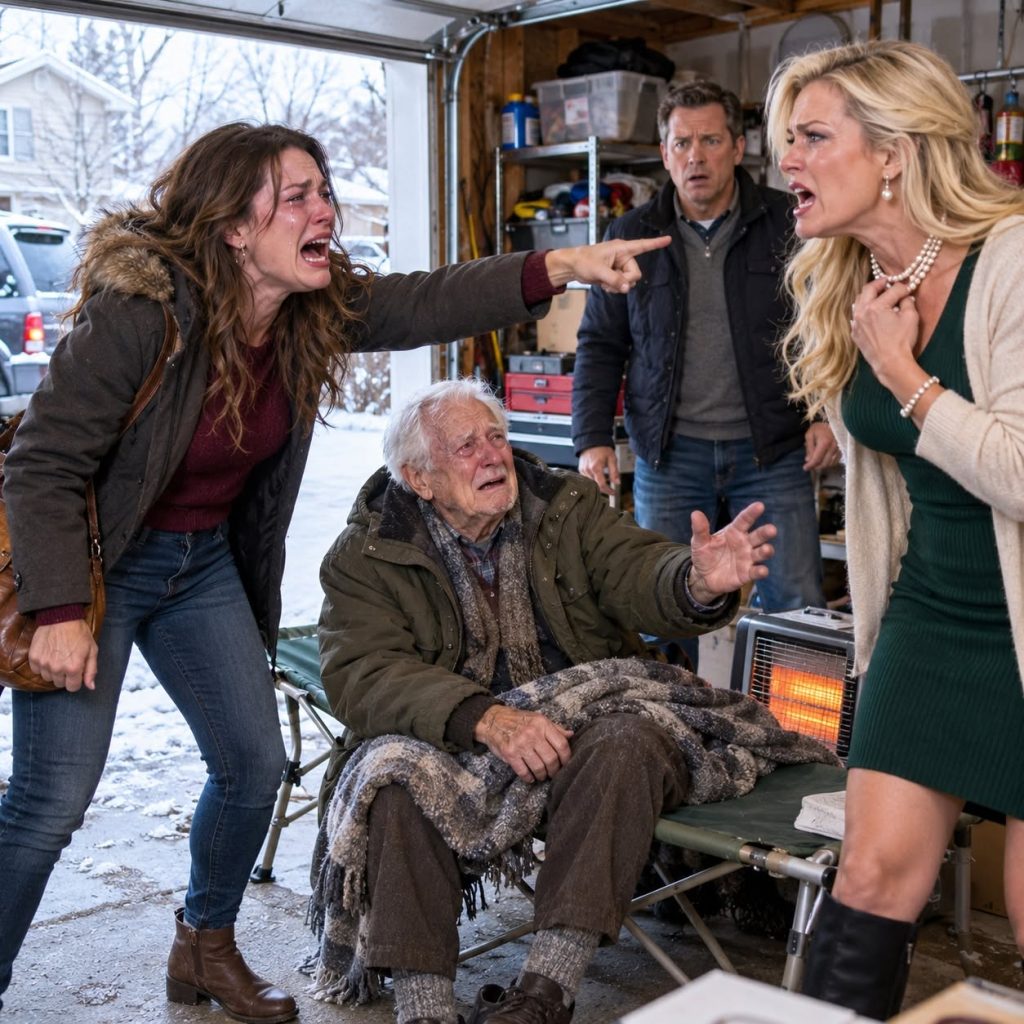
“Remember what I told you about helping somebody who couldn’t help himself?”
He listened.
Then he said:
“Well, boys, this time I’m the one who needs help.”
I watched Grandpa make fourteen phone calls that night.
Some men answered immediately.
Others took longer.
One was driving a delivery truck. Another was working the night shift at a hospital. Two hadn’t spoken to Grandpa in nearly ten years.
But every conversation ended the same way.
“Yes, sir. We’ll be there.”
I finally asked what he’d told them.
Grandpa closed his address book.
“I asked them to help me leave.”
Those words broke my heart.
He wasn’t asking for revenge.
He just wanted to leave the house he’d built without losing everything that mattered to him.
The following morning, I contacted the estate-sale dealer Vanessa had used.
His name was Harold Pierce.
When I explained the situation, he grew quiet.
“Ma’am, your sister-in-law told me the owner was moving into assisted living.”
“He isn’t.”
“She said everything had been authorized.”
“It wasn’t.”
Harold checked his records.
Vanessa had sold him the contents of Grandpa’s workshop for $1,800.
Decades of tools, handmade furniture, and personal keepsakes.
The fourteen wooden boxes were included.
My grandfather’s entire life’s work had been treated like unwanted junk.
Harold agreed to hold whatever remained while ownership was sorted out.
But several items had already been resold.
When Grandpa heard that, he sat quietly for a long time.
Then he said, “I suppose things are only things.”
I knew he didn’t believe it.
Those boxes held pieces of people he’d loved.
On Tuesday, Daniel came to the hotel.
He looked exhausted.
“Vanessa didn’t mean for him to get cold.”
I stared at him.
“She put an eighty-five-year-old man in an unheated garage.”
“She said he wanted to sleep there.”
“And you believed her?”
Daniel rubbed his forehead.
“Emily, things have been bad between us.”
“That’s not an answer.”
He finally admitted they’d been living in Grandpa’s house without paying rent for almost three years.
Vanessa had convinced herself the house would eventually belong to them.
She’d already started planning renovations.
The workshop was supposed to become a short-term rental, generating extra income.
“Did Grandpa agree?”
Daniel shook his head.
“No.”
“Then why did you let her do it?”
He started crying.
“I was afraid she’d leave me.”
I couldn’t believe what I was hearing.
“You were afraid of losing your marriage, so you let Grandpa lose his bedroom?”
Daniel lowered his head.
For the first time, I saw shame instead of excuses.
But shame didn’t undo what he’d allowed.
On Wednesday, Grandpa met with an attorney.
The lawyer confirmed that the house belonged to him alone.
Daniel and Vanessa had no ownership interest.
Grandpa could require them to leave, but because they’d been living there, he needed to follow Tennessee’s proper notice and eviction procedures if they refused.
He also reported the removal and sale of his belongings.
The lawyer helped him document the transactions and demand an accounting.
I suggested he move to Denver with me.
He squeezed my hand.
“Honey, your life is there. Mine is here.”
“Then where will you live?”
He smiled.
“Somewhere with a porch.”
He’d already made a decision.
He wanted a smaller house near his friends, a garden he could manage, and enough room for one workbench.
He planned to sell his old house once Daniel and Vanessa had legally moved out.
I offered to help him search.
He refused to let me do everything.
“Emily, I may be eighty-five, but I’m still allowed to make my own decisions.”
I laughed through my tears.
“Yes, sir.”
Six days after I arrived, I heard engines outside the hotel.
Grandpa was already dressed.
He wore clean jeans, a flannel shirt, and his favorite brown jacket.
“Ready?” he asked.
“For what?”
“For my birthday party.”
We drove back toward the house.
At 9:03 a.m., the first pickup truck turned onto the street.
Then another.
And another.
Fourteen pickup trucks arrived, carrying men between their late thirties and early sixties.
Some wore work boots. Others wore company uniforms.
One carried a bouquet of flowers.
Another brought a birthday cake.
Every truck had come for Walter Bennett.
Grandpa stepped out of my car.
The first man, a tall electrician named Marcus, crossed the lawn and hugged him.
“You taught me how to use a saw when nobody else would hire me.”
A mechanic named Peter began crying.
“You paid for my first set of tools.”
A third man handed Grandpa a photograph.
It showed him standing beside a teenage boy in an old workshop.
“Twenty-three years ago, you told me I could become somebody.”
Grandpa stared at the photograph.
Then he started crying, too.
Nobody laughed.
Nobody told him to stop.
Vanessa came outside wearing Grandma’s pearls.



