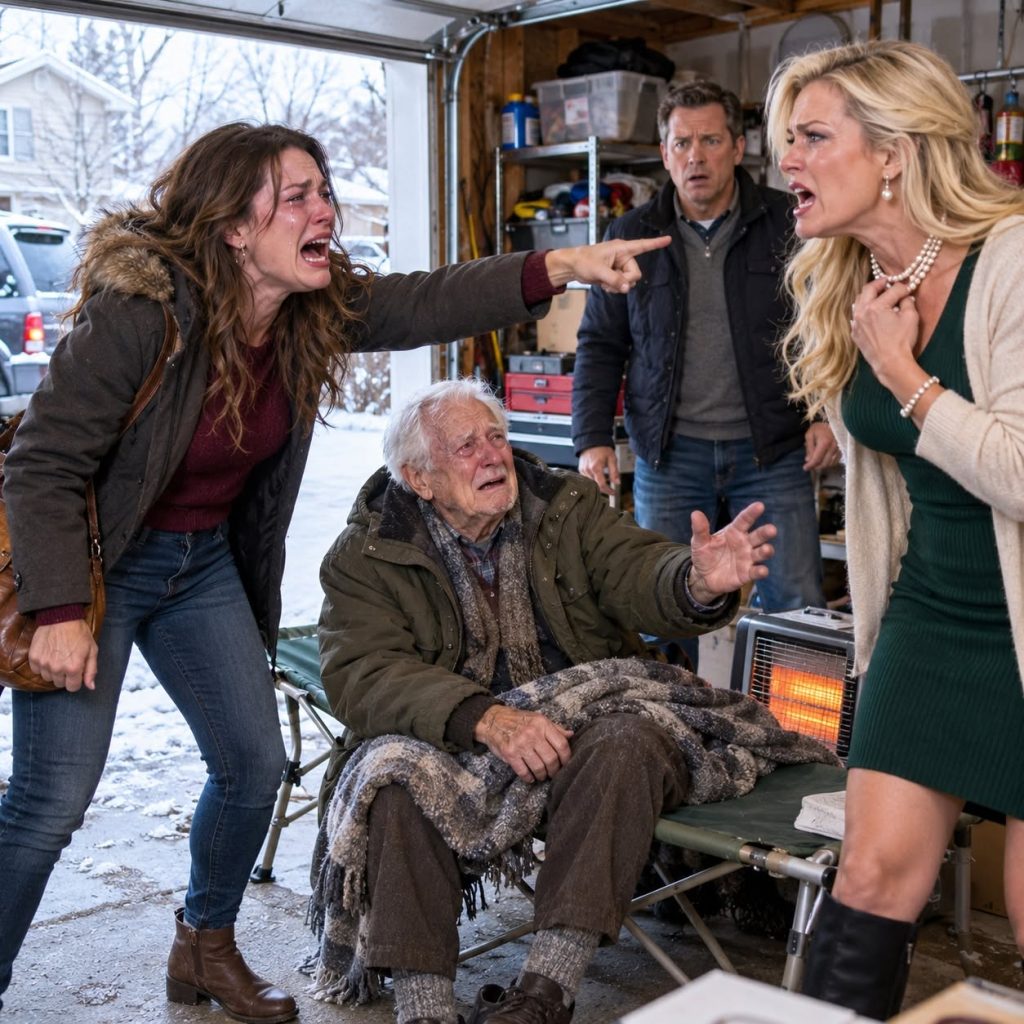
“What is this?” she demanded.
Fourteen grown men turned toward her.
Marcus spoke first.
“We’re here to help Mr. Bennett collect his belongings.”
“You can’t just take things!”
Grandpa stepped forward.
“They’re my things, Vanessa.”
She pointed toward the trucks.
“This is intimidation! I’m calling the police!”
“You’re welcome to,” I said. “Nobody’s entering without permission, and nobody’s touching your belongings.”
Grandpa had already arranged a supervised collection of his personal property with the attorney’s assistance.
Daniel had agreed to let the men enter the workshop.
The trucks weren’t there to throw anybody out.
They were there to help Grandpa take his life back.
Vanessa suddenly reached for her necklace.
Grandpa looked at the pearls.
“Those were Eleanor’s.”
His voice was quiet.
“She wore them on our wedding day.”
Vanessa hesitated.
“I was just borrowing them.”
“Without asking.”
Her eyes filled with tears.
For once, nobody rushed to comfort her.
She slowly unclasped the necklace.
When she placed it in Grandpa’s palm, his fingers trembled.
He didn’t shout.
He simply closed his hand around the pearls.
And somehow, that was more devastating than anything he could have said.
The men carried out Grandpa’s clothes, photographs, furniture, and remaining tools.
Harold, the estate-sale dealer, arrived with a trailer.
He’d recovered nine of the fourteen wooden boxes and several tools.
The others had already been sold to buyers he couldn’t immediately locate.
Marcus opened one of the recovered boxes.
Inside was a crooked wooden birdhouse.
He burst out laughing.
“Good Lord. I made this when I was sixteen.”
Grandpa grinned.
“Still couldn’t cut a straight line.”
Everyone laughed.
The kind of laughter that brings people together instead of tearing somebody apart.
Then Marcus knelt beside Grandpa.
“We’ll find the other five, Pop.”
Grandpa shook his head.
“You don’t owe me anything.”
Marcus looked around at the men.
“That’s where you’re wrong.”
Over the following month, Daniel and Vanessa moved into an apartment.
Grandpa didn’t forgive Daniel immediately.
He told him rebuilding their relationship would require more than apologies.
As for Vanessa, the estate-sale dispute became a formal legal matter.
With help from the attorney, Grandpa obtained compensation for items that couldn’t be recovered.
He used part of the money to restore his workshop equipment.
But the strangest change wasn’t financial.
Vanessa eventually wrote him a letter.
She admitted she’d treated him like an obstacle instead of a person.
She didn’t ask for money or permission to return.
She simply apologized.
Grandpa read it once and placed it in a drawer.
“Maybe she’s learning,” he said.
He wasn’t ready to forgive her.
And that was his decision.
Three months later, Grandpa moved into a small cottage outside Knoxville.
It had two bedrooms, a covered porch, and a detached workshop with proper heating.
The fourteen men helped him move again.
This time, nobody cried from humiliation.
They laughed, argued over furniture placement, and ate barbecue in the backyard.
Above his workbench hung fourteen photographs.
Beneath them, Grandpa placed a small wooden sign.
“Nobody Gets Left Out in the Cold.”
On his first evening there, he handed me Grandma’s pearls.
“She wanted you to have these.”
I stared at him.
“Grandpa, I can’t.”
“You came home for my birthday,” he said. “And you reminded me that being old doesn’t mean being helpless.”
I hugged him.
He whispered something I’ll never forget.
“Those boys didn’t come because I needed saving, Emily. They came because, once upon a time, somebody believed they were worth saving.”
I looked at the fourteen pickup trucks parked outside.
For years, Vanessa had seen Grandpa as an old man taking up space.
She’d never understood how many lives he’d helped build.
And by the time she did, he’d already found somewhere he truly belonged.
THE END.



