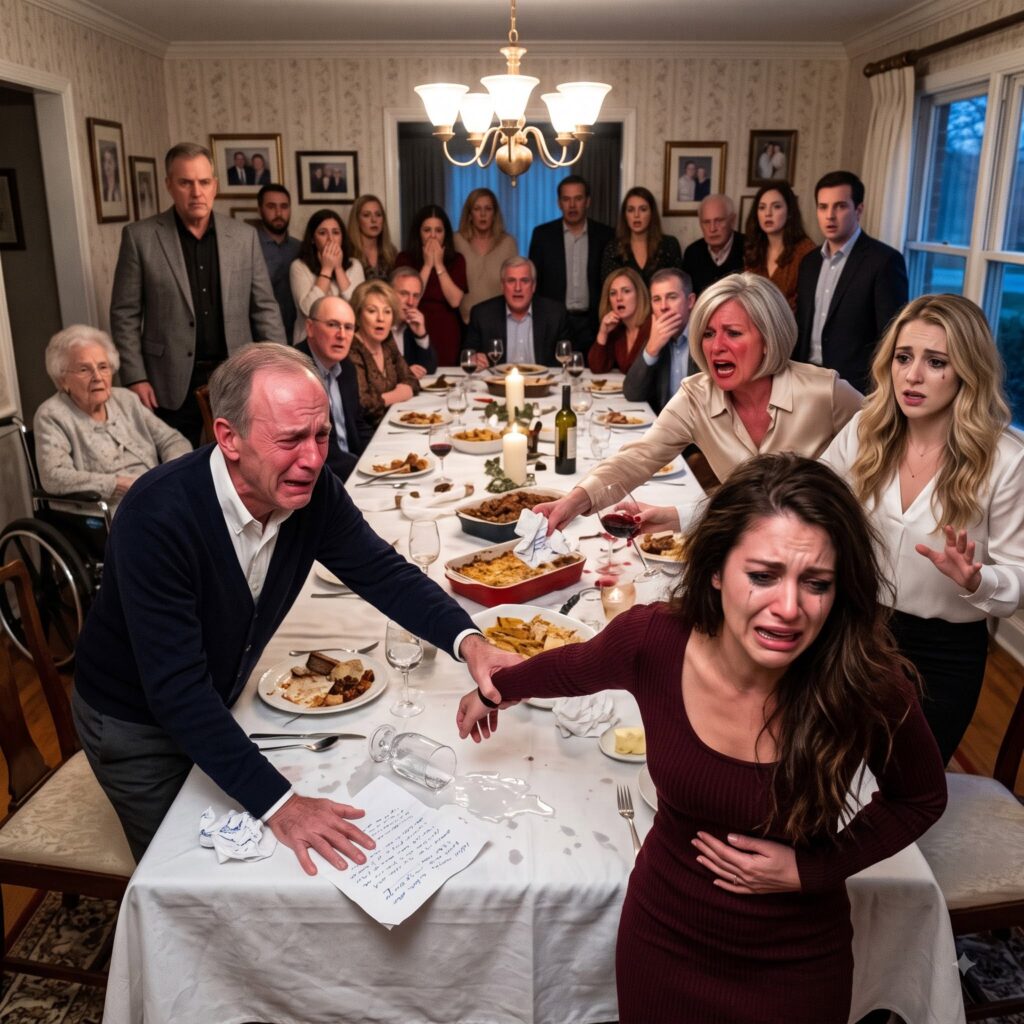
My mother started crying before anyone asked her a question.
“Courtney came to me the night the results came back,” she said. “She was shaking. She said she couldn’t do it. That she’d been having panic attacks for weeks, that she’d rather die than lie on that operating table. And I looked at my baby, and I—” She pressed her fingers to her lips. “I thought, Hannah is strong. Hannah never needs anything. Hannah will be fine.”
The words landed like a slap. I’d heard that sentence my whole life. When I worked two jobs through hygiene school. When Courtney got a car for her sixteenth birthday and I got a bus pass. Hannah will be fine.
“So you lied to me,” I said. “You let me think she wasn’t a match.”
“Courtney begged me to say it. I told myself it was kinder.” Mom’s voice cracked. “Then the fundraiser started, and she was so proud, and I thought, if she gets to be the hero, maybe she’ll forgive herself.”
Uncle Tom turned to my sister. “And the money, Courtney?”
All the glow had drained out of her. She sank into her chair. “I had forty-one thousand dollars on credit cards,” she said to the tablecloth. “The boutique never made a dime. People kept donating, and the money just sat there. I told myself I’d put it back before anyone noticed. Then it was eleven transfers and a trip to Cabo, and I couldn’t stop.” She looked at me, mascara streaking. “I didn’t think you’d ever find out. You never ask for anything.”
“I didn’t ask,” I said quietly, “because I was holding my own life together with both hands.”
Nobody spoke. Then Dad pushed himself to his feet, one trembling hand on the back of his chair, and every head turned.
“Here’s what I know,” he said. “Nine weeks ago, I woke up in a hospital bed, and the first face I saw was my daughter Hannah’s, gray as a sheet, asking, ‘Is it working, Dad?’ She’d just lost an organ, and she was worried about me.” His voice broke. “I spent eighteen days trying to find a way to say this without breaking this family. And I couldn’t. Because the truth is the only thing I have left to give her.”
He lifted his water glass, his hand shaking. “To my daughter Hannah. Who gave me her kidney. Who gave me my life. And who got a toast tonight from nobody but me.”
For a long moment, nothing. Then my grandmother Rose, ninety years old, raised her glass with both hands. “To Hannah,” she said, loud and clear. Uncle Tom followed. Then my cousins. Then, one by one, twenty-two glasses rose again, and this time, every single person was looking at me.
I’d waited nine weeks to be seen. I cried in front of the whole family and didn’t care who watched.
Courtney bolted for the door.
“Sit down,” Dad said, and I had never heard that voice from him. “You’ll hear all of it. And then you’ll fix it.”
She sat. Nobody rushed to comfort her. It was the first time I’d seen my family let her feel the weight of something.
The weeks that followed were hard. GiveHope refunded every donor under its guarantee and referred the case to the Cuyahoga County Prosecutor. Courtney pleaded guilty to felony theft. The judge gave her three years’ probation, three hundred hours of community service, and a restitution order for every dollar she’d taken. She sold her car, shut down the boutique, and took a job at an insurance call center, where she still works.
Dad refused to let me carry the loss. He paid me back for all nine weeks of missing wages out of his retirement account, plus the rent I’d fallen behind on. I tried to refuse the check. He put it in my hand and closed my fingers around it. On the memo line, he’d written one word: Thank you.
Mom didn’t get off easily, either. For three weeks, she barely spoke to anyone. Then she showed up at my apartment with a handwritten letter and a casserole I hadn’t asked for.
The letter was four pages long. On the last page, she’d written Hannah will be fine and crossed it out, over and over, until the pen tore the paper. Under it: I’m so sorry I never asked if you were.
I didn’t forgive her that day. I let her come in and sit down. It was a start.
Dad didn’t leave her. But he went with her to counseling every Thursday, and he told her plainly that forgiveness would take as long as it took.



