In April, my mother said she had bought diapers.
Amy’s online order history showed a case of diapers arriving two days earlier, paid from our joint account.
In May, Teresa said she was “taking care of cleaning.”
No cleaner had ever come.
Amy had assumed Teresa meant she was helping personally.
She wasn’t.
In June, Teresa said she had spent extra because Frederick needed “special baby supplies.”
The only thing Amy could remember my mother buying that month was a stuffed elephant.
Twenty-two dollars.
I sat at the dining room table with my laptop open.
The numbers blurred.
Three thousand.
Three thousand.
Three thousand.
Transfer after transfer.
Automatic.
Reliable.
Predictable.
Money I had worked for.
Money I had believed was protecting my family.
At some point, Amy placed a cup of coffee beside me.
I hadn’t heard her enter.
“Connor.”
I looked up.
“What?”
“You’re shaking.”
I looked at my hands.
She was right.
“I paid her to hurt you.”
“No.”
“I did.”
“You didn’t know.”
“I should have.”
“You should have listened sooner.”
I swallowed.
She continued gently.
“That’s different.”
I looked toward the stairs.
Frederick was sleeping.
“I keep thinking about you sitting on that stool.”
Amy’s eyes dropped.
“I was so hungry.”
My throat closed.
“She wouldn’t let you eat?”
“She didn’t say I couldn’t eat.”
“What did she say?”
Amy hesitated.
“She told me the guests came first.”
I looked away.
“She said I could eat after the kitchen was under control.”
I stood so suddenly the chair scraped across the floor.
Amy touched my arm.
“Connor.”
“I need air.”
I walked outside.
The night was warm.
One balloon still floated above the patio.
It had Frederick’s name printed across it.
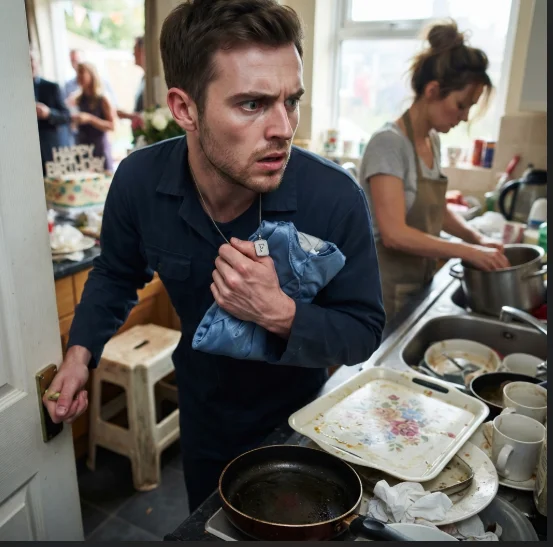
HAPPY 1ST BIRTHDAY, FREDERICK.
Underneath it was a table covered in half-eaten seafood.
My mother had spent money on all of this.
Maybe my money.
Probably my money.
She had purchased abundance for people I barely knew while my wife ate bread over a sink with one hand.
That image stayed with me.
I picked up the nearest trash bag and started cleaning.
Not because the mess mattered.
Because if I didn’t do something physical, I thought I might explode.
Amy came outside.
“You don’t have to do this tonight.”
“Yes, I do.”
“Why?”
“Because you shouldn’t have to.”
She stood quietly.
Then she picked up another trash bag.
I looked at her.
“No.”
She almost smiled.
“This is my house too.”
Those words stopped me.
My house too.
Simple.
Obvious.
And somehow, after months of my mother’s manipulation, it sounded like a declaration.
We cleaned together.
Not because Teresa had ordered it.
Not because guests were waiting.
Because it was our home.
The next morning, I contacted an attorney.
Not because I wanted revenge.
Because the deed scared me.
The attorney told me the first thing to do was verify the current recorded ownership with the county and secure every original document.
We did.
The title remained in our names.
Mine and Amy’s.
No change had been completed.
That brought relief.
But not enough.
Because someone had still taken the original deed from my locked office.
The document itself did not magically transfer ownership.
But its disappearance proved intention.
Someone had gone looking for it.
Someone had wanted control of paperwork related to my house.
And my mother’s statement to the police—“This is my house”—no longer sounded like an angry exaggeration.
It sounded like something she had begun believing.
Or something she wanted everyone else to believe.
Mason called me two days later.
I almost didn’t answer.
Amy was sitting across from me.
“Take it,” she said.
I put the phone on speaker.
“Connor?”
“What do you want?”
“I want to explain.”
“Then explain.”
Silence.
“Teresa told me you knew.”
“Knew what?”
“The papers.”
“What papers?”
“She said she wanted you to sign something later.
Some kind of family arrangement.”
My stomach tightened.
“What kind?”
“I don’t know.”
“You expect me to believe that?”
“I swear.
She didn’t show me anything.”
“Then why did she need my deed?”
“She said she needed the property information.”
“You can get property information publicly.”
“I know.”
“So why take the original?”
“I don’t know.”
Amy was watching me.
I asked, “Why were you carrying it?”
Mason exhaled.
“She told me to get the folder out of the house when she saw the police.”
There it was.
Not a theory.
Not an assumption.
A direct instruction.
“Why?”
“She said people wouldn’t understand.”
“Understand what?”
“I don’t know.”
“Mason.”
“I really don’t.”
I believed that part.
Mason wasn’t a mastermind.
He was the kind of relative who agreed to things without asking questions because Teresa had always acted like the family’s authority.
That didn’t excuse him.
But it explained him.
“She told me the house was basically hers,” Mason said.



