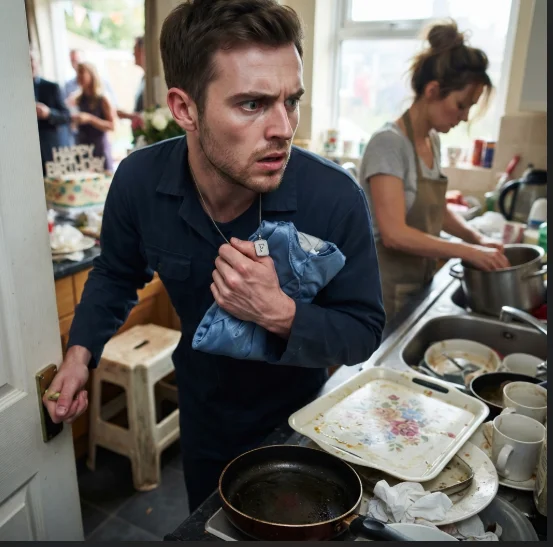
Amy stood at the door.
“What are you doing?”
“Getting rid of this.”
She laughed.
“Connor, it’s a stool.”
“I hate it.”
“You are holding a grudge against furniture.”
“Yes.”
She laughed harder.
It was the first time I had heard that sound from her in weeks.
I put the stool on the curb.
Then came back inside.
She was still smiling.
I walked upstairs and returned with two things.
The blue dress.
And the velvet box.
I had almost forgotten both after the birthday disaster.
Amy stared at the dress.
“What is that?”
“Your birthday present.”
“My birthday isn’t for four months.”
“Not your birthday.”
She looked confused.
Then I corrected myself.
“Your Frederick’s-birthday present.”
“That makes even less sense.”
“I bought it because you liked it.”
Her fingers touched the fabric.
“You remembered?”
“Of course.”
Her eyes filled again.
“No crying.”
“I can cry if I want.”
“Fair.”
Then I gave her the velvet box.
She opened it.
The little silver F caught the light.
For a second, she didn’t speak.
“Connor.”
“It was supposed to be for that day.”
She touched the pendant.
“It’s beautiful.”
“I wanted you to have something for his first birthday.”
Amy looked down.
“That birthday was terrible.”
“I know.”
She held the pendant in her palm.
Then she said, “Not all of it.”
I looked at her.
“You came home.”
That sentence stayed with me.
You came home.
At first, I thought she meant literally.
I walked through the back door.
I saw the truth.
I stopped what was happening.
But over time, I understood she meant something more.
For months, I had been physically living in our house without fully seeing what was happening inside it.
I knew the mortgage payment.
The insurance.
The construction schedule at work.
The grocery budget.
The pediatrician appointments.
I knew the numbers.
I didn’t know my wife was afraid.
I had outsourced attention.
That was my biggest mistake.
I thought sending money meant I was helping.
I thought trusting my mother meant I was honoring her.
I thought avoiding conflict meant I was keeping peace.
But money without attention can become power in the wrong hands.
Trust without boundaries can become permission.
And peace built on someone’s silence isn’t peace.
It’s pressure waiting to break.
We celebrated Frederick’s first birthday again.
Not officially.
There was no banner.
No expensive food.
No twenty guests.
Just the three of us.
I bought another small cake.
We put Frederick in his high chair.
Amy wore the blue dress.
The pendant rested against her neck.
Frederick slapped both hands into the frosting before we finished singing.
Amy laughed so hard she had tears in her eyes.
He smeared blue icing across his face.
Then somehow across mine.
Amy took pictures.
I took pictures of her taking pictures.
We ate cake directly from paper plates.
There were dishes afterward.
We left them in the sink.
Nobody apologized.
Later, after Frederick fell asleep, Amy and I sat outside on the patio.
The same patio where my mother had stood and declared:
In this house, I decide the rules.
I looked through the glass door.
At the kitchen.
At the family photographs.
At the toys scattered across the floor.
At the ordinary mess of a home where people actually lived.
Amy rested her head against my shoulder.
“You okay?” she asked.
“Yeah.”
“You’re thinking.”
“Always dangerous.”
She smiled.
I looked toward the back gate.
For a moment, I could almost see myself standing there again.
Cake in my hand.
Gift bags under my arm.
Listening.
That version of me still believed his mother was helping.
He still thought the three thousand dollars was making his wife’s life easier.
He still thought a quiet marriage meant a peaceful marriage.
He was about to open a door and lose a version of his family he had believed in his entire life.
But he was also about to see his real family clearly.
Amy.
Frederick.
Us.
My mother had wanted me to believe protecting family meant obeying her.
I learned something different.
Sometimes protecting your family means standing up to the person who taught you the word family in the first place.
Sometimes the person hurting your home isn’t a stranger.
Sometimes they have a key.
Sometimes they know exactly which guilt to use.
Sometimes they call control love.
And sometimes the most important door you ever open is the one that shows you a truth you never wanted to see.
I spent a year giving my mother three thousand dollars every month because I believed she was taking care of my family.
What she was actually doing was teaching my wife to feel powerless inside her own home.
She was using my trust to make herself indispensable.



