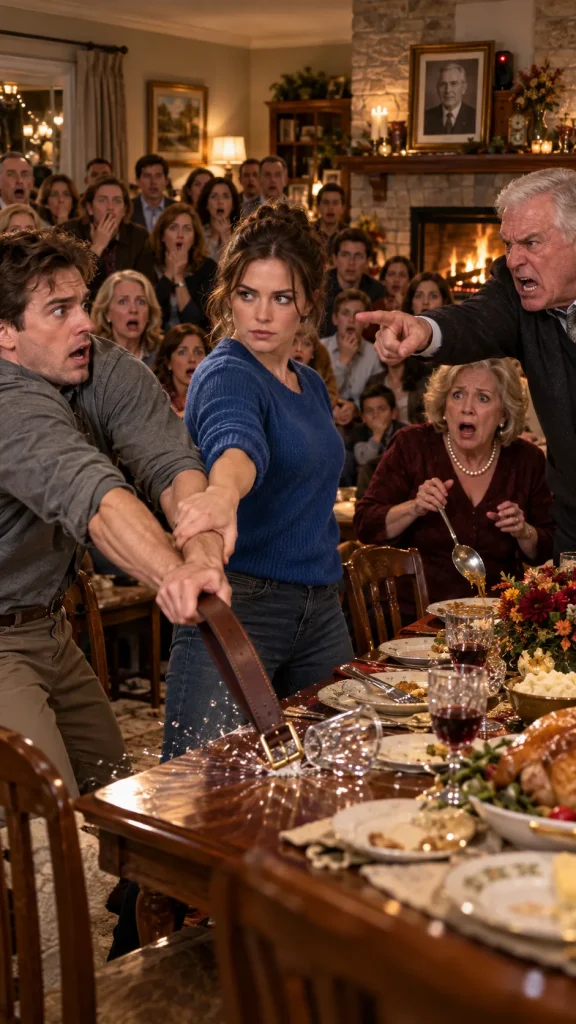
Robert noticed.
“Walk out with her and your mother pays for it.”
Nobody spoke.
Nobody even pretended not to understand.
I took Susan’s hand.
“You can come with us.”
She glanced at the doorway and whispered, “Not tonight.”
A man in the dining room lifted his phone to record.
Robert immediately straightened his jacket.
“Don’t put that online,” he ordered.
The cousin answered, “Then maybe don’t threaten people in front of twenty witnesses.”
Robert shoved past him and blocked the front door.
I didn’t touch him.
I asked the cousin to call the police and kept my hands where everybody could see them.
Robert moved away only when sirens became audible outside.
David followed me to the car without looking back.
As I started the engine, he caught my wrist gently.
“There’s something I should’ve told you before the wedding.”
My throat tightened.
“Then tell me now.”
He looked at the house where his mother stood alone behind the curtains.
“My father has done this before,” he said.
“And I helped him hide it.”
Chapter 4 – THE THING DAVID HID
The police took statements on Robert’s lawn while his guests slipped away in expensive coats.
One officer photographed the belt.
Another wrote down the cousin’s name.
Robert claimed I’d attacked him and David without warning.
David said nothing until I looked straight at him.
“Tell them who gave you the belt.”
His jaw trembled.
“My father,” he answered.
“And did he tell you to hit me?”
“Yes.”
It wasn’t enough to erase what happened, but it mattered that he’d finally said it aloud.
At home, I slept on the couch.
David sat on the floor beside the coffee table until sunrise.
He told me about the garage.
When he was twelve, he’d broken a headlight on Robert’s truck.
Robert made Susan watch while he punished David with the same leather belt.
When a teacher noticed bruises, Susan said he’d fallen off his bicycle.
“I repeated the story,” David admitted.
“Dad told me they’d take me away if I didn’t.”
I wanted to hug the frightened boy he’d been.
I also wanted to shake the grown man who’d almost raised a belt against me.
“Why didn’t you tell me?”
“Because I thought marriage would make me different.”
“Marriage doesn’t do that for you.”
He nodded without arguing.
At eight-thirty, my principal called.
His careful voice told me something was wrong before he said my name.
“Emily, a video involving you has been circulating among parents.”
I opened my phone.
There I was on Robert’s living room camera, catching David’s wrist.
But the first half of the clip had been cut away.
There was no belt hitting the table, no order to beat me, no threat against Susan.
Only a headline: TEACHER ATTACKS HUSBAND AT FAMILY DINNER.
Underneath, Robert had written one sentence.
“Would you trust this woman around your children?”
The view count was already climbing.
Principal Walsh asked me to stay home while the district reviewed the video.
“I understand why you’d need facts,” I told her.
“But please get all of them.”
I had trained students to speak up when something felt wrong.
Now messages poured into my inbox from strangers telling me to lose my job.
One woman wrote that I’d probably hit the kids too.
I stared at that sentence for a long time.
David paced our kitchen and called his father seventeen times.
Robert finally answered on speaker.
“You should’ve listened,” he told me.
“Apologize, resign, and this all disappears.”
“Did you cut the video?” I asked.
He laughed.
“People saw what they saw.”
David ended the call before I could answer.
I looked at him.
“Your father is trying to take away my students because I wouldn’t let him hurt me.”
“I know.”
“Then knowing isn’t enough.”
That afternoon I met a lawyer named Rachel Benton, who specialized in workplace disputes and protective orders.
She listened without interrupting, then wrote three things on a yellow legal pad: original video, witnesses, timeline.
“We aren’t going to win a shouting match online,” she said.
“We’re going to document what actually happened.”
The cousin, Marcus, agreed to describe the belt and the threat.
He’d stopped recording when Robert yelled at him, but he had captured the words “Show Emily who’s in charge.”
It was a start.
Rachel advised me not to confront Robert or publish private details about the family.
I went home carrying a folder of statements and an ache behind my eyes.
Susan was waiting outside our apartment in a thin cardigan, clutching her purse.
There was a fresh red mark around her wrist.
“Robert knows I talked to you,” she said.
Then she opened her purse and showed me a bank notice bearing my husband’s name.
“He’s not only trying to ruin you, Emily.”



