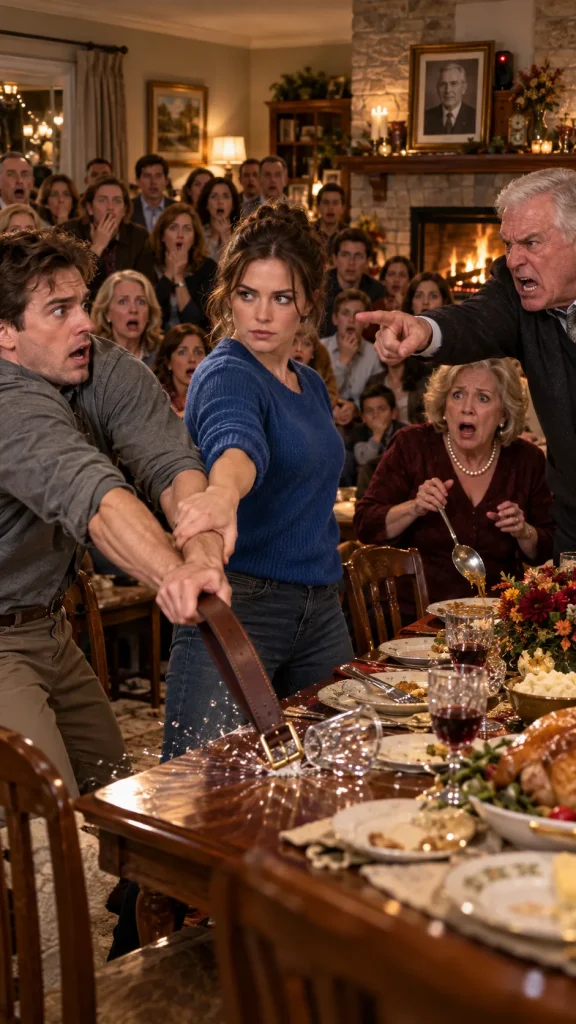
“He’s about to take our home.”
Chapter 5 – SUSPENDED BY A LIE
Principal Walsh asked me to stay home while the district reviewed the video.
“I understand why you’d need facts,” I told her.
“But please get all of them.”
I had trained students to speak up when something felt wrong.
Now messages poured into my inbox from strangers telling me to lose my job.
One woman wrote that I’d probably hit the kids too.
I stared at that sentence for a long time.
David paced our kitchen and called his father seventeen times.
Robert finally answered on speaker.
“You should’ve listened,” he told me.
“Apologize, resign, and this all disappears.”
“Did you cut the video?” I asked.
He laughed.
“People saw what they saw.”
David ended the call before I could answer.
I looked at him.
“Your father is trying to take away my students because I wouldn’t let him hurt me.”
“I know.”
“Then knowing isn’t enough.”
That afternoon I met a lawyer named Rachel Benton, who specialized in workplace disputes and protective orders.
She listened without interrupting, then wrote three things on a yellow legal pad: original video, witnesses, timeline.
“We aren’t going to win a shouting match online,” she said.
“We’re going to document what actually happened.”
The cousin, Marcus, agreed to describe the belt and the threat.
He’d stopped recording when Robert yelled at him, but he had captured the words “Show Emily who’s in charge.”
It was a start.
Rachel advised me not to confront Robert or publish private details about the family.
I went home carrying a folder of statements and an ache behind my eyes.
Susan was waiting outside our apartment in a thin cardigan, clutching her purse.
There was a fresh red mark around her wrist.
“Robert knows I talked to you,” she said.
Then she opened her purse and showed me a bank notice bearing my husband’s name.
“He’s not only trying to ruin you, Emily.”
“He’s about to take our home.”
Chapter 6 – A SIGNATURE THAT WASN’T HERS
Susan spread the bank notice across our counter and smoothed its corners with trembling fingers.
The loan was secured against the house she’d lived in for thirty-one years.
Three payments were overdue.
A larger balance would come due unless the account was brought current or new terms arranged.
David’s name appeared on the paperwork.
So did Susan’s.
“I never signed for this,” she whispered.
David stared at the page.
His face told me he recognized it.
“Talk,” I said.
He gripped the sink.
“Dad borrowed money to keep his contracting business afloat.”
“What contracting business?”
“He started it after retiring from the factory.”
“And you signed?”
He nodded.
“I thought I was helping Mom.”
Susan let out a small, broken laugh.
“You didn’t ask me.”
“I thought Dad had.”
“How many times have you believed him because it was easier than asking her?” I said.
David had no answer.
Robert called Susan four times while we talked.
On the fifth call she answered, and I watched her shoulders curl inward.
“Come home,” he ordered.
“No,” she said, surprising all three of us.
His voice hardened.
“Then enjoy sleeping in your son’s little apartment.”
She hung up, shaking so badly that David helped her sit.
Rachel referred Susan to a lawyer who handled financial exploitation and family property disputes.
We photographed the notice, saved the call history, and made a written list of what Susan remembered signing.
For the first time, I saw how long Robert had practiced making other people doubt themselves.
Near midnight Susan said, “There’s another document.”
She reached into her purse again.
It was a photocopy of a power of attorney.
The signature looked like hers, except for one thing.
Susan pointed to the date.
“I was in the hospital that week.”
Chapter 7 – THE MAN BEHIND THE PORTRAIT
The next morning, Susan told me about the man Robert had been before I met him.
He hadn’t started by shouting.
He’d started by checking receipts, deciding which friends she could see, and mocking her when she disagreed.
By the time David was born, Susan had stopped asking permission to do things she enjoyed.
“He always told me I was lucky,” she said.
“Lucky he stayed.”
I made coffee, but neither of us drank it.
David sat quietly at the table, listening to the childhood his mother had survived.
When Susan described the garage, he closed his eyes.
“I remember the sound more than the pain,” he said.
I understood that better than he knew.
In taekwondo, a sharp noise makes your body react before your mind catches up.
Training had taught me to choose what happened next.
Nobody had taught David that.
He told us his father’s contracting business had done poorly for months and that Robert had pressured him to guarantee part of the debt.



