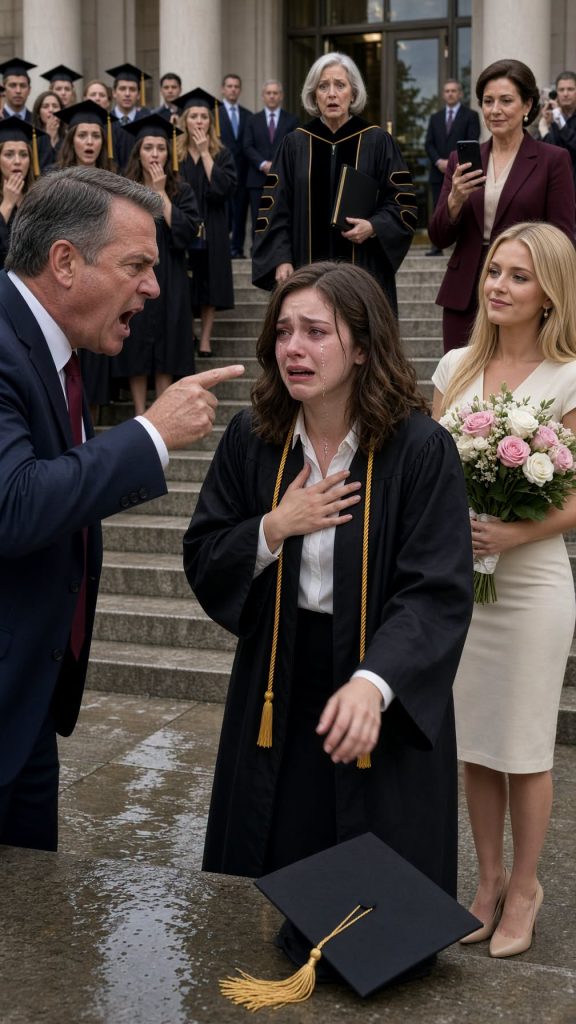
My graduation cap landed in a puddle when my father knocked it out of my hands. My stepsister wanted my reserved seat inside, and he screamed that I didn’t belong at my own ceremony. Then the university president came outside, called my name, and revealed why she’d been looking for me.
My graduation cap hit the wet pavement so hard that the gold tassel snapped off.
“Pick it up,” my father said. “Then give Madison your seat.”
Dozens of graduates stopped outside the auditorium. My stepsister stood beside him in a cream-colored dress, clutching a bouquet she had bought for herself. My stepmother watched from beneath the entrance awning, her phone already pointed at us.
I stared at my cap. Four years of night shifts, scholarships, and skipped holidays, and my father had reduced everything to something lying in a puddle.
“That’s the student speaker’s seat,” I told him. “It’s assigned to me.”
“Madison deserves to be in the front row,” he snapped. “You can sit somewhere else for one day.”
Madison tilted her head. “I don’t even need to give the speech, Claire. I just want the seat for the pictures. Why do you always make things difficult?”
I had spent three months preparing my commencement address. The university had selected me after my student food pantry program helped hundreds of classmates get through semesters they couldn’t afford. Madison had never volunteered a single afternoon there.
Yet somehow this was another thing I was supposed to surrender.
“You’re both graduating,” I said. “Sit in the section on your ticket.”
My father’s expression sharpened. “Don’t lecture me. I supported you when nobody else would.”
I almost laughed. He hadn’t paid my tuition. He hadn’t even come to my research presentation. The only messages he’d sent that semester were demands that I congratulate Madison on her achievements.
He stepped closer and pointed toward the doors.
“YOU DON’T BELONG HERE!”
Several students flinched. A faculty marshal hurried toward us. I bent to retrieve my cap, but my father caught my wrist.
“Tell them you don’t want the honors seat,” he hissed. “You owe your sister this.”
“Let go.”
He tightened his grip.
Then the auditorium doors opened.
University President Dr. Elaine Porter emerged with two staff members. She looked past my father, past Madison, and straight at me.
“Claire Bennett?”
My father released me instantly.
“I’m her father,” he announced. “There’s been a mistake with the seating. Madison should be—”
“No, Mr. Bennett,” Dr. Porter interrupted. “The seating isn’t the mistake.”
She held out a folder and lowered her voice.
“Claire, someone submitted a signed statement claiming you stole your award-winning project from Madison.”
The page inside carried my name. Under it, beside the words Witnessed by, was my father’s unmistakable signature.
“That’s not my signature,” I said, pointing to the name above my father’s.
Dr. Porter didn’t look surprised. “That’s why we came looking for you.”
She led us into a small reception room behind the auditorium. The faculty marshal stayed by the door. Through the wall, I could hear the orchestra tuning up for a ceremony I was suddenly afraid I wouldn’t be allowed to attend.
The statement said I had copied Madison’s proposal for Open Table, the campus food pantry I founded during sophomore year. It claimed Madison had designed the program, recruited the volunteers, and written the speech I was scheduled to deliver.
At the bottom was a request that I relinquish both my student leadership award and the reserved seat beside the stage.
“Where did this come from?” I asked.
“Madison submitted it to our honors office yesterday,” Dr. Porter answered. “She told the staff that you were too ashamed to deliver it yourself.”
Madison’s face reddened. “Because it’s true.”
“Then explain why my faculty adviser has my original proposal,” I said. “Dated three years before you ever applied to this university.”
My father slammed his palm against the table. “Enough. Your sister has suffered because of you.”
“Because of me? You signed a statement saying I was a thief.”
“I signed what Madison brought me.” He looked away. “She said it was the only way to fix things.”
That hurt more than his shouting outside. He hadn’t called me. Hadn’t asked for one document. He had simply signed.
Dr. Porter opened a second folder. “Our faculty committee has the original grant application, volunteer records, and emails from the community partners. We have not accepted the allegation. But there’s something else you need to understand.”
She turned toward Madison.
“Your graduation eligibility was reviewed last month. You were notified in writing that you had not completed the requirements to participate today.”
My father went completely still.
“What?” he whispered.
Madison grabbed his sleeve. “They were supposed to reconsider.”
“No,” Dr. Porter said firmly. “No exception was approved.”
Suddenly, the seating demand made horrible sense. Madison didn’t want a better view. She wanted a photograph in the graduates’ reserved section, close enough to the stage that my family could pretend she had walked across it.
My father stared at her. “You told me your diploma was ready.”



