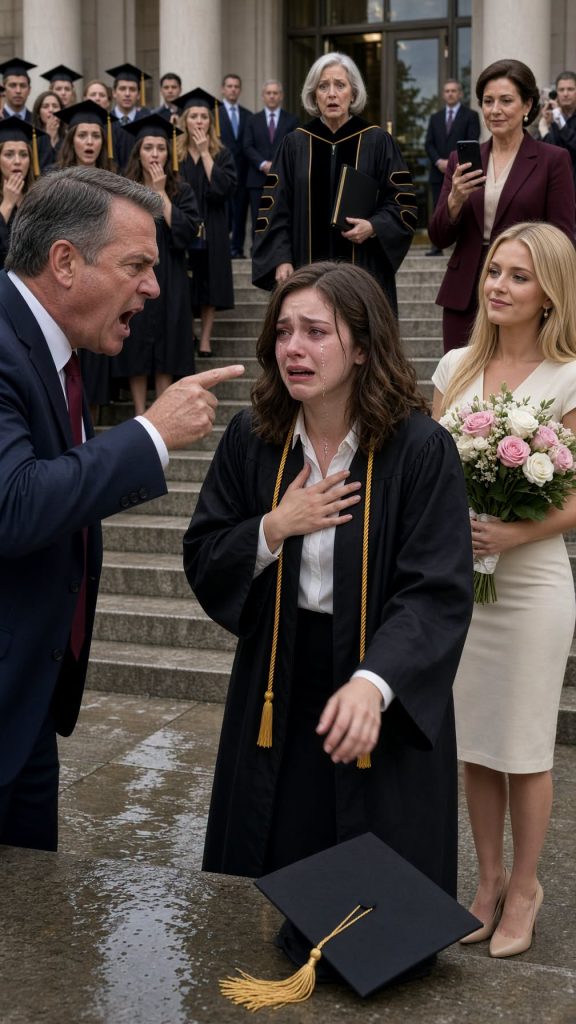
“It would have been,” she snapped, pointing at me, “if Claire hadn’t made everyone think the pantry was hers!”
“Madison,” I said, “you weren’t even there when we opened it.”
Dr. Porter glanced at her watch. “Claire, the board has already verified your contribution. You’re still our student speaker. We can protect your place today.”
For one breath, relief nearly buckled my knees.
Then my phone began vibrating.
My aunt. My cousin. Three classmates. A dozen messages in the family group chat.
My father had posted the forged statement, captioned: Claire finally admitted what she did. The truth should come out before the ceremony.
As I watched, strangers began sharing it. And the first message from a campus reporter appeared on my screen.
The reporter’s message contained only seven words: Is this why you’re not graduating today?
The ceremony hadn’t started, and my father had already turned his lie into a story strangers believed.
“Our communications office can correct this,” Dr. Porter said.
“People are already calling me a fraud,” I whispered.
She sat opposite me. “You are graduating today. You are delivering the speech you wrote. We will not punish you for an accusation we have already checked against the evidence.”
I stared at my father’s caption. He had announced my guilt without asking for a single fact.
I turned the phone toward him.
“Did you post this?”
He looked at the floor. “I thought you would finally give Madison what she deserved.”
“You thought strangers should hate me until I obeyed you?”
“I didn’t think it would spread.”
Madison crossed her arms. “You can still make it stop. Tell them you gave me permission to use the project. Then maybe they’ll let me participate.”
“No.”
She blinked. My father lifted his head as if I’d said something impossible.
“No more signatures. No more pretending. You are not taking my work or my graduation.”
Dr. Porter asked the faculty marshal to escort them out. Madison protested that her mother was waiting inside, but the marshal explained that she could attend only with a valid guest ticket, not enter the graduate seating area. My father tried to follow me instead.
“Claire,” he said, suddenly soft, “don’t do this to the family.”
I looked at the signature on the statement one last time.
“You did this when you signed without asking me.”
The door closed behind them.
My adviser, Professor Elena Reyes, arrived with my original Open Table application, signed by three faculty members years earlier. She carried volunteer schedules and dated photographs from our first distribution day. In one picture, I stood behind a folding table with six bags of groceries. Madison wasn’t there.
“Keep these,” Professor Reyes said. “You may need them to correct the public record.”
The university issued a statement confirming that I remained the speaker and that its records did not support the accusation. It kept Madison’s academic record private. I wanted the truth, not another public humiliation.
I sent the reporter and my relatives the statement and a link to the original grant announcement. My message said: Dad’s post is false. I won’t argue during my graduation.
My aunt replied first. I remember the exact words: I’m sorry I didn’t ask you before believing him.
I cried beside a rack of graduation gowns. It was the first apology I’d heard in years.
The marshal appeared at the door. “Claire? They’re ready.”
For a moment, I couldn’t move. My tassel lay broken in my palm. Then Professor Reyes removed the spare gold tassel from the cap she’d brought for me and fastened it in place.
“You didn’t work this hard to stand outside,” she said.
When I stepped into the auditorium, the first person I saw was my stepmother. She sat three rows back, gripping a bouquet that was beginning to wilt. My father’s seat beside her was empty. Madison wasn’t there.
I walked to the front, where a small card with my name rested on the reserved chair. Claire Bennett. Student commencement speaker.
I sat down. No one took the seat from me.
Later, Dr. Porter introduced me. The applause sounded distant at first, like something happening in another room. Then I saw students from Open Table standing near the back, clapping so hard their sleeves shook. They were the people who had packed grocery bags after exams and delivered food between classes. They knew the truth because they had lived it with me.
I unfolded my speech. My hands trembled, but I didn’t change a word to attack my father.



