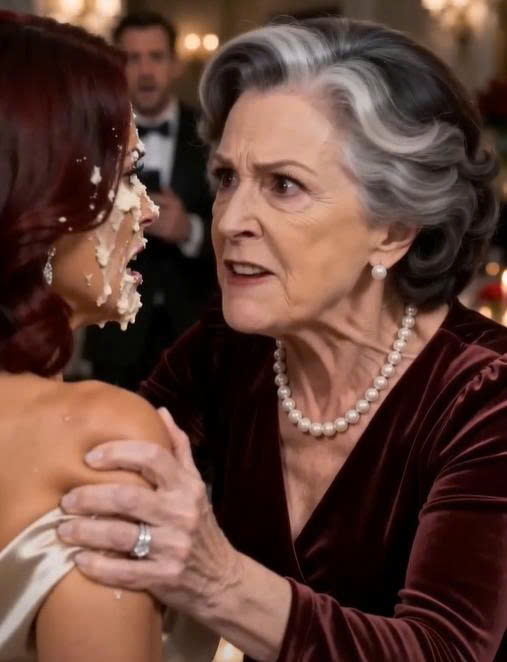
For a brief second, she seemed less angry than frightened.
I went into the office and signed the declaration.
When I came back outside, Remy was alone next to the smashed shop window. Meredith had disappeared.
He had taken off his wedding ring.
It rested in his palm, turning slowly under the red light of the restaurant.
“There’s something else,” he said.
He placed the box on the counter and lowered his voice.
“When the closet door broke, the back panel came off.”
I looked towards the covered shop window.
“Is something missing?”
“No,” he said. “But there appears to be a sealed document behind the wood.”
Remy raised his head.
I stared at the piece of furniture.
For generations, my family had kept these objects without knowing all the truths they contained.
Now, behind the broken pieces of wood, something waited in silence.
And for the first time that night, I understood that Meredith might not have broken the wardrobe just to hurt me.
Perhaps she was trying to bring the family’s hidden history to light.
The sealed document remained behind the back panel of the cabinet until morning, but Meredith’s secret remained intact.
At 7:30, I stood in the closed dining room of the restaurant while Mr. Alvarez opened the front door for the insurance adjuster and the guardian. The Valentine’s Day decorations were still up, but the room had lost all its festive charm. The roses were beginning to wilt in their vases, the candle wax had hardened into pale puddles, and the linen covering the furniture made it look like a body awaiting identification.
Remy was standing next to me without his wedding ring.
He had stayed at the restaurant all night, perhaps sleeping for an hour in the office chair. His suit was wrinkled and his eyes were swollen from crying, but he had not tried to defend himself again.
It mattered less than the day before.
“I called the bank,” he said.
I kept my eyes fixed on the covered wardrobe. “Why?”
“Tell them that the collection is not available under warranty.”
“Did you tell them that before or after they called you?”
“After.”
“So they already knew.”
He nodded.
The tutor, a slim woman named Nora Whitcomb, placed a rigid briefcase on the floor. The insurance company investigator followed with a tablet and a folder of forms.
The damage appeared more extensive in daylight.
The cabinet door was crooked, held by a single brass hinge. Shards of glass glittered beneath the bottom shelf despite careful cleaning, and the back panel was warped, separating from the wooden frame. The pieces of my mother’s plate lay in the padded box. The silver spoon was stored in a separate case, its handle bent but undamaged. The christening cup had a slight dent on the rim.
Nora crouched down near the piece of furniture.
“Nothing should be moved until I have photographed the points of impact,” she said.
The investigator, Mr. Patel, took photographs while she measured the door and examined the brass fittings. He discovered a crescent-shaped bump that corresponded to the metal clasp on Meredith’s purse.
“She didn’t even touch on that,” he said.
Remy lowered his eyes towards the ground.
I saw him absorb the news as if it were a sentence pronounced against someone he still loved.
Nora removed the brass frame from the top shelf and placed it on a padded cloth. The photograph inside showed my parents in front of the restaurant in 1911, my mother’s gloved hand resting on my father’s sleeve. Their expressions were youthful and serious, their future still uncertain, just out of the camera’s view.
Nora tilted the frame towards the light.
“There’s an inscription on the back.”
I approached.
The paper on the back of the sheet had yellowed at the edges, and several words were written in faded blue ink. Nora read them aloud.
“Elise and Auguste Daigle, on Valentine’s Day 1911. In front of the Renaud House.”
My mother’s name was Elise. My father’s name was Auguste. I had known it all my life.
But below it, in smaller print, was another line.
“For the family archives, when the time comes.”
My throat tightened.
“The restaurant was then called Maison Renaud,” said Mr. Alvarez. “The original owner was Henri Renaud. His grandson changed the name after the war.”
I touched the glass above my parents’ faces.
“Who wrote this?”
Nora examined the ink. “The handwriting looks different from the names. We may need to consult a specialist.”
Remy was standing behind me. “Is that your mother?”
“It’s possible.”
The investigator picked up the printed asset sheet from the table where Mr. Alvarez had placed it. The sheet had withstood the damage, although one corner was stained with champagne.
Nora read the descriptions aloud.



