“Wedding plate, Daigle family, circa 1908. Silver serving spoon, Daigle family, circa 1896. Baptismal cup, engraved in 1911. Photograph of Auguste and Élise Daigle in front of the Maison Renaud.”
She paused on the last sentence.
“Who planned this?”
“Meredith helped me understand the descriptions,” said Mr. Alvarez.
I turned to him. “Did she help?”
“She offered. She said she liked genealogy.”
Remy’s head lifted.
“I didn’t have any.”
The room seemed to shrink around us.
“She knew the dates,” I said.
“She knew more than just the dates,” replied Mr. Alvarez. “She corrected the spelling of Maison Renaud. I thought she had consulted old records.”
Remy approached the map. “Where did she get her information?”
“I don’t know.”
I looked at him. “Yes.”
He shook his head. “I didn’t know she was coming here.”
“Your wife was preparing descriptions of my family history while asking how much the objects were worth.”
“I know what it looks like.”
“It looks like a project.”
Her face tightened. “I’m not defending her.”
“You defended her for years.”
“I’m not doing it now.”
Her voice rose, and both Nora and Mr. Patel glanced in our direction.
Remy lowered his arm again. “I’m telling you I knew nothing about that card. I knew she wanted to sell the coins. I didn’t know she had started cataloging them.”
Remy froze.
I felt the air leave my lungs.
He had admitted to the financial pressure the day before. He had acknowledged that Meredith wanted an advance on my inheritance. But this was different. The word “sold” had a definitive character that the term “guarantee” did not.
“What exactly did she intend to sell?” I asked.
Remy rubbed his face with both hands.
“The collection.”
“The collection in this cabinet?”
“Your pieces. Maybe those of other families too. I don’t know.”
“I know.”
“Did you know?”
“I knew Meredith had spoken to someone.”
“OMS?”
Remy looked at me, and shame crossed his face like a shadow.
“An auction house.”
Nora slowly stood up from the piece of furniture.
Remy spoke again before anyone else could say: “She contacted them last week. She sent photos and descriptions. I found the emails on her laptop.”
“Why didn’t you tell me?”
This story is free. A few seconds of video keep it that way.
“So it’s possible he was aware of the article and never told you.”
That’s precisely what scared me.
My father was a discreet man. He rarely explained his decisions, convinced that actions ultimately spoke louder than words. After my mother’s death, he brought the piece of furniture to my home and simply told me that it belonged to the family.
I had interpreted his silence as a form of distance.
Perhaps it was a matter of trust.
Nora photographed the envelope from all angles. “The seal is too fragile to be broken here. I will transport it under controlled conditions.”
Meredith’s voice came from the doorway.
“Non.”
We filmed.
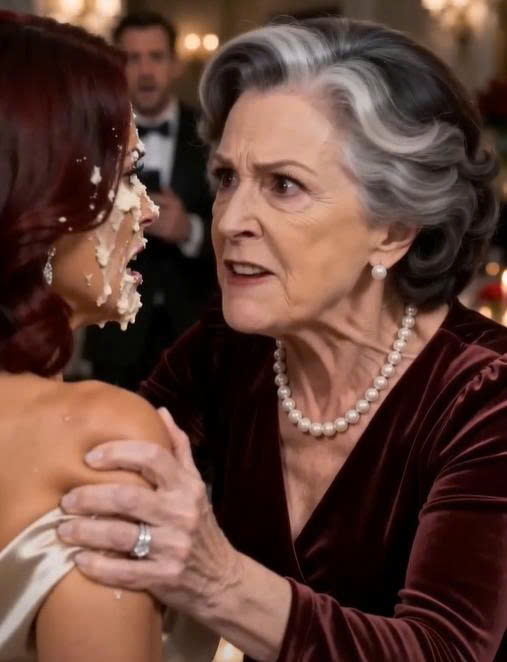
She stood at the entrance of the restaurant, wearing a dark coat over her champagne-stained dress. Her hair was pulled back, and no makeup concealed the fading mark on her cheek. She looked exhausted, but her gaze was fixed on the envelope.
A police officer was standing behind her.
“Ms. Daigle has been informed that she can retrieve her personal belongings from the private dining room,” he said. “She must not, under any circumstances, obstruct the investigation.”
Meredith ignores him.
“This paper belongs to the family,” she said.
I stood in front of the cabinet. “It is being preserved.”
“This could prove that these items never belonged to you.”
“You have already made that decision.”
“Because I found the records.”
“Which records?”
She laughed once, without humor. “The ones you never bothered to show Rémy.”
Remy approached her. “You contacted an auction house.”
Her face has barely changed.
“You had planned to sell the collection.”
“I had planned to save us.”
“You were planning to sell my mother’s plate.”
“It was going to be sold before it even broke down.”
Her voice trembled. “You knew I didn’t agree.”
“You gave your consent when you gave me the photos.”
“I gave you the photos because you said you wanted an estimate.”
“I wanted the truth.”
“You wanted money.”
Her eyes sparkled. “You needed money.”
The officer intervened. “Ms. Daigle, you must leave.”
Meredith looked at me again. “The letter will prove that Leola’s family had no legal right to keep these items.”
“You seem very self-assured.”
“I’ve read the old transfer documents.”
“Or?”
She glanced at the envelope. “In your father’s files.”
My heart was pounding painfully.
“Which records?”
She did not reply.
Remy’s face changed. “Did you go through Grandpa Auguste’s papers?”
“He is dead.”
“That doesn’t give you the right.”
“I was trying to protect you.”