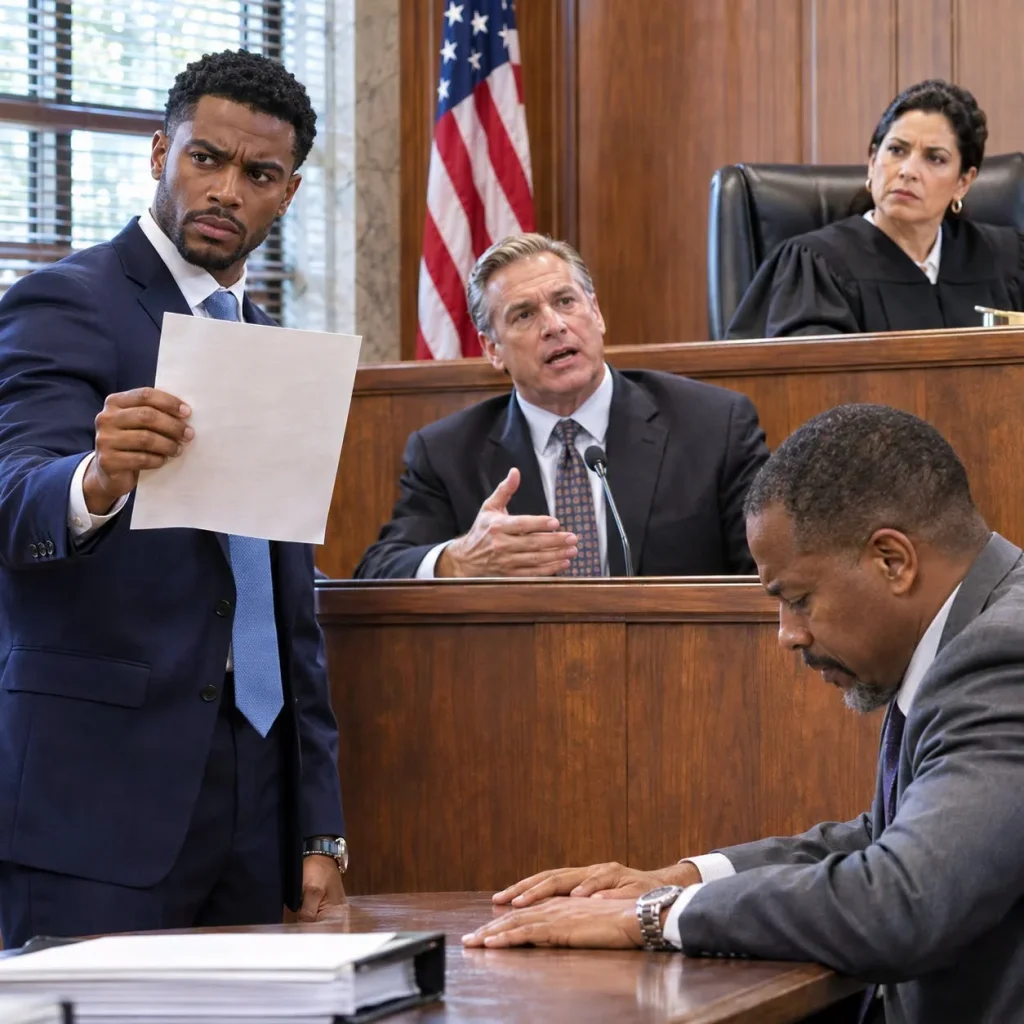
Robert Harrington’s coffee hit the floor before he did. I caught his shoulder on the way down, but his head still struck the edge of the defense table. “Call 911,” I shouted. The courtroom deputy was already moving. Beside me, Michael Reynolds stood with both hands raised, as if someone might blame him for touching the only man who knew how to keep him out of prison. At 8:41, the paramedics wheeled Robert out of the federal courthouse in Newark. At 8:46, Judge Harrison Caldwell sent word that jury selection would begin on schedule.
My name is David Callaway. I was twenty-four, a recent Georgetown Law graduate, and the youngest Black attorney at Harrington and Associates. I’d started as Robert’s intern, and half the office still called me that. My admission to federal court was six weeks old. I’d spent nine months helping build Michael’s defense, and my name was on the case as second counsel. The longest thing I’d ever said in front of a jury was my name. That morning, I had to ask a judge for forty-eight hours while a surgeon figured out whether Robert would live.
“Mr. Reynolds already has counsel,” Caldwell said, looking down at me. “I’m looking at him.” I told him I’d prepared the records witnesses. Robert had prepared the cross-examination of the company’s chief executive. Caldwell leaned back. “Do they still teach cross-examination at Georgetown?” A couple of people in the gallery laughed. Michael heard them. I knew because he stopped trying to straighten the sleeve he’d wrinkled while helping me lift Robert off the floor.
The government said Michael had authorized Omni Corp trucks to dump chemical waste at a closed industrial site near the Passaic River. Its best exhibit was an electronic approval bearing his signature. Michael swore he’d never seen the order until federal agents showed up at his house. Omni’s CEO, Richard Clayton, had turned over the company’s records himself. He’d also given an interview in which he said the company had put its trust in the wrong man. Michael’s teenage daughter had watched that interview with him. He told me she’d asked whether she should stop using his last name at school.
“I’m asking for a short continuance,” I said. “My client deserves time to make a decision about who represents him.” Caldwell looked past me to the courtroom deputy. “Bring up the panel.” Then he looked straight at me. “If you win this case, Mr. Callaway, I’ll resign from the bench.” The court reporter’s fingers paused. “You can take that down,” he told her. I asked that the record also reflect our objection and Michael’s request for time to speak with me privately. That, at least, Caldwell granted.
In the consultation room, Michael asked me whether I believed him. I said yes. “Then when we go back out,” he said, “could you call me Michael? Everybody in there talks about me like I’m already gone.” By late afternoon a jury had been seated, and Evelyn Croft, the federal prosecutor, was walking them through the approval order. She enlarged Michael’s signature until it filled the monitor. During a recess, our paralegal Sarah slipped me a note. The government’s exhibit number matched a folder in the discovery drive. Inside it, Ben had found the native audit file behind the printout. There was a device identifier that didn’t appear anywhere on the page the jurors had seen.
After court, we pulled up the file in a borrowed conference room. It showed the order had been approved through an executive override. We found the same device identifier in an Omni equipment inventory, beside a laptop assigned to Richard Clayton. I was reaching for my phone to call Croft when Sarah asked me to wait. A second entry showed a document had been attached to the approval and deleted from the shipping system three minutes later. Omni’s archive still held a copy. Ben opened it. It was a letter directing the company’s accounting department to release a payment to a holding company. I’d seen the company’s name that morning on a disclosure Robert had flagged in his trial binder. “Scroll down,” I said. Ben did. The name at the bottom of the letter was Harrison Caldwell.
Pinned Comment
I’d gone looking for the person who used Michael’s name. By the time I saw the judge’s name on my screen, I had a different question. How much of what happened in that courtroom had already been decided? The rest of the story is below 👇
Part 2
“Don’t close it,” I said. Ben took his hand off the trackpad. I pulled Robert’s binder out of his briefcase and found the disclosure. Caldwell’s brother owned a holding company that leased office space to several businesses, including Omni. The judge had described it as an ordinary lease and said he had no financial interest in the company. The letter on our screen directed a six-figure payment to that same company and described Caldwell as its beneficial owner. It carried what appeared to be his signature. The date was two days before the first truck went out.



