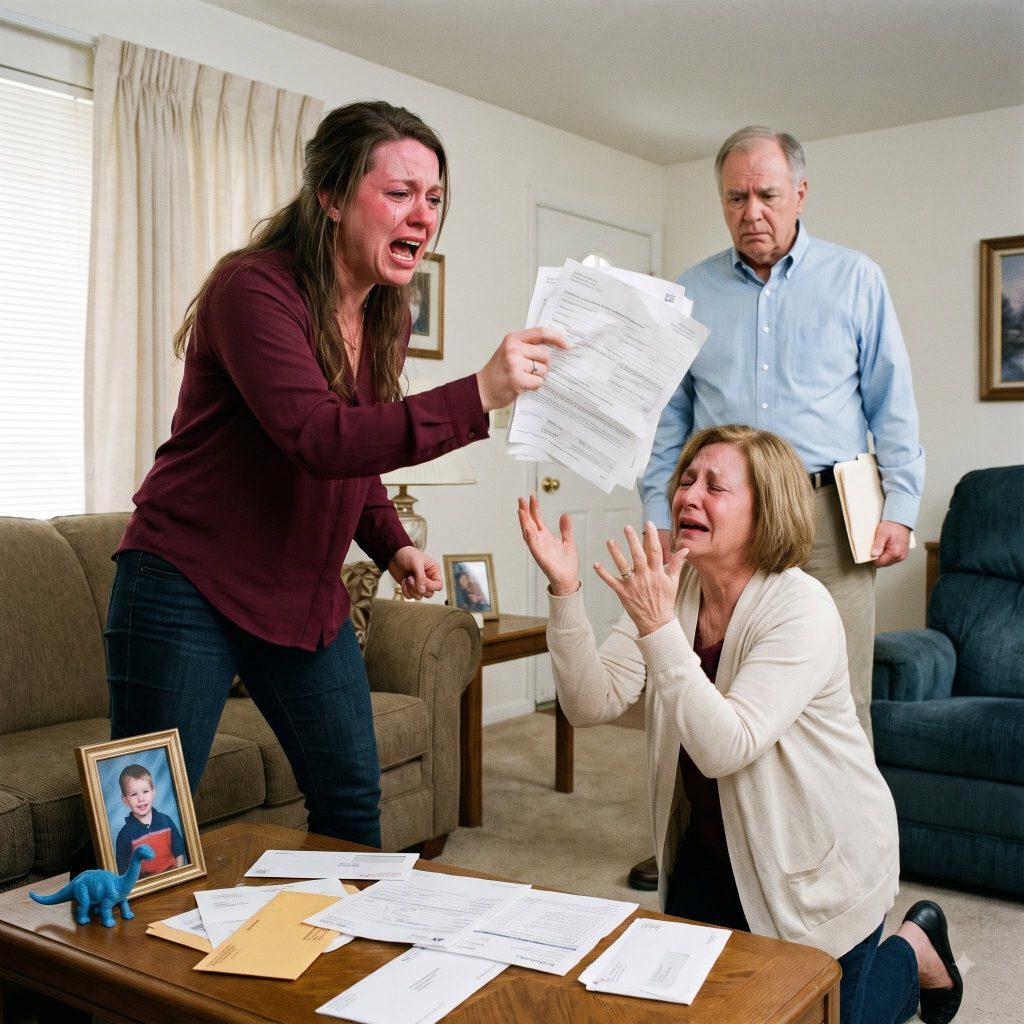
Mom wasn’t merely begging me to help.
She was telling a critically ill woman that her only hope had already been found.
And she was using my dead son’s name to force me into giving it.
“Rachel, listen carefully,” I said. “I have never taken a donor compatibility test.”
She didn’t answer immediately.
Then she whispered, “So Mom lied again.”
“Yes.”
I heard her struggling to breathe steadily.
“Please don’t hate me,” she said.
Those five words hurt more than anything my parents had said that night.
“Rachel, I don’t hate you.”
“They told me you refused to help Noah understand he was dying. They said you were angry with everyone because you couldn’t accept what the doctors told you.”
I gripped the kitchen counter.
For five years, I’d believed Rachel knew what happened.
For five years, she’d believed I had abandoned her after an impossible tragedy.
Our parents hadn’t just taken money.
They’d stolen the truth from both of us.
“I begged them to help him,” I whispered. “I was on my knees in that hospital.”
Rachel started crying again.
“I would have given you every dollar.”
“I know that now.”
The next morning, I went to the hospital.
Rachel looked painfully thin. A dialysis catheter was visible beneath her hospital gown.
For a moment, neither of us moved.
Then she reached for me.
I hugged my sister for the first time in five years.
And we cried until a nurse quietly closed the door.
When Rachel finally pulled away, she looked at my hands.
“You still wear his bracelet.”
Around my wrist was a faded blue band with Noah’s name printed on it.
“I never take it off.”
She touched it gently.
“I still have his birthday present.”
I stared at her.
“The dinosaur book,” she explained. “I bought it before he got sick. I couldn’t throw it away.”
Something inside me broke.
We weren’t two sisters fighting over money.
We were two women who had lost the same little boy, then lost each other because of lies.
Rachel was the first to speak.
“I don’t want your kidney if you’re doing it because they hurt you.”
“You need a transplant.”
“I need a transplant,” she agreed. “But I won’t let Mom turn your body into another family obligation.”
That afternoon, we requested a meeting with the transplant social worker.
She explained that living donation required independent medical testing, psychological evaluation, and fully informed consent.
Nobody could declare me compatible from old blood work.
Nobody could pressure me into surgery.
And Rachel had other options, including continued dialysis and the deceased-donor waiting list.
For the first time, my sister looked relieved.
Not because she’d been promised a kidney.
Because someone had finally told her the truth.
Three days later, I met with an attorney.
I brought every document my father had delivered.
The attorney examined the signature, the transfers, and the trust agreement.
Then she asked one question.
“Did your grandfather authorize your parents to use these funds for their own investments?”
“No.”
She turned another page.
“Then we need the complete financial records.”
An independent forensic accountant reviewed the transactions over the following weeks.
What she uncovered was devastating.
My parents hadn’t merely invested $95,000.
They’d used money from the family trust to purchase a controlling stake in Rachel’s company. The trust records described it as assistance to Rachel, while ownership documents placed the investment under my parents’ private company.
They had been collecting profits ever since.
Then came the worst discovery.
The transfer hadn’t been made four days before Noah died.
That was merely the date it cleared.
My mother had initiated the transaction the morning I first begged them for help.
While I was calling hospitals, she was moving money.
I sat in the attorney’s office, staring at that date.
For five years, I’d imagined my parents making a terrible decision under pressure.
But there had been no hesitation.
They’d already decided.
My attorney was careful about one thing.
The documents could establish financial wrongdoing.
They could not establish that paying the hospital would certainly have saved Noah.
I understood.
I would never know whether my son could have survived.
But I finally knew why my parents hadn’t tried.
When Rachel learned about the findings, she asked her lawyer to obtain the company’s ownership records.
Then she confronted our parents.
I wasn’t there.
She told me afterward.
Mom had begged her not to destroy the family over old paperwork.
Rachel had answered, “You destroyed it when you turned Noah’s emergency into an investment.”
Dad offered to transfer his company shares to her.
Rachel refused.
“I don’t want another gift from you. I want you to account for what you took.”
Within months, our attorneys negotiated a settlement requiring my parents to repay the misused trust funds and surrender the profits attributable to the investment.



