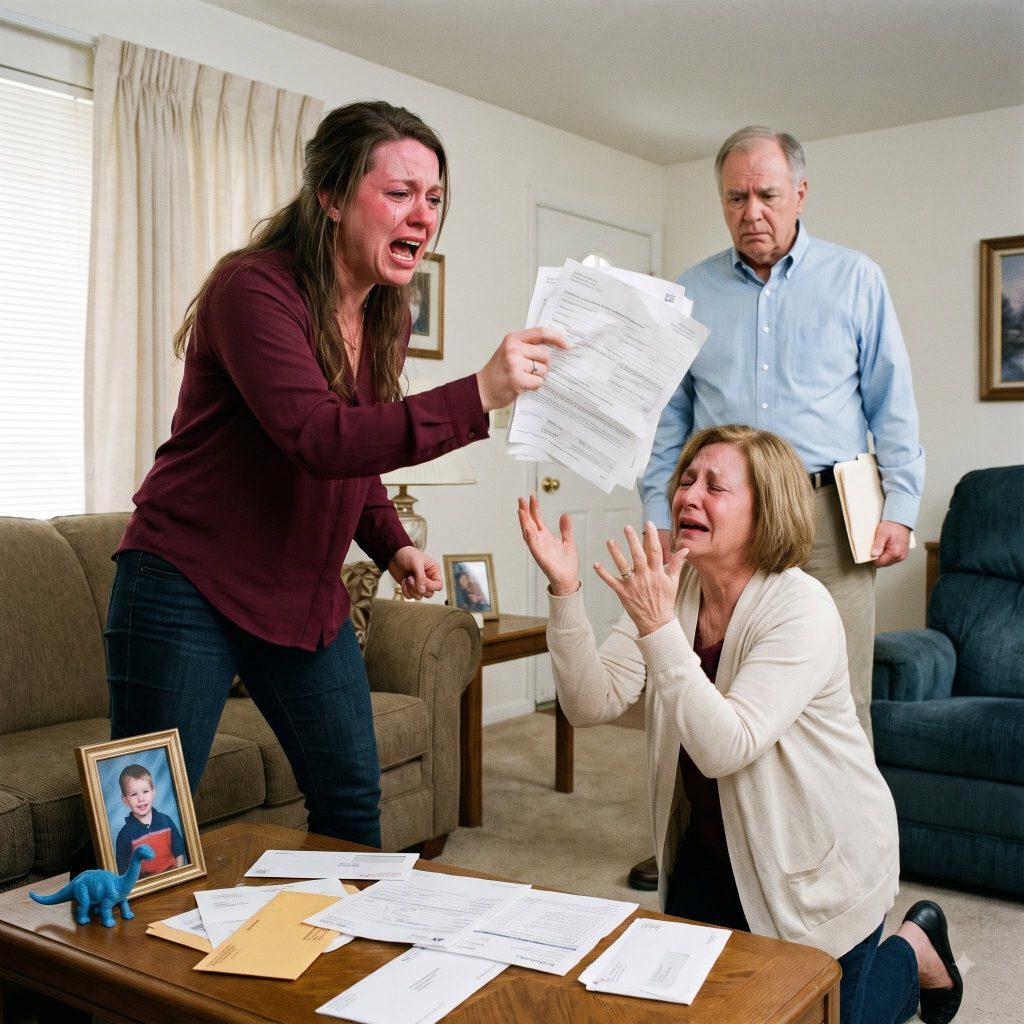
The disputed signature became part of the legal record.
No public confrontation. No dramatic arrest.
Just documents, lawyers, and consequences they couldn’t talk their way out of.
Meanwhile, Rachel’s condition remained serious.
I privately began the living-donor evaluation.
I didn’t tell my parents.
I didn’t even tell Rachel until the first appointments were complete.
My kidney function was normal, but further imaging showed an anatomical issue that made donation less suitable for me.
The transplant team advised against proceeding.
I cried in my car afterward.
Not because I owed Rachel anything.
Because I wanted the decision to be mine.
That evening, I told her.
She took my hand.
“Then you’re not donating.”
“But Rachel—”
“No. We already lost Noah. I’m not going to let you risk your health against medical advice to prove you love me.”
I looked at her.
“You’re not angry?”
She smiled sadly.
“You came back. That’s more than I thought I’d ever have.”
We continued searching for a suitable donor through her transplant center.
Rachel remained on dialysis.
Some weeks were frightening.
Some were simply exhausting.
We learned that forgiveness didn’t erase fear, and reconciliation didn’t magically cure illness.
But we also learned to speak honestly.
Eight months later, Rachel received an unexpected call.
A deceased-donor kidney had become available.
The transplant team believed it was a suitable match.
The surgery went ahead.
There were difficult days afterward, including medication adjustments and one frightening episode of rejection that responded to treatment.
But eventually, Rachel came home.
Six weeks later, she asked me to drive her somewhere.
Not to our parents’ house.
To the cemetery.
We stood beside Noah’s grave.
Rachel carried a small wrapped package.
Inside was the dinosaur book she’d kept for five years.
She placed it beside the headstone.
“I should have been here,” she whispered.
I put my arm around her.
“You’re here now.”
We stayed until she was tired.
Later, Rachel and I used part of the recovered money to establish a small fund supporting families whose children needed specialist care away from home.
We couldn’t promise anyone a miracle.
But we could help with travel, lodging, and the expenses that make an already terrible medical crisis harder.
At the fund’s first gathering, someone asked why we’d created it.
Rachel looked at me.
I answered, “Because families shouldn’t have to prove their children are worth helping.”
My parents wrote several letters over the following year.
Dad apologized for the financial decisions.
Mom wrote that she had been frightened of losing their security.
Neither explanation changed what happened.
I didn’t reconcile with them.
Rachel chose limited contact, with boundaries they weren’t allowed to negotiate.
I respected her decision, just as she respected mine.
Last Sunday, Rachel came over for dinner.
Afterward, she noticed Noah’s photograph on the mantel.
He was laughing, holding a toy dinosaur, with frosting on his cheek.
“He looks so happy,” she said.
“He was.”
She leaned her head against my shoulder.
“I wish he were here.”
“So do I.”
For years, I’d carried one terrible question: Why wasn’t my son worth saving?
I no longer ask it.
Noah was worth every effort, every dollar, every sleepless night.
My parents’ choices never determined his value.
And when Mom begged me to save Rachel because I was supposedly her only chance, the answer I finally gave her was this:
“I’ll help my sister because I love her. Not because you get to decide whose life matters.”
Rachel survived.
Our relationship survived.
And Noah’s memory became something my parents could never control again.



