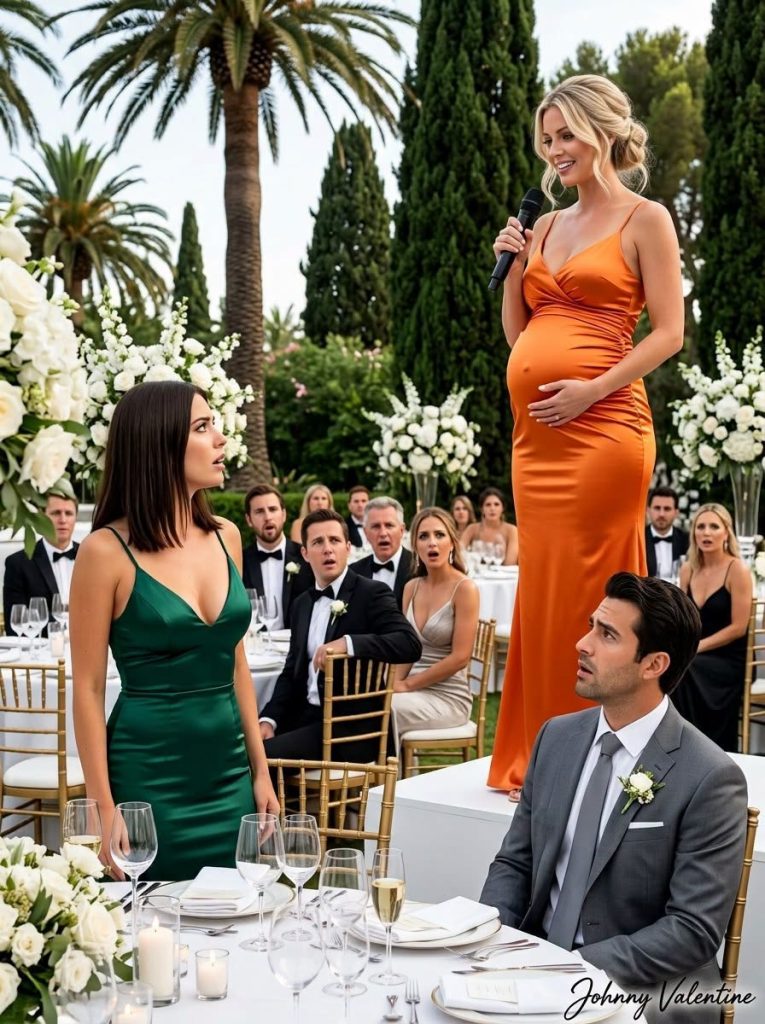
“Just accept it, Clara. You lost. This time, I won.”
I stopped four feet from the edge of the riser.
Behind Natalie, Eric took a stumbling, cowardly step backward, trying to place the floral arch between himself and the room. His hands were shaking so violently that his bourbon sloshed over his cuff, staining the white linen shirt I had ironed with starch at six o’clock that morning.
“A family,” I repeated. The word was cold, clinical.
“Yes! A family!” she sneered, raising her chin. “A child with Eric’s blood! A child who will inherit everything Dad built, not some charity project from your veteran outreach boards!”
Grant Miller walked past Table Twelve.
He moved with the silent, heavy-shouldered purpose of an ex-marine who had spent fifteen years tracking corporate embezzlement and matrimonial fraud through five continents. He wore no tie, his charcoal lapels slightly worn at the corners, the thick red leather folder tucked securely beneath his left bicep.
He did not look at Eric. He did not look at my parents.
He stepped up to the edge of the cake table, took the heavy red folder, and set it down with a dull, wooden thud directly beside the four tiers of spun sugar and white fondant.
Natalie’s voice died in her throat.
Her eyes flickered down to the folder. For the first time, a hairline fracture appeared in her confidence. The manic, theatrical glow in her pupils dimmed, replaced by a sudden, sharp wariness.
“Who is that?” she asked, her voice dropping out of the microphone’s sweet spot. “Clara, who is this?”
I reached out my hand.
I did not snatch the microphone. I simply closed my fingers around the cold mesh head and pulled. Natalie’s grip held for half a second, her red acrylic nails scraping against my knuckles, before her fingers gave way under the leverage of my grip.
I took the microphone, lowered it three inches, and looked her in the eyes.
“He’s the man who has been holding something for four months, Natalie,” I said into the hall. “Something even you didn’t know existed.”
Grant’s thick fingers untied the black silk ribbon of the folder. He opened the heavy cardstock cover, bypassed forty pages of surveillance logs, hotel folios, and credit card manifests, and drew out a single, pristine sheet of thirty-pound bond paper.
At the top of the page was the embossed blue seal of the American Forensic Genetics Laboratory in Baltimore, Maryland.
Below it were two columns of DNA loci markers, four paragraphs of statistical analysis, and an official notarization dated Thursday at 4:15 PM.
Grant handed the sheet to me without a word.
I did not read it. I had memorized every allele frequency on that page forty-eight hours ago while sitting in my lawyer’s office on Lexington Avenue.
I held the paper up, turning it slowly so the front tables—the tables where my family, my in-laws, and Eric’s corporate directors sat—could see the dark, official stamps.
“Sis,” I said, my voice completely steady, carrying to every chandelier in the hall. “That baby isn’t Eric’s.”
The silence in the room deepened into something breathless, suffocating.
Natalie’s mouth opened slightly. The color began to drain from her lips, leaving them the shade of wet clay beneath her scarlet gloss. “What… what are you talking about? That’s impossible. Eric and I—”
“Eric didn’t father that child, Natalie,” I said, taking half a step closer until I could smell the expensive, stolen cologne radiating from her skin. “And the real father is sitting right here in this room.”
I raised my right arm, my index finger extending, pointing directly past the tiers of the wedding cake, past my father’s trembling hands, straight toward the center of Table Three.
“Just three tables away from you,” I said into the microphone. “Isn’t that right, Marcus?”
Chapter 3 – The Architecture of an Ambush
Table Three was the executive table.
Sitting in the center, flanked by two senior vice presidents from the Port Authority, was Marcus Vance.
Eric’s elder brother.
Forty-two years old. Chief Operating Officer of Vance Global Logistics. A man who wore five-thousand-dollar bespoke three-piece suits, served on the board of the Metropolitan Opera, and had been married to his wife, Sarah, for fourteen years.
When my finger pointed at his chest, Marcus did not drop his glass.
He was too experienced a predator for that. His fingers merely tightened around the stem of his pinot noir until the glass groaned beneath the pressure. His wife, Sarah—a gentle, patrician woman who had spent the last five years running pediatric cancer charities in Westchester—looked from me to her husband, her brow furrowing with slow, uncomprehending confusion.



