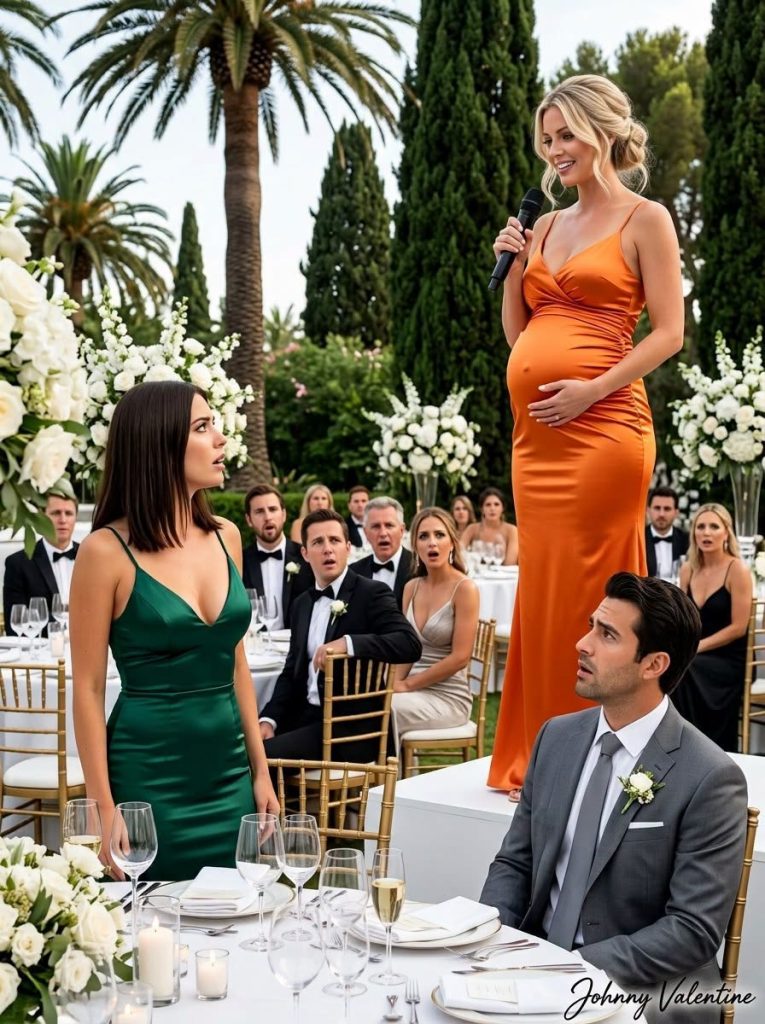
“Clara,” Marcus said, his voice smooth, resonant, carrying that deep, boardroom timber that had settled four union strikes in New Jersey. “You’ve clearly experienced an emotional break. The stress of your… domestic situation has clouded your judgment. Put the papers down before you embarrass the family any further.”
“Read the markers, Marcus,” I said, my voice cutting through his polish like an iron wedge through dry pine.
Grant Miller stepped forward. He did not wait for an invitation. He drew a second copy of the genetic analysis from the red folder, walked the twenty paces to Table Three, and laid the paper flat on the white damask tablecloth, directly between Marcus’s butter knife and his water goblet.
“Section Four, Paragraph B,” Grant announced, his gravelly voice filling the immediate vicinity of the table. “Comparative STR profiling between the fetal tissue sample obtained during the subject’s chorionic villus sampling on the twelfth of last month and the reference profile of Eric Vance.”
Grant leaned his knuckles on the table, looking down into Marcus’s eyes with the flat, dead stare of a military policeman who had caught three deserters in a supply shed.
“Exclusionary match,” Grant said. “Eric Vance possesses zero percent paternal probability. The subject loci show a ninety-nine point nine eight percent inclusionary match with the secondary familial reference profile obtained from Marcus Vance’s personal effects.”
“What personal effects?” Sarah Vance whispered, her hand rising to her throat, her diamonds trembling against her collarbone. “Marcus… what is he talking about?”
“The coffee cup he left in the executive suite at the New York Athletic Club on August fourteenth,” I spoke into the microphone, my voice echoing off the high plaster moldings. “The afternoon Natalie told Eric she was spending the day at a spa in SoHo. The afternoon Marcus told Sarah he was in an emergency board session regarding the Newburgh terminal expansion.”
Natalie let out a small, wet gasp—a sound like a tire losing its air through a slash in the sidewall. She turned her head toward Table Three, her eyes wide, wild, filled with a sudden, horrifying betrayal that surpassed anything she had intended for me.
“Marcus?” she whimpered.
The microphone in my hand picked up the tiny, ragged syllable.
“Marcus, you told me…” She took two stumbling steps off the riser, her red silk catching on the edge of the velvet staging. “You told me the test was clean! You told me Eric was the only one!”
“Shut up, Natalie!” Marcus hissed, his composure finally detonating.
He stood up so violently that his heavy mahogany chair tipped backward, crashing against the marble floor with a concussive bang that made the women at Table Four scream.
His patrician mask had vanished. His jaw was clenched, his nostrils flared, his eyes darting toward the exits like a rat caught in a granary fire.
“She’s lying!” Marcus shouted, turning to his wife, whose face had gone the color of chalk. “Sarah, listen to me! This is an extortion scheme! Clara has been planning this for months because she knows Eric is leaving her! She’s trying to drag down the whole firm!”
“I don’t need to drag down your firm, Marcus,” I said, lowering the paper to my side. “Your firm was liquidated at four-fifteen this afternoon.”
Chapter 4 – The Iron in the Blood
My father, Arthur, finally found his feet.
He was an imposing man—six feet three inches, with a mane of white hair and the heavy, authoritarian carriage of an old Southern judge who had spent forty years sending boys to the chain gang for stealing livestock. He leaned his heavy hands on the table, his chest heaving beneath his starched shirtfront, his face mottled with purple rage.
“Clara!” he roared, his voice cutting through the rising hum of the ballroom. “That is enough! You will cease this public desecration of your sister this instant! Do you hear me? You will hand that microphone to the manager and walk out of this room!”
I turned my head toward him.
For thirty-eight years, that voice had governed my life. It had told me that my duty was to be the strong one, the silent one, the daughter who didn’t cry when her knees were scraped, the daughter who took the commission in the Army because Natalie needed the college fund, the daughter who signed the deeds of guarantee so my father’s real estate holdings could be preserved during the crash of two thousand and eight.
I looked at him now.
I didn’t see a judge. I didn’t see an autocrat.
I saw an old, broken man who had spent three decades feeding his eldest daughter to the furnace to keep his favorite child warm.
“No, Father,” I said.



