The flowerpots Mom rearranged every spring.
Dad’s truck in the driveway.
For a moment, I felt like I was returning to an earlier version of myself.
The daughter who walked through that door already prepared to solve a problem.
I reminded myself that I could leave if the conversation became cruel.
Then I knocked.
Mom opened the door.
She looked older than she had at the party.
Or maybe I was seeing her more clearly.
“Hi, honey.”
“Hi, Mom.”
She stepped aside.
Dad was sitting at the kitchen table.
There were papers spread in front of him.
Bills.
A notebook.
A calculator.
For years, I had been the one who arrived with spreadsheets.
Now my parents had made their own.
Mom poured coffee.
Nobody spoke for a moment.
Then Dad cleared his throat.
“We’ve been working through the budget.”
I nodded.
“How’s it going?”
“Not easy.”
“I imagine.”
He looked at the papers.
“We’ve had to make changes.”
Mom sat down.
“We cut some expenses.”
Dad continued.
“I picked up additional work.”
I looked at him.
He sounded tired.
But there was something else in his voice.
Pride, perhaps.
The kind of pride he used to have before asking for help became easier than changing anything.
“We’re still figuring it out,” he said.
“I understand.”
He tapped the notebook.
“Your mother says you’ve been helping her understand some of the bills.”
“A little.”
He nodded.
Then silence returned.
I waited.
I had promised myself I wouldn’t fill every uncomfortable moment.
Finally, Mom spoke.
“Claire, I’ve been thinking about the party.”
My stomach tightened.
She looked down at her hands.
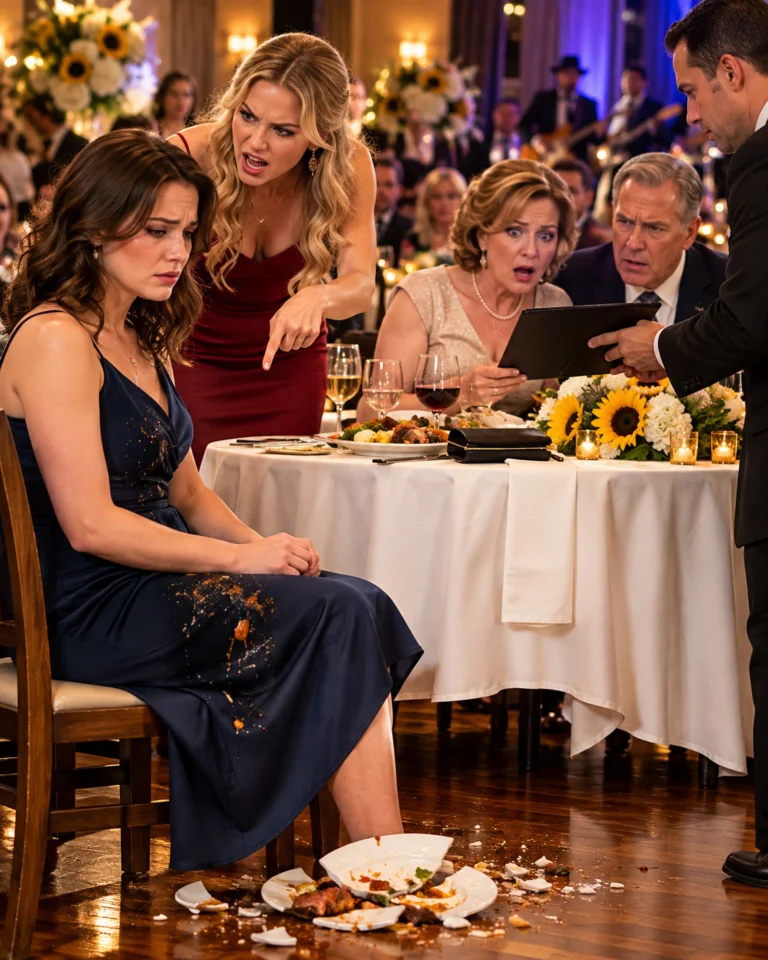
“I keep remembering your face after Marissa dropped that plate.”
I didn’t say anything.
“I told myself it was just a joke.”
She swallowed.
“But you didn’t look angry at first.”
I stared at her.
“You looked hurt.”
My eyes burned.
Mom’s voice became quieter.
“And I ignored it.”
For a moment, neither of us moved.
Then she said, “I’m sorry.”
Two words.
Simple.
Late.
Not enough to erase years.
But real.
I nodded slowly.
“Thank you.”
Dad shifted in his chair.
“I should have handled it differently.”
I looked at him.
He seemed uncomfortable.
He had always been more comfortable giving instructions than admitting mistakes.
“I shouldn’t have told you to keep quiet,” he said.
I waited.
“And I shouldn’t have expected you to pay for things we added without asking.”
I felt something loosen in my chest.
Not completely.
But enough to breathe.
“I wanted you to have a beautiful anniversary,” I said.
Mom’s eyes filled.
“We did.”
“I know.”
“The party was lovely.”
I looked down.
That was the first time she had said it.
She continued.
“The flowers were beautiful. The food was wonderful. Everyone had a good time until…”
She stopped.
“Until Marissa threw my plate,” I finished.
Mom nodded.
“Yes.”
Dad looked at me.
“We should have thanked you.”
I gave a small, sad smile.
“Yes. You should have.”
The honesty surprised all three of us.
Then Dad asked, “Are you still going to Austin?”
“Yes.”
He nodded.
“Good.”
I looked at him carefully.
He seemed to struggle with the next words.
“Your mother says it’s important for your career.”
“It is.”
“Then I hope it goes well.”
I felt my throat tighten.
“Thank you, Dad.”
We talked for another hour.
Not everything was resolved.
There were still awkward moments.
Mom occasionally began explaining Marissa’s behavior before stopping herself.
Dad made one comment about how difficult the budget had become, then changed the subject when I didn’t offer money.
But something important was different.
I wasn’t negotiating for the right to exist in the family without financing it.
I was simply there.
Their daughter.
Not their emergency fund.
When I stood to leave, Mom hugged me.
A real hug.
She held on longer than usual.
“I love you,” she whispered.
“I love you too.”
Then she added, “I know that doesn’t mean you have to pay our bills.”
I closed my eyes.
“No,” I said softly. “It doesn’t.”
Marissa was harder.
For nearly two months, she barely spoke to me.
When she did, her messages were sarcastic.
She accused me of making Mom and Dad feel guilty.
She said I had turned one bad joke into a family crisis.
She told me I was acting superior because I had a good job.
I stopped defending myself.
Then, one evening, she called.
I almost let it go to voicemail.
But I answered.
“Hello?”
“Hey.”
Her voice was different.
Quieter.
“Hey.”
There was a pause.
“Mom said you’re going to Austin next month.”
“That’s right.”
“Congratulations, I guess.”
“Thanks.”
Another pause.
Then she said, “I’ve been thinking about what you said.”
I waited.
“About how I treat you.”
I sat down.
She sighed.



