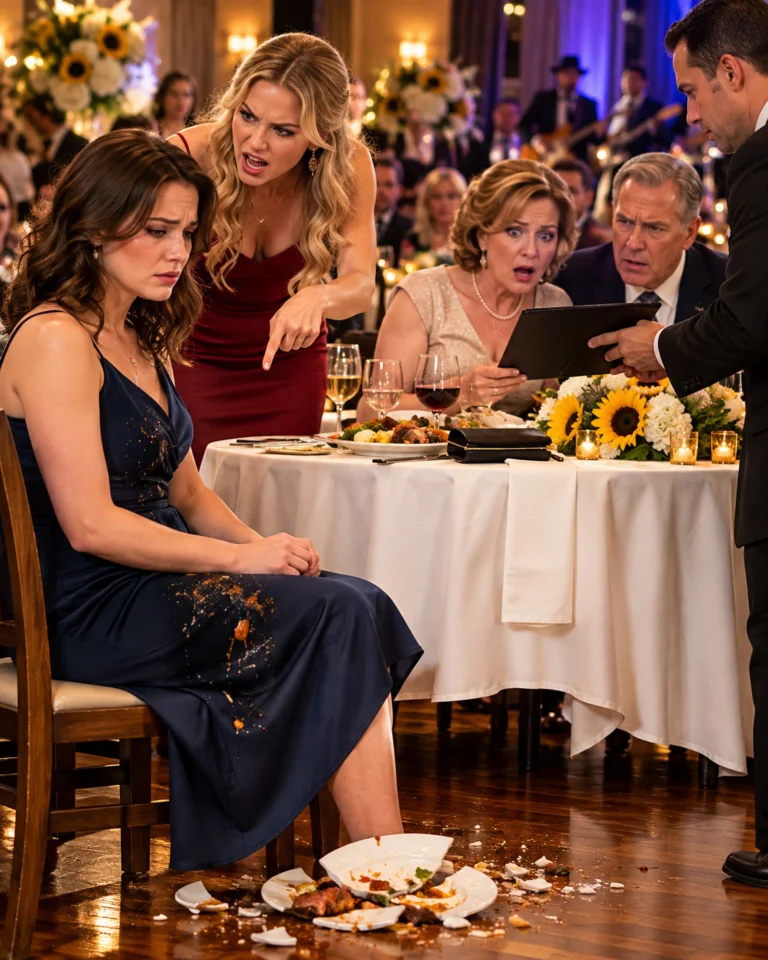
“I don’t know why I made that joke at the party.”
I didn’t believe that.
Not entirely.
But I let her continue.
“I was angry.”
“At me?”
“Kind of.”
“Why?”
She was silent for a long time.
Then she said, “Because everyone knows you’re the successful one.”
I stared at the wall.
“Marissa—”
“No, just let me finish.”
I stayed quiet.
“You have the job. The apartment. The savings. You always know what you’re doing.”
I almost interrupted.
Because she had no idea how often I felt lost.
But she continued.
“And I had this business that failed. And everybody kept acting like I was going to figure something else out, but I didn’t know how.”
Her voice cracked slightly.
“I hated needing your help.”
I closed my eyes.
There it was.
Not an excuse.
But an explanation.
She had turned her shame into cruelty because it was easier to mock my competence than admit how much she depended on it.
“That doesn’t make what you did okay,” I said.
“I know.”
I waited.
Then she whispered, “I’m sorry about the plate.”
My eyes filled.
“And what you said?”
She took a breath.
“That too.”
I looked down at my hands.
“Thank you.”
“I really didn’t think you’d stop helping everybody.”
“I know.”
“I guess I thought you’d always be there.”
I considered that.
“I am here, Marissa.”
She was quiet.
“But I’m not going to keep paying for everything.”
“I know.”
We didn’t suddenly become best friends.
We didn’t erase decades of competition and resentment in one conversation.
But for the first time, my sister had acknowledged that I was a person she had hurt.
Not a resource that had stopped working.
That mattered.
A month later, I boarded a flight to Austin.
I had a carry-on suitcase, a laptop bag, and a folder containing my course materials.
As the plane climbed, I looked out the window.
The city grew smaller beneath us.
I thought about the anniversary party.
The flowers.
The music.
The broken plate.
The bill.
The moment I had sat down and opened my banking app.
At the time, I had thought I was simply stopping a few payments.
I hadn’t understood that I was changing the way I lived.
In Austin, the days were long.
The coursework was demanding.
I spent hours studying financial models, strategic planning, and business scenarios.
I met professionals from other companies.
People who were ambitious.
Curious.
Excited about their futures.
Nobody asked me why I was spending money on myself.
Nobody suggested that my career goals were selfish.
Nobody treated my success as a family inconvenience.
One evening, after a particularly difficult class, I returned to my hotel room and found a message from Mom.
It was a photograph.
She and Dad were sitting at their kitchen table, smiling awkwardly at the camera.
In front of them was a homemade dinner.
Hope your classes are going well. Dad cooked tonight. We’re proud of you.
I stared at the message.
Then I smiled.
It wasn’t a request.
It wasn’t a reminder.
It wasn’t followed by an invoice or an emergency.
It was simply a message from my parents.
I typed back.
Classes are great. Love you both.
A few minutes later, Marissa sent a message.
Mom says you’re doing fancy finance stuff. Don’t forget us little people.
I stared at it.
Then another message appeared.
Just kidding. Seriously, hope you’re having a good time.
I laughed.
Not because everything was fixed.
But because, for once, she had caught herself.
A week later, I completed the program.
When I received my certificate, I held it in both hands and looked at my name.
Claire Bennett.
For years, I had imagined that moment.
I had imagined feeling accomplished.
Proud.
Relieved.
What I hadn’t expected was the quiet sense of ownership.
This was mine.
Not something I had arranged for someone else.
Not something I had paid for to keep the peace.
Not something I had sacrificed because another person’s needs were supposedly more important.
Mine.
When I returned home, Rebecca congratulated me and told me we would discuss the next steps toward the senior role.
My parents invited me to dinner the following weekend.
Mom cooked.
Dad set the table.
Marissa brought dessert.
No one asked me to pay for anything.
After dinner, Mom handed me a small envelope.
I looked at her.
“What’s this?”
“Open it.”
Inside was a card.
The front showed a simple watercolor sunflower.
I smiled.
It reminded me of the anniversary centerpieces.
Inside, Mom had written a message.
Claire, thank you for the beautiful anniversary celebration. We should have said it that night. We’re sorry we didn’t. We’re proud of the woman you’ve become, and we hope you keep doing things that make you happy.
Dad had signed underneath.



