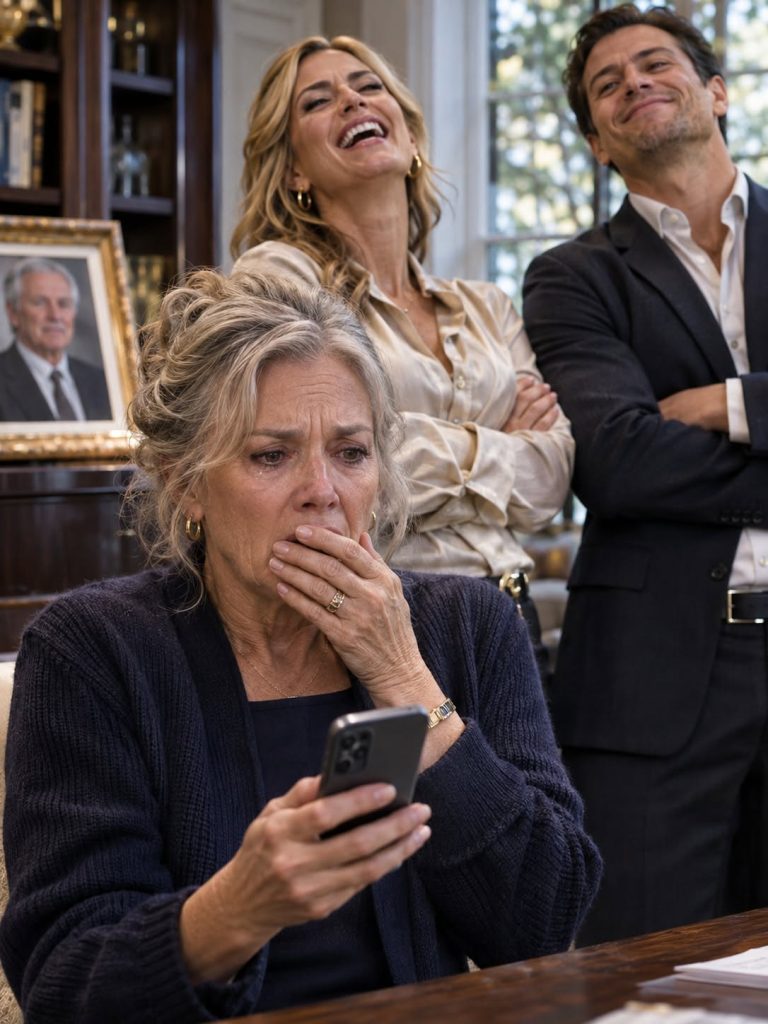
Michael stepped forward from behind his wife. For the first time in his adult life, the weak, placating look on his face had been replaced by a white-hot fury.
“You told her to download my father’s trust files?” Michael said, his voice trembling with rage. “Vanessa… you told me you were just looking at her banking app!”
“Michael, be quiet!” Vanessa hissed, her face flushed crimson with shame and panic. “He’s making it up! She’s paranoid! She’s an old woman who sees ghosts in every computer screen!”
“The digital IP handshake between my home router and your phone occurred at 11:52 PM, Vanessa,” I said evenly. “The files you extracted were encrypted using Richard’s legacy 256-bit institutional cipher. You couldn’t open them. But Mr. Croft thought his offshore contacts could.”
I took half a step toward Croft, who took an involuntary half-step back.
“Richard spent his entire career identifying predators like you, Mr. Croft,” I whispered. “You thought because he died five years ago, his archives were unprotected. You thought this foolish girl would hand you the master keys to twenty years of offshore corporate tax records so you could blackmail former clients.”
“That’s an outrageous accusation,” Croft snapped, though his skin had turned the color of damp parchment.
“The Cook County State’s Attorney’s Financial Crimes Division doesn’t think so,” Thomas added. “Detective Miller and Special Agent Vance are waiting in the lobby. They would like to discuss the IP address that accessed Mrs. Whitmore’s home server—an IP that traces directly to the penthouse suite registered under your name at the Waldorf Astoria.”
Croft looked around the ballroom. The socialites who had been laughing and drinking champagne minutes earlier were now deliberately stepping back, clearing a wide circle around him. In high society, scandal is a contagious disease; no one wants to be photographed standing near the patient when the quarantine arrives.
Croft turned on his heel without uttering another word, walking briskly toward the side corridor leading to the service elevators.
Thomas made a subtle gesture to two plainclothes investigators standing near the coat check. They fell into step behind Croft like shadows.
Vanessa was left standing alone in the center of the floor, clutching her rented designer purse like a life raft in a stormy sea. Her breathing was fast and shallow.
“Eleanor,” she whimpered, reaching out a trembling hand. “Please. Think about Chloe. If… if I get arrested… what happens to Chloe?”
“You should have thought about Chloe before you turned my home into a crime scene,” I said, my voice completely devoid of pity.
I looked at Michael. “Take your wife home, Michael. Pack your things. And do not come back to my house until you are summoned.”
***
Chapter 8 – The Counter-Strike
The following morning brought no peace. Greed, when cornered, rarely surrenders with dignity. Instead, it turns feral.
At nine o’clock, while I was pouring my morning coffee, my doorbell rang with aggressive, rhythmic persistence.
I walked to the front foyer, opened the heavy timber door, and found myself face-to-face with a man in an impeccably tailored three-piece charcoal suit holding a thick manila envelope. Behind him stood a woman with severe features, wearing a dark blazer and holding a medical clipboard.
“Eleanor Whitmore?” the man asked, his voice dripping with synthetic professional courtesy.
“I am,” I replied.
“My name is Bradley Sterling, of Sterling & Cross Family Law. I am here representing your daughter-in-law, Vanessa Whitmore, and your son, Michael Whitmore.”
He thrust the envelope into my hands.
“You have been served with an emergency petition for temporary adult guardianship and financial conservatorship under the Illinois Probate Act.”
I looked down at the envelope, then raised my eyes to the woman behind him. “And who is this?”
“I am Dr. Evelyn Vance,” the woman said flatly, her eyes clinical and cold. “I am a court-appointed independent psychiatric evaluator. We are here to conduct an expedited baseline assessment of your cognitive faculties pursuant to an emergency order entered on the probate docket forty minutes ago.”
A slow, chilling smile touched the corners of my mouth.
Vanessa was fighting back. And she had found the one legal weapon designed to utterly destroy an elderly person’s autonomy before they could defend themselves in court: a conservatorship petition alleging acute dementia and paranoid delusions.
“On what grounds?” I asked, keeping my tone completely level.
Bradley Sterling adjusted his silk tie, projecting the unshakeable confidence of an attorney who had pushed dozens of wealthy, bewildered seniors into private nursing facilities.
“The petition cites severe progressive cognitive decline, erratic behavior, severe paranoia regarding family members, and the reckless freezing of critical family business assets based on ungrounded conspiracy theories regarding offshore accounts,” Sterling recited with practiced ease. “Your daughter-in-law has provided sworn affidavits stating that you willingly gifted her two hundred and eighty-seven thousand dollars for a legitimate family enterprise, only to suffer an acute dissociative episode three days later, claiming the money was stolen.”



