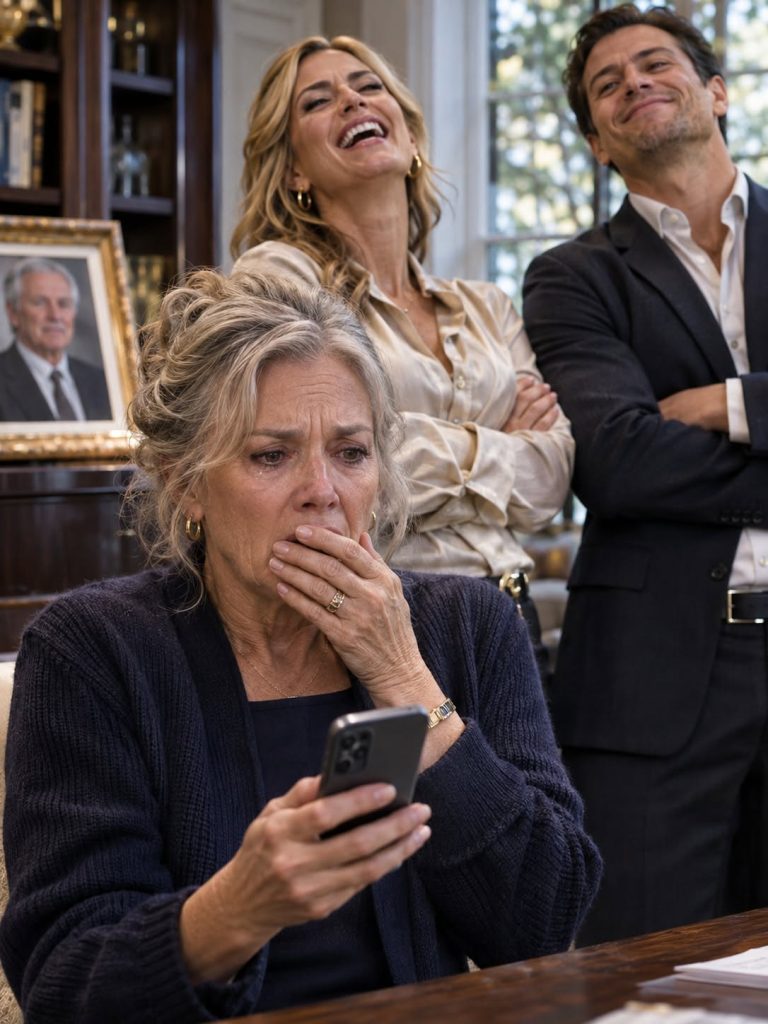
“And Michael signed this petition?” I asked softly.
Sterling’s eyes shifted slightly—the barest micro-tell of professional hesitation.
“The petition is brought by Mrs. Vanessa Whitmore as an interested party and next friend of the family, with supporting documentation regarding your son’s financial dependence on your estate management. Under emergency ex parte procedures, her signature is sufficient to initiate an immediate cognitive evaluation.”
“I see,” I said.
I stepped back from the doorway, opening the door wider.
“Please, come in,” I said smoothly. “It would be impolite to conduct an evaluation on the porch.”
Sterling looked slightly surprised by my immediate compliance, but he stepped over the threshold with an air of smug triumph. Dr. Vance followed closely behind, her pen already hovering over her assessment forms.
I led them into my study—the room where Richard and I had worked side by side for three decades. The walls were lined with floor-to-ceiling bookshelves holding legal digests, financial tax codes, and dozens of bound audit reports.
“Please, have a seat,” I offered, gesturing toward the two leather guest chairs facing my desk.
Sterling sat down, crossing his legs and resting his leather briefcase on his knees. Dr. Vance took the chair beside him, pulling her glasses down her nose.
“Mrs. Whitmore,” Dr. Vance began, her tone patronizingly soft, the way one speaks to a frightened child. “Can you tell me what day of the week it is, and who the current President of the United States is?”
I didn’t answer her.
Instead, I sat down in my executive high-back chair, folded my hands neatly on the polished mahogany desk, and pressed a button on the intercom unit beside my monitor.
“Thomas,” I said clearly. “Our guests have arrived. You can bring Detective Miller in now.”
The side door connecting my study to the adjacent library clicked open.
Thomas Vance stepped into the room, accompanied by a tall, broad-shouldered man in a rumpled suit who possessed the unmistakable, world-weary posture of a senior police detective.
Bradley Sterling jumped out of his chair as if the leather had caught fire. “What is this? This is an unauthorized intrusion into a private probate evaluation!”
“Actually, Mr. Sterling,” Detective Miller said, pulling his gold shield from his jacket pocket and flashing it with casual authority, “this is an active felony sting operation. Sit your backside down before I cuff you to the radiator.”
***
Chapter 9 – The Unraveling
Sterling’s face turned the color of skim milk. He looked at Detective Miller’s badge, then at Thomas Vance, then down at his own expensive briefcase.
Dr. Evelyn Vance froze, her pen trembling above the medical intake form.
“You… you can’t interfere with a probate proceeding,” Sterling stammered, though all the aggressive bravado had vanished from his voice. “My client filed a lawful emergency petition under Section 11a of the Probate Act!”
“Your client,” Thomas said, stepping up to the edge of my desk and dropping a heavy manila folder directly over Sterling’s paperwork, “committed perjury on three separate statutory certifications filed under penalty of felony contempt.”
Thomas pointed at the top document.
“Exhibit A: An affidavit bearing the purported signature of Michael Whitmore, consenting to the conservatorship. Unfortunately for your client, Michael was sitting in the State’s Attorney’s Office in Maywood at eight o’clock this morning, executing a sworn deposition stating he had never seen, read, or authorized this petition.”
Sterling blinked, his mouth opening and closing like a landed trout. “Michael… Michael went to the State’s Attorney?”
“My son made many mistakes, Mr. Sterling,” I said quietly, looking directly at the lawyer. “He was weak, he was vain, and he allowed his wife’s greed to blind him. But when Thomas showed him the forensic evidence of Vanessa’s private offshore communications with Julian Croft—specifically the discussions regarding liquidating Chloe’s college trust fund to finance Croft’s legal defense—Michael finally remembered that he is Richard Whitmore’s son.”
Dr. Vance quietly closed her clipboard and slid it into her bag. “I was retained under false pretenses,” she said quickly, her clinical detachment replaced by sheer panic. “I was told by Mrs. Whitmore that the subject was exhibiting severe combative dementia and had threatened violence against family members. I had no knowledge of any criminal proceedings.”
“You can explain that to the Illinois Department of Financial and Professional Regulation, Doctor,” Detective Miller growled. “Leave the clipboard on the desk. You’re excused. Do not leave the state.”
Dr. Vance practically bolted from the room, her heels clicking in frantic retreat across the hardwood floor until the front door slammed shut.
Bradley Sterling was left standing alone, his tailored suit suddenly looking two sizes too big for his trembling frame.



