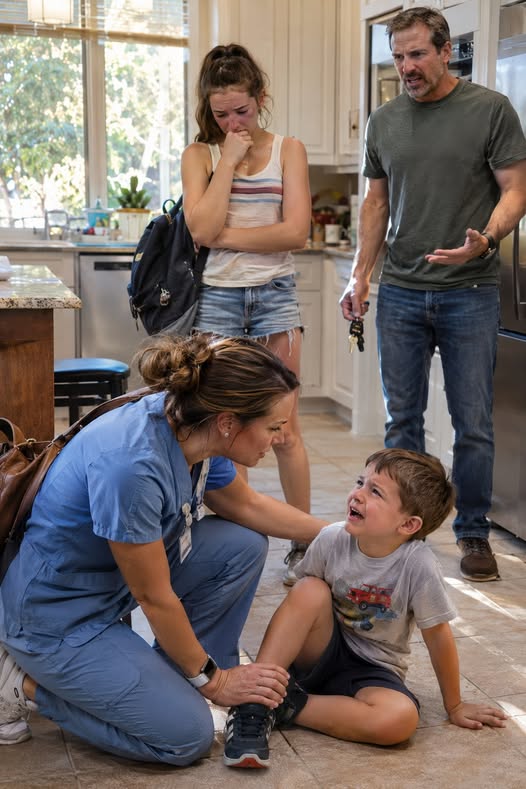
Rachel had planned to photograph that year’s reunion for promotional material for the event business. She wanted photographs of what she called our “real multigenerational family” for her website.
She thought Lily made the story less clean.
I read that sentence three times.
Then I closed the message.
I eventually told Rachel I accepted her apology.
I also told her forgiveness did not restore access.
There is a difference.
The next summer, we held another gathering at the lake house.
Not the old reunion.
I didn’t invite everyone.
Daniel grilled burgers on the deck. Aunt Carol brought potato salad. Cousin Ben came with his wife. A few relatives who had quietly checked on Lily afterward were there too.
No matching shirts.
No formal family photograph.
No speeches about tradition.
Just people who wanted to be together.
Late that afternoon, I found Lily sitting at the end of the dock with her feet above the water.
She was nine then.
I sat beside her.
She asked me something I hadn’t expected.
“Do you think Grandma Evelyn would have liked me?”
Lily had met her only twice before Grandma died.
I thought about the estate letter.
About the house.
About everything that had happened because certain people believed family was a closed circle they had the right to guard.
“Yes,” I said.
“I think she would have loved you.”
Lily smiled.
Then she leaned against my shoulder.
From the deck, Daniel called our names because everyone was ready for dinner.
Lily jumped up and grabbed my hand.
For a moment, I looked back at the house Grandma had trusted me to protect.
I finally understood what she meant.
Protecting a home isn’t only about deeds, bank accounts, locks, or legal documents.
Sometimes it means deciding who gets to feel safe when they walk through the door.
And sometimes the clearest definition of family is incredibly simple.
When a child is standing in a room wondering whether she belongs, family is the person who makes space for her.