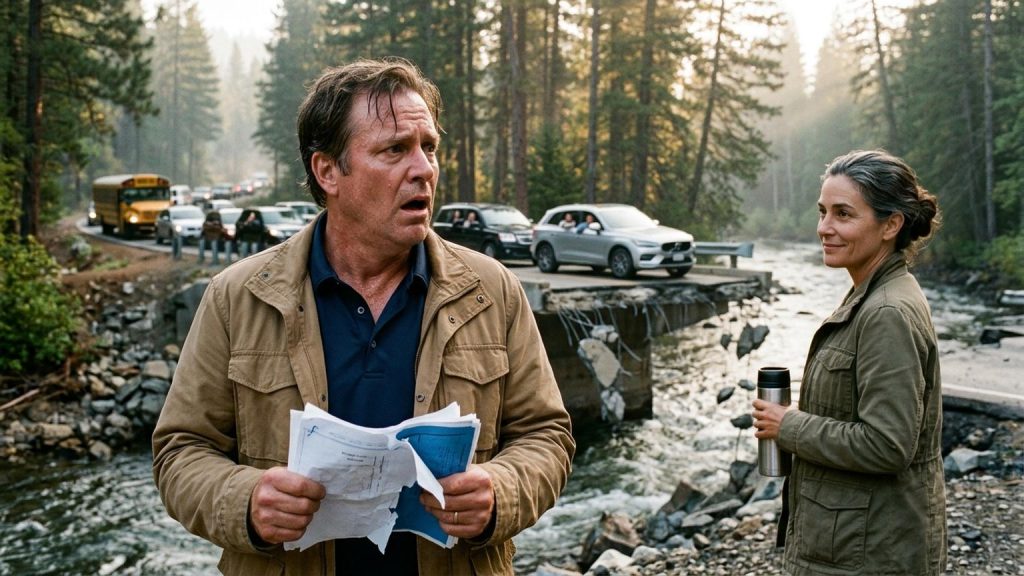
At 6:14 on a Wednesday morning, twelve hundred homeowners discovered that the only emergency road out of their luxury subdivision no longer existed.
The problem was that their HOA had destroyed it three days earlier.
I stood beside Cedar Creek with a thermos of coffee while brake lights stacked up through the trees.
Mercedes.
Teslas.
Range Rovers.
A school bus that had nowhere to go.
Two miles downstream, county crews had closed Whispering Pines Estates’ main concrete bridge after inspectors discovered erosion around one of the support structures.
The subdivision still had a second crossing.
Or it had.
Until Richard Wallace decided my family’s eighty-year-old bridge offended him.
My name is Carter Hale.
For three generations, my family owned land at the north end of Cedar Creek Valley in Colorado.
Most of it disappeared over the years.
Property taxes rose.
My grandfather sold acreage.
Then my father did the same.
By the time the surrounding valley became Whispering Pines Estates—twelve hundred expensive homes behind stone gates—we still owned five wooded acres along Cedar Creek.
And the bridge.
My great-grandfather had commissioned it in 1932 to move timber trucks across the creek.
Seventy feet of steel truss, stone abutments, and cedar decking.
It wasn’t elegant.
It wasn’t modern.
But it was strong.
The bridge had carried loaded logging trucks, tractors, concrete mixers, and almost a century of winters.
It also happened to predate Whispering Pines by decades.
My property was never part of their HOA.
That drove Richard Wallace crazy.
Richard was a retired executive who had discovered late in life that running an HOA gave him the same emotional satisfaction he had once gotten from running a corporate division.
He drove a silver Range Rover.
Wore golf shirts even when it snowed.
And spoke to people as though every conversation were a quarterly performance review.
His vice president, Susan Carmichael, was worse.
Susan had once tried to issue a violation to a delivery driver for parking “inconsistently with community presentation standards.”
Together, they treated Whispering Pines like a small country.
My five acres were the irritating independent nation on their northern border.
At first, they sent offers.
Richard wanted the bridge removed so the HOA could continue its nature trail across the creek with what he described as “a visually appropriate pedestrian structure.”
Glass railings.
LED lights.
Landscaping.
Something that looked like it belonged outside a ski resort hotel.
I ignored him.
Then came fines.
$500 for an “unapproved exterior structure.”
$300 for “failure to maintain community aesthetics.”
$1,000 for “obstruction of planned common-area improvements.”
I called the management office once.
“Carter Hale,” I said. “Parcel 18-B. Please note that I am not a member of Whispering Pines.”
The woman on the phone went silent.
Then whispered:
“We know.”
The letters kept coming anyway.
I used one to light my fireplace.
That was probably childish.
It also felt excellent.
Then Richard arrived in person.
I was changing the oil in my truck when his Range Rover stopped across my driveway.
He stepped out with Susan and a surveyor.
“Carter,” he called. “We’re finished wasting time.”
“You’re trespassing.”
He ignored that.
“You have thirty days to remove the bridge.”
I wiped my hands on a rag.
“Based on what?”
“Cedar Creek is a regulated waterway.”
“So?”
“So structures affecting the community watershed fall under shared oversight.”
“Whose oversight?”
He smiled.
“Ours.”
I actually laughed.
Wrong decision.
Richard’s face darkened.
“The bridge is deteriorated, visually incompatible with the community, and obstructs future planning.”
“It carried a twenty-ton cement truck last month.”
Susan stepped forward.
“That doesn’t mean it meets modern safety standards.”
“It means you should stop walking on my property.”
Richard pointed toward the bridge.
“If you refuse to abate the nuisance, the association will do it and recover the cost from you.”
That was the first moment I understood he might actually be stupid enough to try.
I called the sheriff’s office.
They left before a deputy arrived.
Two weeks later, I flew to Seattle for work.
Five days.
That was all Richard needed.
When I returned Sunday evening, the first thing I noticed was the excavator tracks.
Deep.
Fresh.
Running straight down my private access road.
I left my truck running.
Then I ran.
The bridge was gone.
Not damaged.
Gone.
Steel beams lay cut into sections.
Cedar planks were shattered along the bank.
One stone abutment had been partially torn apart.
Chunks of twisted steel sat in the creek.
The water pushed around broken timber and debris.
For several seconds, I couldn’t process what I was looking at.
My great-grandfather had built that bridge.
My grandfather had repaired it.
My father had taught me to drive across it.
And somebody had erased it while I was on an airplane.
Then I saw the laminated notice nailed to an oak.



