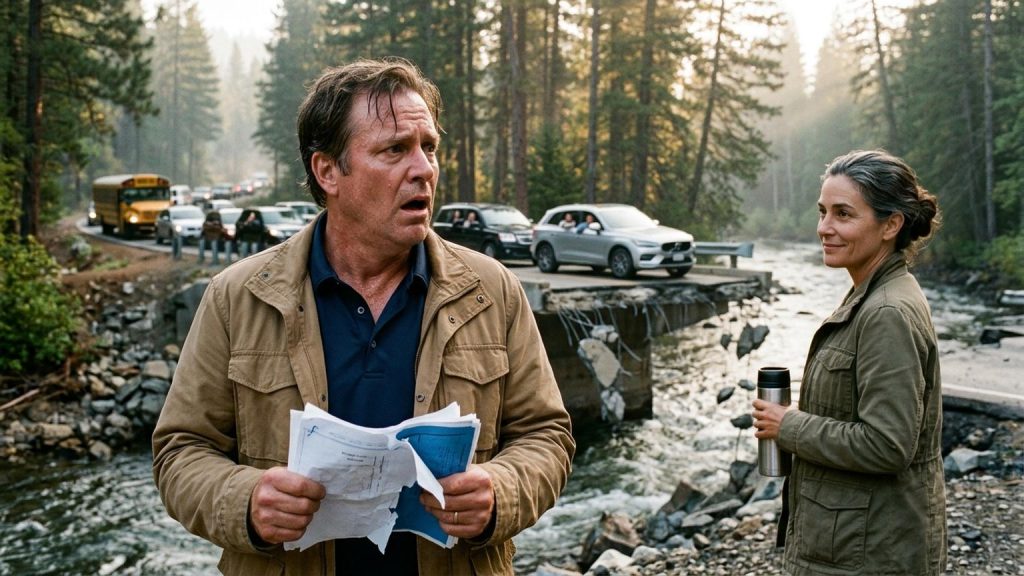
Residents could still leave through the old mountain road if they owned the right vehicle and were willing to crawl over washboard gravel for more than an hour.
For everyone else, the county arranged temporary shuttle access to a staging area near the highway.
School schedules were disrupted.
Deliveries were postponed.
Contractors canceled jobs.
One resident missed a flight.
Another had to leave his Porsche at home and ride out in his landscaper’s pickup.
That last part became neighborhood legend.
At 2:30, a local television crew arrived.
I declined an interview.
Richard did not.
That was his next mistake.
He stood beside the temporary gate and told the reporter:
“The HOA removed a dangerous structure in good faith based on our responsibility to protect residents.”
The reporter asked:
“Did you own the bridge?”
Richard answered:
“The ownership situation is complicated.”
It wasn’t.
Then she asked:
“Did you have the owner’s permission?”
Richard stopped smiling.
By evening, Whispering Pines held an emergency meeting.
Harrison advised me not to attend.
“You don’t need to enter their circus.”
He was right.
But one resident, Dr. Elaine Porter, called me afterward.
Elaine was a trauma surgeon.
She lived near the north end of the development and had used my grandfather’s bridge during a wildfire evacuation fifteen years earlier.
“Carter,” she said, “did Richard have permission to tear it down?”
“No.”
“Was there a board vote?”
“I don’t know.”
“There wasn’t.”
That interested Harrison.
The next morning, we obtained the HOA meeting records.
Richard and Susan had approved the demolition using discretionary maintenance funds.
No full board vote.
No engineering report declaring the bridge unsafe.
No county demolition permit.
No title verification.
No environmental authorization.
Just an invoice from a low-cost contractor and an internal email from Richard:
REMOVE STRUCTURE WHILE HALE IS OUT OF STATE. DELAY WILL ONLY CREATE MORE RESISTANCE.
Harrison read it twice.
Then he looked at me.
“He actually wrote that.”
“Apparently.”
“I love people who document their own bad faith.”
The lawsuit was filed two days later.
Not some theatrical fifty-million-dollar claim.
Harrison kept it credible.
Trespass.
Conversion and destruction of private property.
Cost to restore the crossing.
Damage to the creek bank.
Loss of use.
Surveying and engineering costs.
Potential punitive damages based on intentional conduct.
We also sought an injunction preventing further HOA entry onto my land.
The demolition contractor was named separately.
So were Richard and Susan.
That frightened them far more than suing the association alone.
HOA officers like collective authority.
Personal liability has a different flavor.
Then the environmental issue arrived.
The county water-quality office inspected the creek because demolition debris had been left in the channel.
Treated timber.
Steel.
Hydraulic-fluid residue near the excavation area.
The agency ordered cleanup and erosion-control measures.
The responsibility question quickly became another argument between the demolition company and the HOA.
Meanwhile, Whispering Pines homeowners were furious.
Not because they suddenly loved my bridge.
Most had barely noticed it before.
They were furious because Richard had created a crisis nobody voted for.
A second emergency meeting drew more than six hundred residents.
This time, someone recorded it.
Richard stood behind a podium.
Sweating.
Trying to regain control.
“I made the decision based on the information available.”
A corporate lawyer named Thomas Keene stood from the audience.
“What information?”
Richard looked toward him.
“The bridge had been identified as a liability.”
“By whom?”
“Our community planning advisers.”
“Name one engineer.”
Richard paused.
Thomas continued.
“Did a licensed engineer declare the bridge unsafe?”
“No formal declaration had been issued.”
“Did the county order demolition?”
“No.”
“Did you obtain a permit?”
Richard’s attorney tried to intervene.
Thomas ignored him.
“Did the association own the bridge?”
Richard’s face tightened.
“We believed—”
“That’s not what I asked.”
The room started turning.
Another resident stood.
“Did the full board vote?”
Susan answered from the side of the room.
“The executive committee had authority to act.”
“Where in the bylaws?”
Silence.
Then someone shouted:
“How much did you spend?”
Richard answered reluctantly.
“Twenty-eight thousand four hundred fifty dollars.”
A woman near the back yelled:
“You spent thirty grand to destroy an emergency route the week before the main bridge failed?”
Richard slammed his hand against the podium.
“I could not have predicted the county closure!”
That was true.
And I always thought it mattered.
Richard had not caused the south bridge failure.
He had not intentionally trapped anyone.
His real failure was worse in a quieter way.
He destroyed critical infrastructure he didn’t own because he believed nobody had the power to tell him no.
The homeowners voted that night to remove both Richard and Susan pending an independent investigation.
Richard lost overwhelmingly.
Susan resigned before the final count.
The remaining board contacted Harrison the next morning.
For the first time since the conflict started, someone from Whispering Pines asked a useful question.



