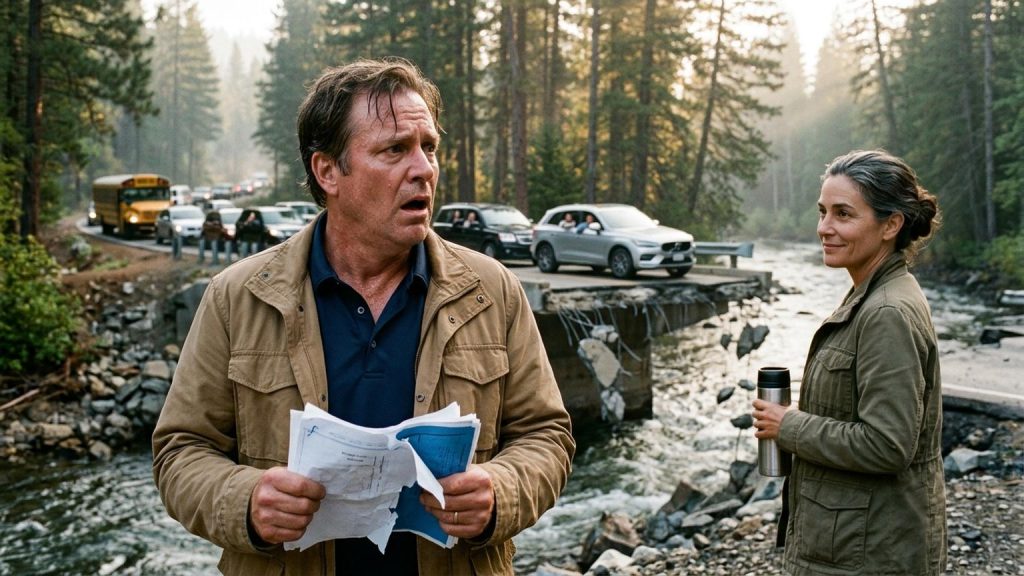
NOTICE OF ABATEMENT.
The Whispering Pines HOA had “removed an unsafe and unauthorized structure.”
They also billed me $28,450 for demolition and administrative expenses.
At the bottom:
RICHARD WALLACE, PRESIDENT.
I wanted to drive straight to his house.
Instead, I called Harrison Cole.
Harrison had been my father’s real-estate attorney for twenty years.
He was sixty-three, permanently irritated, and possessed a deep professional distrust of anyone who used the phrase “community standards” without first checking a deed.
He came out the next morning.
Walked the creek.
Photographed everything.
Then asked one question.
“Did they remove anything on the opposite bank?”
“The eastern stone abutment.”
“All of it?”
“Most of it.”
Harrison stopped.
His entire expression changed.
“What?”
“Come with me.”
We drove to his office.
He pulled a century-old title binder from storage and spread the survey across his desk.
The old family parcel was stranger than I remembered.
Our property did not end at the western creek bank.
The deed included the creek bed beneath the bridge and a fifty-foot strip of land on the opposite side.
The bridge had been built entirely within my family’s recorded parcel.
Harrison circled the eastern abutment.
“This is yours.”
I stared at him.
“The HOA side?”
“That fifty-foot strip is not HOA land.”
“So their crew—”
“Entered your property from both directions.”
“And tore out my bridge.”
“Yes.”
He turned another page.
“And excavated inside a recorded riparian parcel without your permission.”
I sat back.
Richard had spent years acting as though his subdivision surrounded me.
Legally, at the northern crossing, I surrounded him.
Harrison wasn’t finished.
He pulled up a county notice on his computer.
“Now this is where Richard’s week becomes interesting.”
The headline said:
EMERGENCY CLOSURE SCHEDULED — WHISPERING PINES SOUTH BRIDGE.
I read it twice.
“What happened?”
“Scour around one support. County inspectors are closing it tomorrow morning pending repairs.”
“For how long?”
“Initial estimate? Six to ten weeks.”
I looked at the map.
Whispering Pines sat between the creek and a mountain ridge.
The main bridge connected the development to the state highway.
The old northern bridge—mine—had always served as a secondary emergency route by informal permission from my father and grandfather.
Richard had just destroyed it.
“What about the logging road east?”
Harrison shook his head.
“Seasonal. Four-wheel drive only. Not suitable for school buses, ambulances, delivery trucks, or most passenger cars.”
A cold realization settled over me.
“Twelve hundred houses.”
“Correct.”
“One real road.”
“Until six tomorrow morning.”
I looked down at the title survey.
Then at the demolition photographs.
Then back at Harrison.
“If the bridge were still there…”
“They’d have an emergency crossing.”
“But Richard destroyed it.”
Harrison smiled.
“Yes.”
Then he tapped the fifty-foot strip of land Richard believed belonged to his HOA.
“And tomorrow morning, he is going to discover something else.”
“What?”
“You own the only place where anyone could legally build a replacement.”
We didn’t trap Whispering Pines.
That distinction mattered.
The county closed their main bridge.
Richard had destroyed their backup.
All I did was secure land I already owned.
Before sunrise, a fencing contractor installed a temporary steel gate across the eastern side of my parcel, well inside the surveyed boundary. Large signs read PRIVATE PROPERTY — NO VEHICLE ACCESS.
At 6:00 a.m., county crews barricaded the south bridge.
By 7:10, traffic inside Whispering Pines was backed up nearly a mile.
At 7:43, Richard’s Range Rover appeared near my ruined crossing.
He stopped at the gate.
Then started screaming.
“Carter! Open this!”
I stood across the creek.
“There’s nothing to open.”
“We need emergency access!”
“You destroyed the bridge.”
“We can install a temporary crossing.”
“On whose land?”
He hesitated.
Harrison stepped beside me holding the recorded survey.
“Mr. Wallace,” he called, “the eastern abutment, creek bed, and fifty-foot landing area are all part of Mr. Hale’s parcel.”
Richard stared at him.
“That’s HOA common land.”
“No.”
Susan arrived behind him.
“We have an emergency easement.”
Harrison shook his head.
“You had an informal permissive use of the existing bridge. Then your board demolished the bridge without the owner’s consent.”
Richard grabbed the fence.
Harrison raised his phone.
“I strongly recommend you stop touching my client’s property.”
Richard let go.
Behind him, more residents were arriving.
Someone shouted:
“Richard, what happened to the old bridge?”
Another voice:
“You told us it was county property!”
Richard turned.
And for the first time, I watched him realize the people he had spent years controlling were no longer looking at me.
They were looking at him…
By noon, everybody in Whispering Pines knew.
Not every detail.
But enough.
The south bridge was closed.
The northern crossing was destroyed.
And the HOA president had authorized the demolition.



