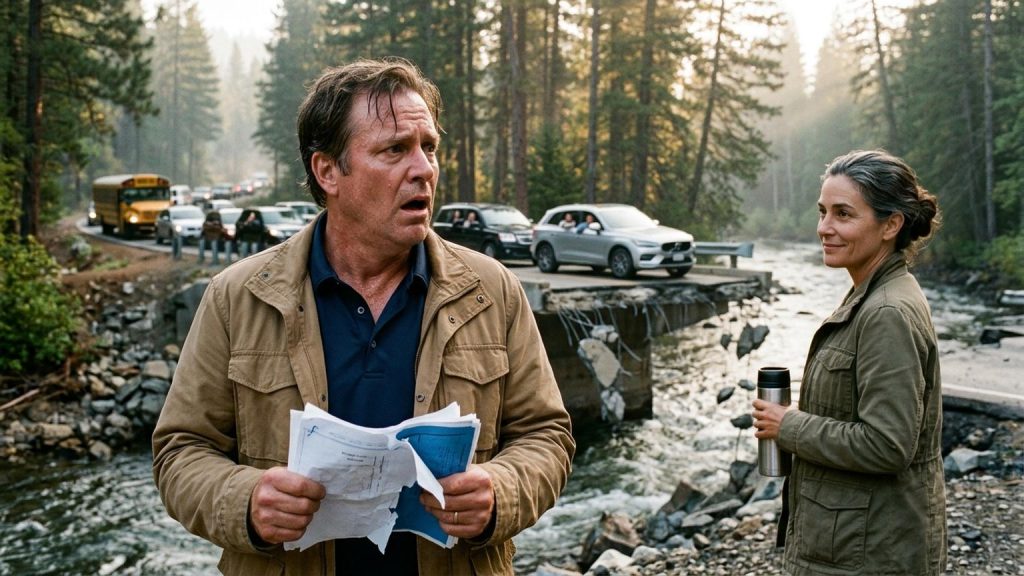
“What would it take to restore the northern crossing?”
Harrison looked at me.
I already knew my answer.
“A proper bridge.”
Not a temporary steel plate.
Not a cheap emergency span.
If we rebuilt it, we were doing it correctly.
We commissioned an engineering firm that specialized in historic structures.
They studied photographs.
Original drawings.
Remaining foundations.
The steel dimensions.
The cedar deck.
The goal wasn’t to create a museum piece.
It was to preserve the character while meeting modern load and safety standards.
Estimated cost:
$684,000.
The number shocked everyone.
Including me.
Replacing an eighty-year-old bridge in modern Colorado wasn’t cheap.
Whispering Pines wanted to negotiate.
I expected that.
Their first proposal was predictable.
The HOA would contribute to reconstruction if I granted a permanent public easement allowing all residents unrestricted access.
No.
Second proposal:
The HOA would pay half if the bridge became joint property.
No.
Third:
They would pay the entire reconstruction cost if the crossing became an official secondary emergency and service route subject to a recorded agreement.
That was different.
Harrison and I spent weeks on it.
I had no desire to punish 1,200 families for Richard’s stupidity.
People had jobs.
Children.
Medical needs.
The community legitimately needed redundancy.
My grandfather had allowed emergency access for decades because he understood that.
So we negotiated something clear enough that nobody fifty years from now would have to guess what “permission” meant.
I kept ownership.
The bridge remained private property.
Whispering Pines received a limited recorded easement for emergency vehicles and approved community traffic during closure of the main bridge.
Routine resident use remained prohibited.
Heavy commercial vehicles required advance permission.
The HOA contributed annual funds toward inspection and maintenance.
If they damaged the structure or violated the agreement, access could be suspended subject to the terms we negotiated.
Most importantly, every right and every responsibility was written down.
No informal handshake.
No assumptions.
No future Richard Wallace deciding history was whatever he said it was.
The HOA agreed.
Their insurance covered part of the loss after lengthy disputes over the board’s actions.
The demolition contractor’s insurer contributed another portion.
Richard and Susan ultimately entered a separate settlement regarding their conduct.
I’m not going to pretend they were financially destroyed overnight.
Real lawsuits are slower and less cinematic than internet stories.
But Richard paid personally.
So did Susan.
They also had to live with the fact that the entire community knew why.
The old debris came out of Cedar Creek first.
That took nearly two weeks.
Crews stabilized the disturbed banks.
Environmental inspectors signed off.
Then bridge construction began.
I visited almost every morning.
So did my father’s old friend Jackson.
He ran a fabrication shop and knew more about steel than half the engineers I’d met.
One morning he stood beside the new truss sections and whistled.
“Your great-granddad would approve.”
“You think?”
“No.”
He grinned.
“He’d complain the bolts cost too much.”
Probably true.
We salvaged whatever original material was structurally usable.
Most of the cedar wasn’t.
Some of the decorative steel plates were.
One original beam segment became part of a small overlook beside the crossing.
I kept a damaged section with the date 1932 stamped into it.
Not as a trophy.
As evidence that old things matter even when they’re inconvenient.
The main Whispering Pines bridge reopened before ours was finished.
That lowered the tension immediately.
Residents could drive normally again.
For a while, the northern crossing became just another construction project.
Then something unexpected happened.
People started coming to watch.
Families.
Older residents.
Kids on bicycles.
A few brought photographs of the original bridge.
One man named Raymond told me he had crossed it during the 1996 wildfire evacuation.
“I never knew your family owned it,” he said.
“Most people didn’t.”
“We just assumed it was part of the development.”
“That assumption caused a lot of trouble.”
He nodded.
Then looked embarrassed.
“I signed one of Richard’s petitions against you.”
“I know.”
He looked at me.
“You knew?”
“Harrison kept everything.”
“Of course he did.”
Raymond laughed.
Then became serious.
“I’m sorry.”
I believed him.
The new bridge opened the following spring.
Steel trusses.
Heavy timber decking.
Stonework designed to resemble the old abutments.
Modern guardrails.
Load-rated structure.
It looked familiar without pretending nothing had happened.
At the entrance on my side stood a small bronze plaque.
THE HALE CROSSING
ORIGINAL STRUCTURE 1932
REBUILT 2027
Underneath:
PRIVATE PROPERTY — EMERGENCY ACCESS BY AGREEMENT.
No LED uplighting.
No glass rails.
Richard would have hated it.
That pleased me more than it should have.
He sold his house before construction finished.
The last time I saw him was in the parking lot outside Harrison’s office after one of the settlement conferences.
He looked smaller.
Not physically.
Just stripped of the performance.
No board title.



