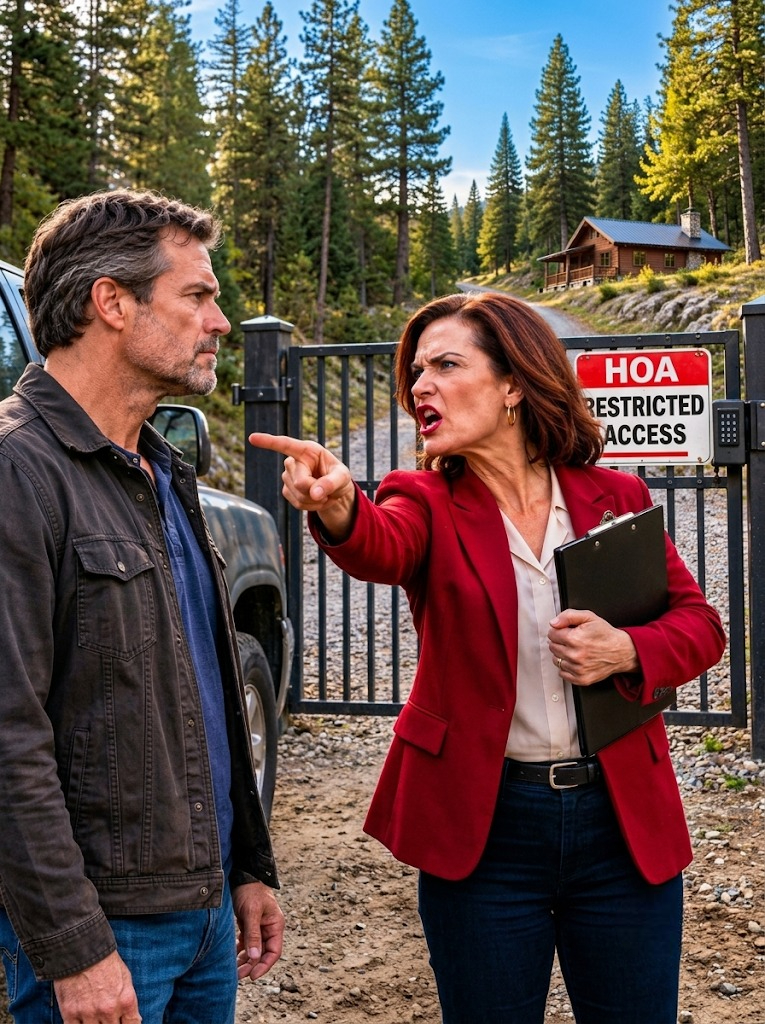
The steel gate appeared across the only road to my cabin on a Thursday morning.
By Friday, the HOA had fined me for trying to reach my own land.
By Sunday, a broken water line was flooding the cabin while my truck sat two miles downhill.
And by Monday, I knew the gate had never been about road safety.
My name is Daniel Reeves. I was fifty-three years old, a heating contractor from Asheville, North Carolina, and I had owned a small mountain cabin above Laurel Ridge for seventeen years.
The cabin wasn’t luxurious.
Two bedrooms.
Stone fireplace.
Tin roof.
A porch overlooking a valley that turned blue at sunset.
But it was mine.
And there was exactly one vehicle road leading to it.
Black Pine Road began at the county highway, climbed through what later became a subdivision called Timber Crest, then continued another mile into older mountain property.
My cabin had been there before Timber Crest.
So had the road.
For seventeen years, I drove it without asking anyone for permission.
Then the subdivision elected Vanessa Pierce as HOA president.
The first time I met her, she was standing beside a newly installed gate wearing a red wool coat.
Two contractors were pouring concrete around steel posts.
“You don’t have vehicle access anymore,” she said.
I hadn’t even turned off my engine.
I looked toward the road beyond her.
“That’s the road to my cabin.”
“It’s now controlled access.”
“Controlled by who?”
“Timber Crest.”
“Since when?”
She held up a clipboard.
“The board classified it as a private association road.”
I got out.
A laminated sign hung from the chain.
AUTHORIZED TIMBER CREST VEHICLES ONLY
Underneath were towing warnings and fines.
No recording number.
No legal description.
No reference to my parcel.
“Show me the document that lets you block me.”
Vanessa smiled.
“You can submit a request.”
“For access to my property?”
“For permission to use association infrastructure.”
That sentence bothered me.
Not enough to start shouting.
Enough to start taking pictures.
The gate.
The posts.
The contractor’s truck.
The wet concrete.
The sign.
Then I drove back down.
That night, I pulled the closing file from my safe.
My deed contained old language referring to “perpetual access over the mountain road serving the upper tract.”
Another recorded instrument from 1976 described a right of ingress and egress from the public highway to the parcel that eventually became mine.
Timber Crest had not existed until 2006.
I emailed the HOA.
I asked for the board resolution authorizing the gate and the recorded instrument giving Timber Crest the power to terminate my access.
No answer.
Three days later, they replaced the chain with a keypad gate.
Then came the certified letter.
It called Black Pine Road “association-controlled private property” and warned me against bypassing the gate.
I replied with copies of my deed.
The next HOA letter changed the wording.
Now Timber Crest merely “maintained and regulated” the road for safety.
That difference mattered.
Ownership.
Maintenance.
Control.
Those are not interchangeable words.
But I wasn’t a lawyer.
So I called one.
Her name was Sarah Keene.
She read everything and said, “Don’t cut the gate.”
“I wasn’t going to.”
“Don’t drive around it.”
“Wasn’t going to do that either.”
“Good. Let them explain their authority.”
While Sarah researched the records, I requested temporary access because I needed to replace a failing pressure valve at the cabin.
Vanessa denied it.
She wrote:
You are not currently an authorized user of Timber Crest roadway infrastructure. Please make alternative arrangements.
Alternative arrangements.
On a mountain.
With no second road.
Two nights later, rain hit the ridge.
The pressure valve failed.
A neighbor hiking nearby called me.
“Daniel, there’s water running out beneath your cabin.”
I climbed up by an old logging path carrying tools in a backpack.
It took nearly an hour.
Inside, water covered the utility room floor.
Insulation was soaked.
Trim had warped.
The repair that would have cost a few hundred dollars had become several thousand.
I photographed everything.
The next morning I sent the HOA the damage.
Vanessa responded with a violation notice.
Why?
Because Timber Crest claimed I had entered a “restricted road corridor” while reaching the cabin.
I had never touched the road.
That was when Sarah stopped treating this as confusion.
Someone had decided my access needed to disappear.
We hired a surveyor named Oliver Grant.
He spent two days reconstructing the old mountain plats.
Then he called me.
“The access right is real.”
“How real?”
“Recorded before the subdivision existed. It follows substantially the same mountain route.”
“And the HOA?”
“They inherited maintenance responsibilities on part of the road.”
“So they can maintain it.”
“Yes.”
“Can they exclude me?”
“That’s Sarah’s question.”
But Oliver found something else.



