Repair invoices.
Survey expenses.
Attorney costs where recoverable.
Extra labor.
No invented emotional-damages fortune.
No punishment number.
The HOA’s insurer became involved.
That accelerated everything.
Insurance attorneys are not interested in neighborhood pride.
They ask what was recorded.
Who knew what.
When they knew it.
And what happened afterward.
Vanessa’s emails were terrible for that analysis.
The HOA board suspended her authority pending a recall.
She resigned before the vote.
Linda became interim president.
Her first action was to order an independent legal review of Black Pine Road.
The result was practical.
My access easement remained valid.
Timber Crest retained road maintenance responsibilities.
I agreed to contribute an annual amount based on reasonable usage.
The gate stayed.
But my parcel received permanent access credentials.
No yearly application.
No discretionary approval.
No individual board member could deactivate my code without documented emergency cause or legal process.
The violation disappeared.
The fine disappeared.
The warning that called me unauthorized disappeared.
The insurer paid a negotiated portion of my documented repair and professional costs.
Crestview Mountain Holdings faced a separate problem.
Its lender froze the fourteen-cabin project.
Why?
Because the company had represented Black Pine Road as controllable access.
It wasn’t.
Not exclusively.
My easement did not prevent development.
But it prevented them from promising the lender sole control of the road.
Crestview had three choices.
Negotiate.
Redesign.
Or abandon the project.
Vanessa’s husband chose negotiation first.
His attorney contacted Sarah.
They offered to buy my cabin.
I said no.
They increased the number.
Still no.
Then they offered to relocate my access to a new road at their expense.
I considered it.
Not because I wanted to help them.
Because a second access route could actually improve my property.
But the proposed route was steeper.
Longer.
More vulnerable to winter ice.
I rejected it.
Eventually Crestview redesigned the project.
Fourteen cabins became nine.
They built a separate entrance from the county road using land they already controlled.
More retaining walls.
Higher engineering cost.
Less profit.
But legally clean.
That was their business.
I never tried to stop development.
I only refused to become the missing piece they could take without asking.
Months later, Linda called.
“We’re replacing the gate signs.”
“What do they say now?”
“Private road. Authorized users only. Emergency and recorded access rights honored.”
I laughed.
“That’s wordy.”
“Lawyers.”
“Fair.”
Then she asked something unexpected.
“Would you join the road committee?”
“No.”
She laughed.
“I had to ask.”
“I’ll pay my share and stay out of your meetings.”
“That may be healthier for everyone.”
We became friends in the strange way people do after surviving paperwork together.
Vanessa sold her Timber Crest home the following spring.
Her husband’s company continued operating.
I never learned whether they moved because of the controversy or simply because another project took them elsewhere.
It stopped mattering.
What mattered was that Black Pine Road became boring again.
That is the best possible condition for an access road.
Boring.
Predictable.
Open when it should be.
Closed only when a tree falls or ice makes the upper switchback dangerous.
Nobody standing beside it with a clipboard deciding whether I belong.
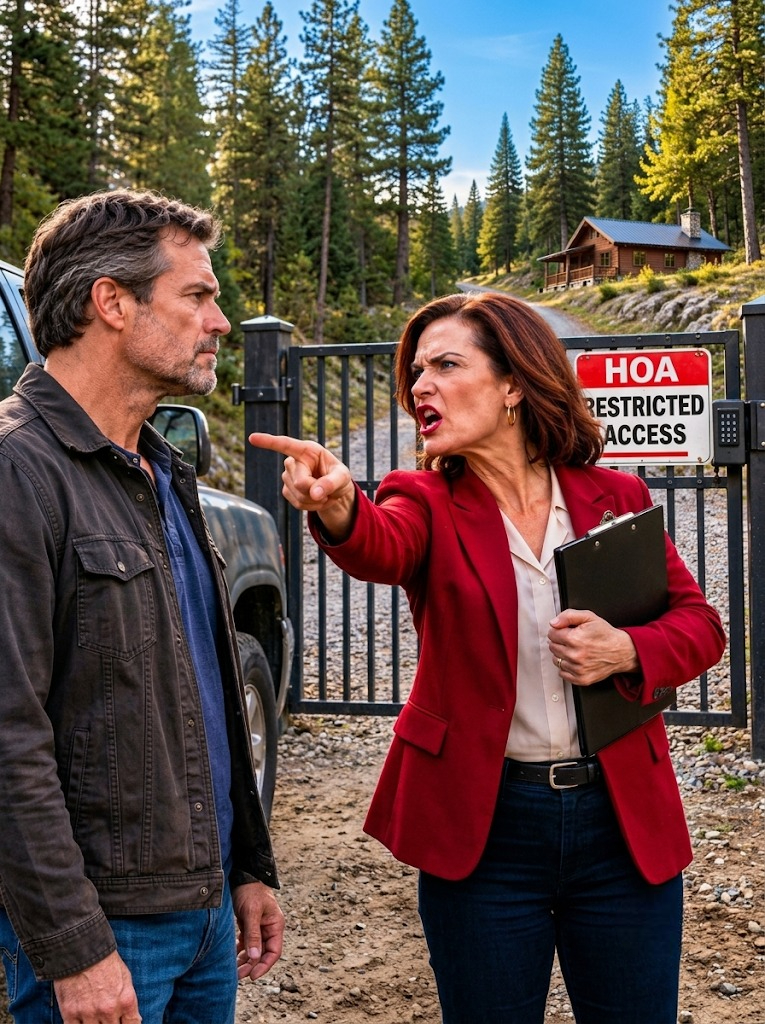
One October morning, almost a year after the first gate appeared, I loaded my truck exactly the way I had on that original trip.
Groceries.
Fuel.
Tools.
A replacement filter.
The mountains were turning red and gold.
Mist sat low in the valley.
I entered my code.
The gate opened.
This time I noticed a small plaque mounted beside the keypad.
It listed emergency numbers.
Road-maintenance contacts.
And beneath them:
Recorded access users: rights preserved.
Six words.
That was all I had wanted from the beginning.
Recognition that maintaining something did not mean owning every right connected to it.
At the cabin, I replaced the filter.
Checked the pressure system.
Cleaned the gutters.
Split firewood.
Ordinary work.
In the afternoon, I sat on the porch with coffee.
From there, I could see part of Black Pine Road through the trees.
I thought about Vanessa’s first sentence.
You don’t have access here anymore.
She had said it as though rights could disappear because somebody installed steel posts.
That was the mistake underneath everything.
Physical control feels powerful.
A gate closes.
A lock clicks.
A code changes.
Suddenly the person on the wrong side feels powerless.
But physical control and legal authority are not the same thing.
Sometimes a person has both.
Sometimes only one.
You find out which by reading.
The deed.
The easement.
The maintenance agreement.
The board minutes.
The emails.
The dates.
Especially the dates.
The oldest document in my file had existed before Timber Crest.
Before Vanessa.
Before Crestview.
Before the gate company.
It did not scream.
It did not threaten.
It simply sat in the county archive describing a right that traveled with the land.



