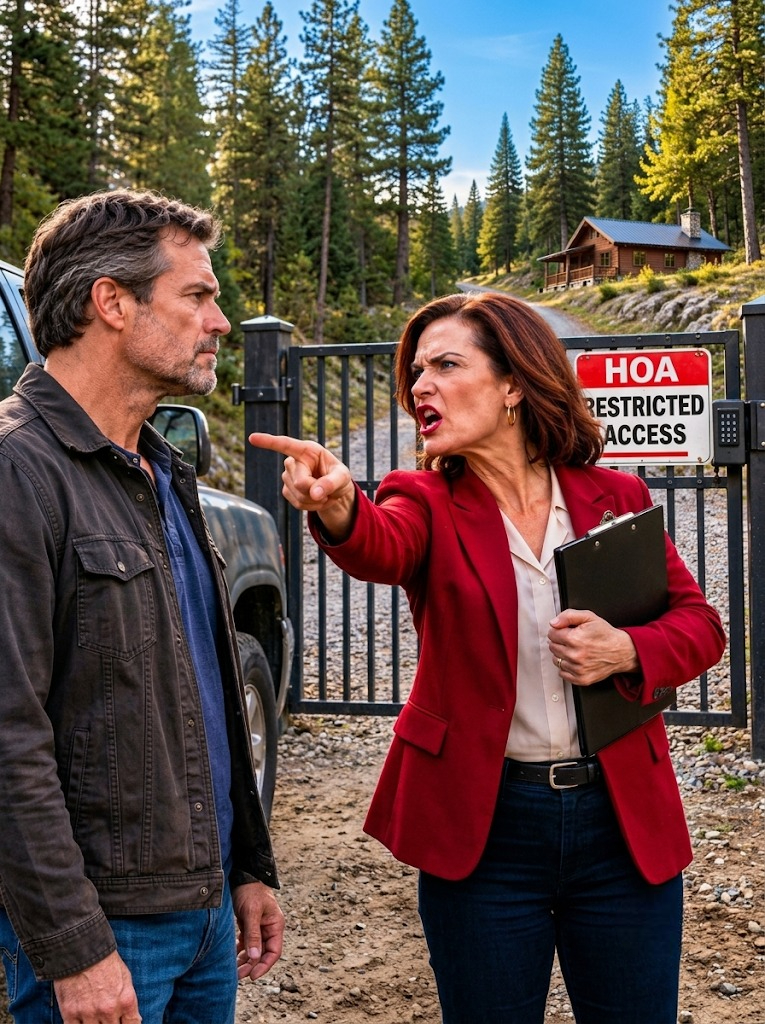
The gate had been placed at the only choke point where the newer subdivision road crossed the older access corridor.
One barrier controlled everything uphill.
That looked deliberate.
Then my neighbor Carl mentioned something strange.
Timber Crest had recently bought three undeveloped lots near the upper ridge.
I checked county records.
The purchases were made by an LLC called Crestview Mountain Holdings.
The registered manager was Vanessa Pierce’s husband.
Sarah found the planning application two days later.
Crestview wanted to build fourteen luxury cabins above Timber Crest.
There was one problem.
The proposed access road overlapped Black Pine Road.
And beside the traffic plan was a note:
Existing upper-parcel access rights may complicate controlled-entry design.
My cabin was one of those upper parcels.
Suddenly the gate looked less like road management.
It looked like preparation.
Then Sarah obtained the HOA minutes from six months earlier.
Vanessa had presented something called the “Mountain Access Consolidation Plan.”
One paragraph said:
Legacy access users outside Timber Crest should be transitioned to association authorization or alternative access where feasible.
Alternative access.
There was none.
But the final line was worse.
Successful consolidation will improve development potential of upper ridge properties.
I was still reading when Sarah slid another document toward me.
An email.
From Vanessa to her husband.
Once Reeves loses routine vehicle access, his cabin becomes much less useful. He may finally sell.
Underneath was his reply.
Then keep the gate in place. We only need time.
I stared at the screen.
The road dispute had never been about keeping Timber Crest safe.
They were trying to make my property inconvenient enough that I would give it up.
And that was when Sarah smiled for the first time.
“Good,” she said.
“Good?”
“They finally wrote down why they did it.”
Sarah sent Timber Crest a formal demand: restore my access, withdraw the violation, preserve all board communications, and identify the legal authority for permanently excluding a recorded easement holder.
The HOA’s attorney responded within forty-eight hours.
His language was very different from Vanessa’s.
He stopped calling Black Pine Road HOA-owned property. Instead, he argued that Timber Crest possessed maintenance and safety authority and could impose “reasonable access controls.”
Sarah answered with one question.
“How is permanently denying the easement holder a gate code reasonable?”
Then another board member contacted us.
Her name was Linda Carter, the HOA treasurer. Vanessa had never told the full board that her husband controlled Crestview Mountain Holdings.
Linda also forwarded several emails.
One showed Vanessa pushing the gate installation before the HOA attorney had reviewed the old access documents.
Another showed the attorney warning:
Maintenance authority should not be assumed to include the right to extinguish or materially impair pre-existing recorded access.
Vanessa received that warning three weeks before the gate went up.
Then Sarah found the final piece.
Crestview’s lender had required “secured and controllable vehicle access” before releasing financing for the fourteen-cabin project.
Black Pine Road was the proposed route.
My existing easement prevented exclusive control.
That afternoon, Timber Crest called an emergency board meeting.
Vanessa told residents I was threatening the HOA with a lawsuit because I refused to follow basic safety rules.
Sarah and I arrived carrying certified land records, Oliver’s survey, repair invoices, and the emails.
But before the meeting began, Linda walked over holding a folder.
“There’s something else.”
Inside was the contractor invoice for the gate. The customer name was not Timber Crest HOA. It was Crestview Mountain Holdings. Vanessa’s husband’s company had paid for the gate that locked me out…
The clubhouse was packed.
People stood near the doors and along the back wall.
Vanessa sat at the center of the board table wearing the same red coat she had worn the first morning at the gate.
She looked composed.
That was her strength.
She could make a decision sound inevitable before anyone had agreed to it.
The vice president called the meeting to order.
Vanessa immediately took the microphone.
She described Black Pine Road as fragile mountain infrastructure.
She spoke about erosion.
Emergency access.
Road wear.
Liability.
Unauthorized traffic.
Then she described me as an outside property owner demanding unrestricted use of a road Timber Crest residents paid to maintain.
If I had heard only her version, I might have agreed with her.
Sarah waited.
When Vanessa finished, Sarah stood.
“My client is not asking for unrestricted use of Timber Crest property.”
She projected my deed.
“He is asking to use a recorded access right that existed decades before Timber Crest.”
Then came the 1976 instrument.
Permanent ingress and egress.
Upper parcel.
Public highway.
Then Oliver’s survey.
Older access corridor.
Existing traveled road.
Modern subdivision.
The lines were not perfectly identical at every curve.
Mountain roads evolve.
But the physical route remained substantially the same corridor serving the upper property.



