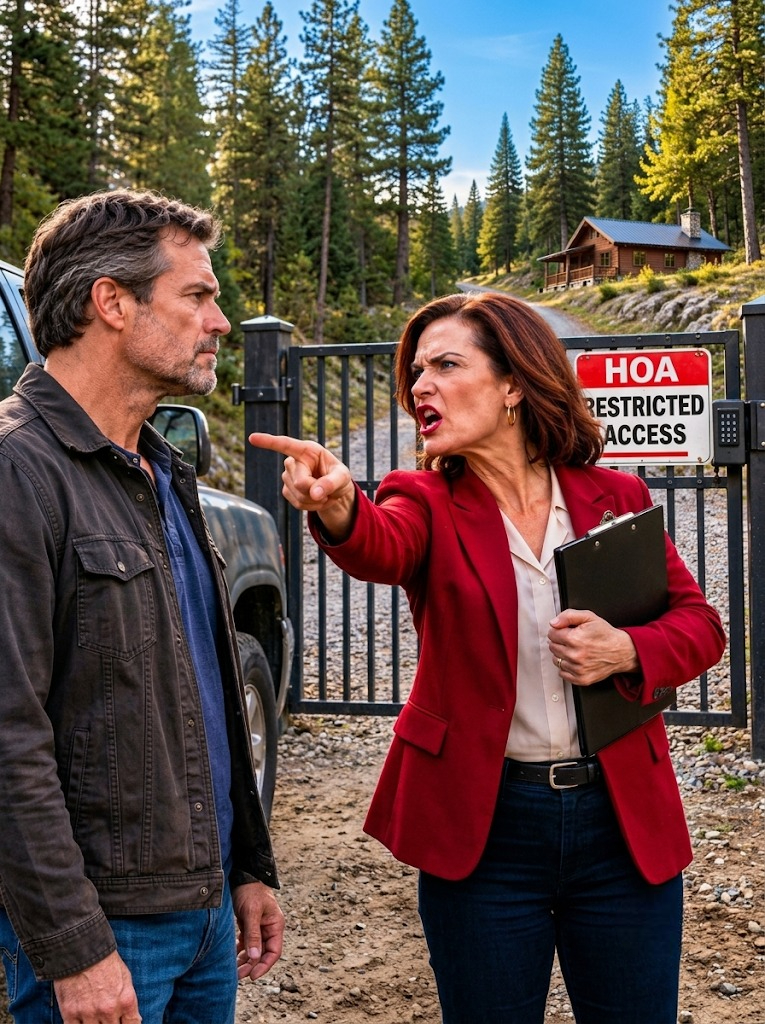
Sarah explained that the HOA could have legitimate maintenance powers.
It could grade.
Repair drainage.
Temporarily close a dangerous section.
Set reasonable limits during construction.
What it could not automatically do was convert maintenance authority into the power to erase an older property right.
A resident raised his hand.
“Then why did we install a gate?”
Linda answered.
“We didn’t.”
Vanessa turned sharply.
“What?”
Linda placed the contractor invoice on the projector.
Customer:
Crestview Mountain Holdings LLC.
The room changed instantly.
Vanessa leaned toward the microphone.
“Crestview advanced the installation cost because the HOA budget cycle—”
Linda interrupted.
“Where was the reimbursement vote?”
Vanessa stopped.
“There wasn’t one,” Linda said.
Another board member asked, “Why is a private development company installing gates on an HOA road?”
Vanessa’s husband was standing near the back.
His face had gone pale.
Sarah projected the Crestview planning map.
Fourteen proposed cabins.
Black Pine Road.
Controlled entry.
Then the lender condition.
Secured and controllable vehicle access required prior to financing release.
The room erupted.
Vanessa struck the gavel.
“Order.”
Nobody listened.
One homeowner shouted, “Were HOA rules being used to help your husband’s project?”
Vanessa shook her head.
“No.”
Sarah displayed the email.
Once Reeves loses routine vehicle access, his cabin becomes much less useful. He may finally sell.
People read it silently.
Then the reply.
Then keep the gate in place. We only need time.
Vanessa’s husband left the room.
That told people more than any speech.
Vanessa remained seated.
“This is private correspondence taken out of context.”
Sarah nodded.
“Then explain the context.”
Vanessa stared at her.
For the first time, she looked uncertain.
“The HOA needed control of traffic.”
Sarah switched documents.
The attorney warning appeared.
Maintenance authority should not be assumed to include the right to extinguish or materially impair pre-existing recorded access.
Date:
Three weeks before gate installation.
Recipient:
Vanessa Pierce.
Sarah asked the HOA attorney, who was sitting beside the board, whether the message was authentic.
He looked miserable.
“Yes.”
Vanessa turned toward him.
“You’re counsel for the association.”
“Yes.”
“And?”
“And that is my email.”
There was no way around it.
He had warned her.
She had proceeded.
Then Linda asked the question that ended Vanessa’s defense.
“Did the board vote to deny Daniel a code?”
Vanessa said yes.
Linda opened the minutes.
“No.”
The board had voted to explore access control.
It had never voted to permanently exclude me.
Vanessa had taken the broader discussion and treated it as authorization.
Just like she had taken maintenance power and treated it as ownership.
Just like she had taken a private development goal and wrapped it in HOA language.
The vice president called a recess.
Residents spilled into the parking lot.
Some were angry at me.
That surprised me until I understood why.
They paid for the road.
They worried a court case might force the HOA to cover damages.
They worried their dues would rise.
I understood.
I did not want their money.
I wanted my access restored and the damage handled fairly.
When the meeting resumed, I asked to speak.
“I don’t want your road.”
The room quieted.
“I don’t want Timber Crest dissolved.”
I looked toward the residents.
“You maintain the road. That benefits me too.”
Then I looked at Vanessa.
“But maintaining a road does not mean you get to decide my property becomes worthless because your husband wants the route.”
Nobody interrupted.
“I’m willing to pay a fair share of maintenance attributable to my use if the recorded documents support it.”
That surprised the board.
Sarah had suggested I say it.
She was right.
The dispute was never about getting something for free.
It was about being locked out.
“I’ll follow reasonable weight limits. Construction closures. Safety notices. Whatever applies legitimately.”
I paused.
“But I will not ask permission every time I need to go home.”
That sentence became the center of the eventual settlement.
The board voted that night to restore my access immediately.
Four to one.
Vanessa voted no.
At 10:14 p.m., I received a temporary gate code.
The next morning, I drove Black Pine Road for the first time in seven weeks.
The keypad beeped.
The steel gate swung inward.
I sat there for a few seconds.
Then I drove through.
No celebration.
No music.
No victory speech.
Just gravel beneath my tires.
At the cabin, the water damage looked worse than I remembered.
My handyman followed with tools.
We removed ruined insulation.
Replaced part of the utility-room floor.
Opened one wall to dry framing.
The original failed valve cost less than sixty dollars.
The final repair cost thousands.
That was the absurdity of the whole dispute.
A sixty-dollar maintenance problem had become property damage because someone decided controlling access mattered more than resolving rights first.
Sarah submitted my documented losses.



