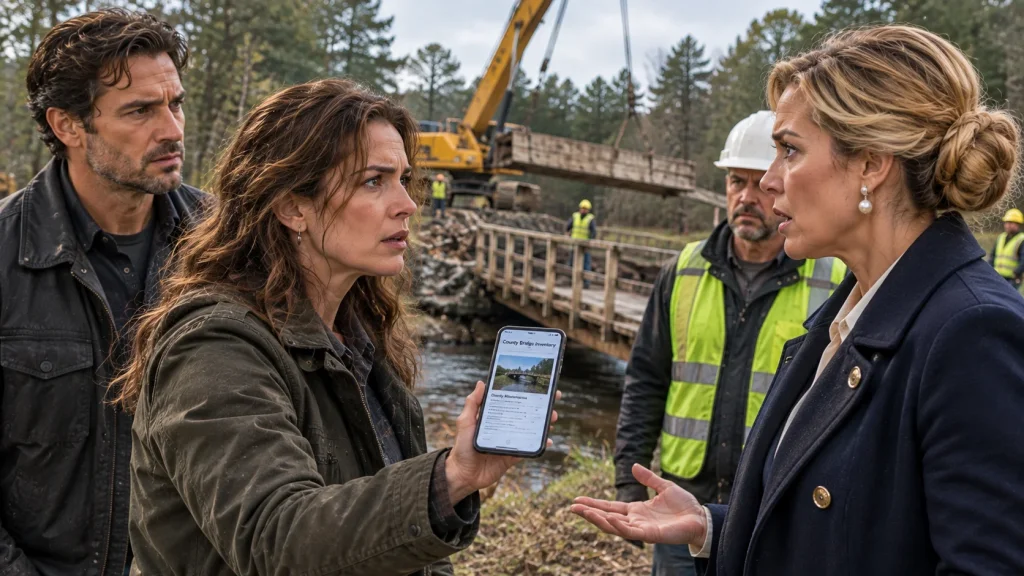
The first timber section rose from the bridge at 8:16 on a Saturday morning.
A crane lifted it slowly, rain-dark wood hanging above the creek while workers guided the load with ropes. Beneath it opened a gap wide enough to make the crossing useless.
Mara Whitcomb stood beside her driveway and watched.
She had known for three weeks that the bridge might not belong to the HOA.
She had known for eleven days that county records listed the structure under county maintenance.
And she had carried that record in her phone while Cynthia Bellamy, president of the Lakeside Pines Homeowners Association, signed the demolition order.
Mara could have stopped everything with one email.
She had chosen not to.
Now a worker was kneeling beside the exposed railing, brushing dirt from an old metal plate.
He called to the supervisor.
“Sir, you need to see this.”
Cynthia walked over.
Mara stayed where she was.
She already knew what the plate would say.
Three weeks earlier, the fight had seemed almost ordinary.
Cynthia had arrived beside the bridge with a contractor and orange marking flags.
“We’ll close the approach here,” she said.
Mara had been carrying groceries from her car.
“Close it for what?”
“Removal.”
Mara stopped.
The wooden bridge crossed a narrow county creek beside her property and connected Lakeside Pines to a secondary road. Residents used it when the main entrance backed up. Daniel Mercer used it several times a week to take his wife to medical appointments.
“Who owns the bridge?” Mara asked.
Cynthia’s expression tightened.
“The association has maintained it for years.”
“That wasn’t my question.”
Cynthia pointed toward weathered boards and a leaning rail.
“We have an insurance review coming up. Residents have complained about safety. Somebody has to act.”
“Then inspect it.”
“We have.”
“Repair it.”
“The board approved removal.”
Mara looked at the contractor.
“Did the HOA show you a deed?”
The man glanced toward Cynthia.
“Our agreement requires the client to establish necessary authority before demolition.”
Cynthia spoke before he could continue.
“The association has maintained the bridge since this neighborhood was built.”
“Maintenance isn’t ownership,” Mara said.
That sentence became the center of every argument that followed.
Cynthia believed Mara opposed nearly everything the board did near her property. Mara believed Cynthia treated questions as insubordination.
Neither woman particularly liked the other.
That mattered more than either admitted.
The contractor warned Cynthia that site preparation could begin, but actual demolition should wait until ownership and permissions were verified.
Cynthia signed a $12,800 removal agreement anyway.
“You cannot expect ninety families to wait forever because one homeowner wants another round of paperwork,” she told Mara.
Mara went home furious.
That evening, she opened the county bridge inventory she had downloaded months earlier while researching access near her driveway.
Bridge ID.
Location.
Structure type.
County maintenance designation.
The document did not prove title by itself, but it was enough to make any reasonable contractor stop and call the county.
Mara drafted an email.
**Cynthia, attached is a county record identifying the bridge as county-maintained property. Do not proceed until ownership is confirmed.**
Her cursor hovered over SEND.
Then she remembered months of Cynthia ordering her to trim weeds beside the approach. Cynthia telling her which shrubs were acceptable. Cynthia threatening citations over landscaping near a bridge the HOA now suddenly claimed as its own.
Mara deleted the attachment.
She sent only a request asking Cynthia to prove ownership.
Cynthia replied:
**Unless you provide specific evidence warranting reconsideration, the board will proceed under its approved project.**
Mara had the specific evidence.
She said nothing.
Daniel Mercer confronted her the next morning.
“You found something, didn’t you?”
“Something that raises questions.”
“Did you send it?”
“I asked Cynthia to verify ownership.”
“That’s not what I asked.”
Mara crossed her arms.
“She needs to understand that a board vote doesn’t create authority.”
Daniel looked toward the bridge.
“My wife has an oncology appointment next Thursday. If they close that bridge, the main entrance adds almost thirty minutes during morning traffic.”
“I’ll make sure there’s another route.”
Daniel stared at her.
“You’re trying to teach Cynthia a lesson.”
“I’m trying to make her do her job.”
“And if the bridge gets torn down while you’re teaching her?”
Mara had no answer she wanted to say aloud.
She arranged temporary access through a neighboring private lane and paid $1,600 herself so affected families would have another way out during the closure.
That eased her conscience.
Too much.
The following week, the contractor again warned Cynthia that HOA spending approval was not proof of bridge ownership.
“Delay the demolition until it’s confirmed,” the supervisor recommended.
Cynthia looked directly at Mara.
Mara said nothing about the county inventory.
Cynthia signed a revised authorization directing preparations to continue.



