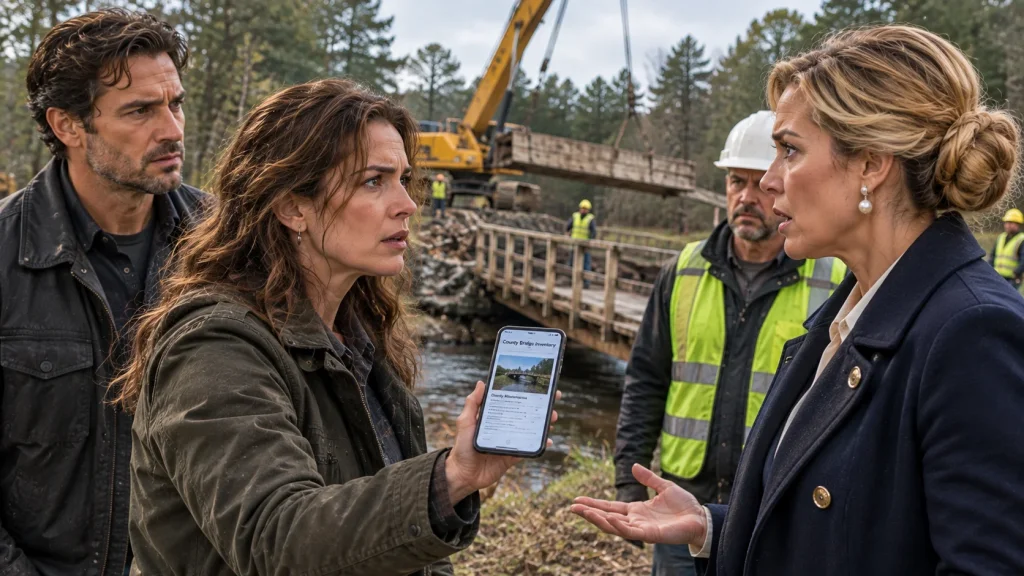
That night, Mara sat at her kitchen table and wrote the document that would destroy the version of the story she most wanted people to believe.
The first sentence was simple.
I possessed the county bridge inventory before the Lakeside Pines HOA authorized demolition.
She stared at it for a long time.
Deleting those words would have been easy.
Instead, she kept typing.
She described how Cynthia first announced the removal project, how Mara challenged ownership, and how the contractor repeatedly warned that board approval was not proof of authority. She included the revised authorization Cynthia signed after being told verification was still outstanding.
Then Mara documented her own decision.
She had county information that could have triggered an immediate ownership check.
She deliberately withheld it.
Not because she believed the record was irrelevant.
Because she wanted Cynthia to be forced to discover the limits of her authority herself.
Mara attached the inventory, emails, temporary-access agreement, contractor correspondence, and every document she possessed.
Then she sent the package to the full HOA board, county public works staff, the contractor, and every household directly affected by the closure.
Daniel appeared at her driveway that afternoon carrying a printed copy.
“Tell me I misunderstood this.”
“You didn’t.”
“I asked you whether you had something that could stop them.”
“I know.”
“You let me think you were still investigating.”
Mara started to explain that technically she had never lied.
The argument sounded pathetic before it reached her mouth.
“I should have told you.”
Daniel looked toward the barriers around the bridge.
“You used something everybody relied on as leverage in your fight with Cynthia.”
Mara swallowed.
“Yes.”
The honesty did not make Daniel less angry.
If anything, it made the betrayal more real.
“My wife needed that crossing.”
“I paid for the temporary route because—”
“That isn’t the point.”
“I know.”
Daniel folded the chronology.
“You wanted Cynthia to learn a lesson.”
“Yes.”
“And now everybody gets the lesson.”
He walked away.
An hour later, Cynthia arrived.
She held the same document.
“You wrote this as if I knowingly destroyed county property.”
“No. I wrote that the contractor warned you ownership wasn’t established and you signed anyway.”
“And you knew the county had records.”
“That’s in there too.”
Cynthia looked almost offended by Mara’s refusal to defend herself.
“You realize the board may try to assign part of the cost to you.”
“They can examine whatever they need to.”
“You think admitting your mistake makes mine worse.”
“No.”
Mara looked directly at her.
“I think both mistakes belong in the same record.”
That stopped Cynthia.
For months, they had treated the conflict like a contest in which only one person could be wrong.
The destroyed bridge had made that impossible.
The emergency board meeting took place four days later.
Every chair was occupied.
Several residents stood along the walls.
Daniel sat near the back.
Cynthia opened the meeting by explaining why the board had acted. The bridge was old. The railing had deteriorated. Insurance questions were unresolved. Residents had complained about liability.
“No one intended to destroy county property,” she said.
That was probably true.
A director named Raymond Cole turned toward her.
“Were you warned before demolition that ownership had not been established?”
Cynthia looked down at the contractor’s paperwork.
“Yes.”
“Did the contractor recommend postponement?”
“Yes.”
“And you signed the revised authorization?”
“Yes.”
Raymond then looked at Mara.
“You possessed the county inventory?”
“Yes.”
“Before the original agreement?”
“Yes.”
“Before the revised authorization?”
“Yes.”
“Before demolition?”
Mara felt Daniel watching.
“Yes.”
“Why didn’t you provide it?”
“Because I wanted Cynthia to verify ownership herself.”
The room became completely still.
Mara continued before anyone could rescue her with a softer interpretation.
“I thought if I handed her the answer, she would dismiss the underlying problem—that the board kept acting first and establishing authority later. I wanted her to be forced to confront that.”
A woman near the front spoke.
“So you knew the bridge might be county property and let them remove it?”
“Yes.”
Cynthia leaned toward the microphone.
“That is what I have been saying.”
Mara turned toward her.
“And the contractor warned you without needing anything from me.”
Cynthia’s expression hardened.
“I was trying to address a safety problem.”
“And I was trying to prove you were overreaching. We can both explain why we did what we did. The bridge is still gone.”
For the first time all evening, nobody interrupted.
The board spent two hours examining the chronology.
They could not determine legal liability. That would require attorneys, insurers, the contractor, and the county.
But they could establish facts.



