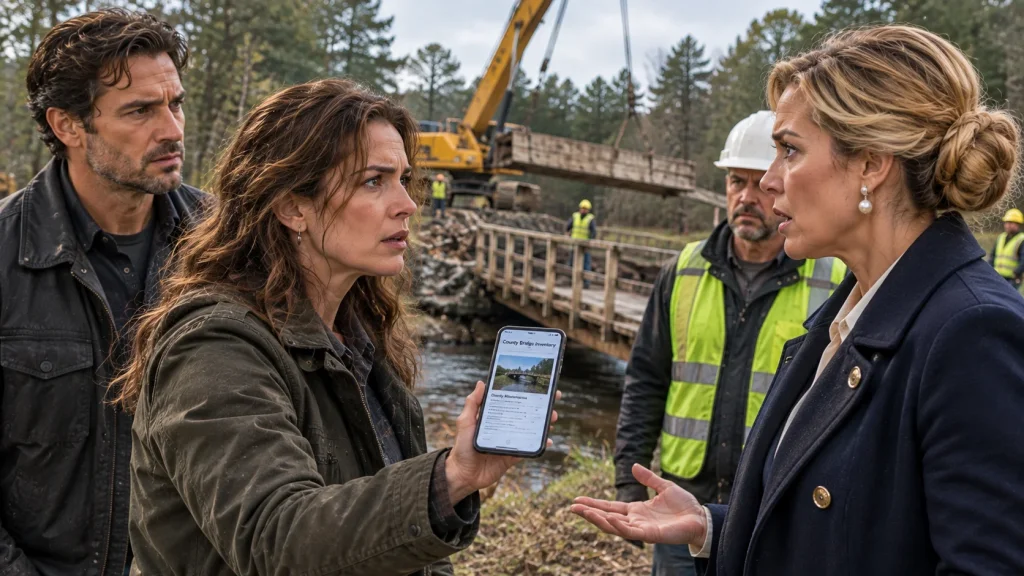
“If conflicting ownership evidence appears, we stop,” the supervisor said.
“I understand,” Cynthia replied.
Saturday morning, the crew arrived.
Mara stood beside her driveway with the county record open on her phone.
The first decking boards came loose.
She could still walk over.
She did not.
A crane lifted the first major timber section.
The bridge became unusable.
Then the worker beneath the railing called out.
“Stop work!”
The machinery fell silent.
Cynthia crossed the gravel.
“What happened?”
The worker turned an old metal plate toward her.
Stamped across it were a county identification number and the words:
**COUNTY BRIDGE PROPERTY — PUBLIC WORKS DIVISION**
Cynthia stared.
Then the contractor looked at Mara’s phone.
“What are you holding?”
Mara felt every eye turn toward her.
She finally held out the county inventory.
Cynthia read the screen.
Her face went pale.
“You had this?”
“Yes.”
“Since when?”
Mara looked at the missing section of bridge.
“Before you signed the contract.”
For several seconds, Cynthia said nothing.
Then she asked the question Mara had spent three weeks waiting to hear.
“You knew—and you let us tear it down?”
Mara had imagined that moment a dozen times. In every version, Cynthia finally realized she had overstepped her authority, and Mara felt vindicated.
Standing beside the broken bridge, there was no satisfaction.
“I told you to verify ownership,” Mara said.
Cynthia stared at her. “You had the county record.”
“Yes.”
“You could have stopped this.”
“I could have shown it to you.”
“Why didn’t you?”
Mara looked toward the crane.
“Because I wanted you to prove you had the authority you kept claiming.”
Daniel Mercer arrived minutes later and stopped beside the barriers.
His face changed when he saw the open span.
“They actually demolished it?”
Then he noticed Mara and Cynthia.
Daniel had already used the temporary lane Mara arranged for his wife’s appointment, but the bridge had served the neighborhood for years.
He looked at Mara.
“You knew the county might own it?”
Mara could have blamed Cynthia.
She could have mentioned the contractor’s warnings.
Both were true.
“Yes.”
Daniel’s jaw tightened.
“And you let it happen.”
Mara did not deny it.
The county arrived that afternoon and confirmed the bridge was its property. Work stopped immediately, but too much had already been removed for the crossing to reopen.
The HOA still owed $7,400 for demolition and stabilization.
Then Cynthia emailed residents describing the disaster as an “ownership misunderstanding.”
She mentioned neither the contractor’s warnings nor her signed authorization.
Mara printed the notice and confronted her.
“You left out what happened.”
Cynthia looked up.
“And you left out the evidence until after the bridge was destroyed.”
Mara paused.
Then she nodded.
“You’re right.”
Cynthia clearly had not expected that.
“So I’m writing the complete chronology,” Mara said. “Your warning. Your authorization. My silence. Everything.”
Cynthia leaned back.
“You understand that could make you responsible too.”
Mara looked through the office window toward residents now forced onto the longer road.
“Yes.”
Then she said the one thing she should have said weeks earlier.



