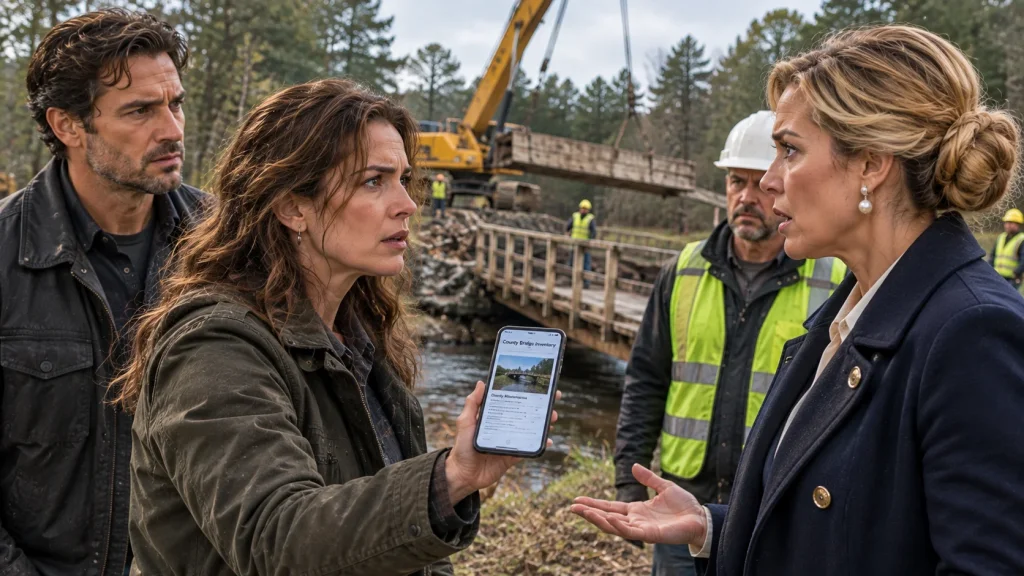
The final resolution stated that Lakeside Pines commissioned removal of a county-owned bridge before completing ownership verification; the contractor had raised an explicit concern; Cynthia signed an authorization allowing preparations to continue; Mara possessed relevant county information and intentionally withheld it; and the contractor’s own duties remained subject to separate review.
The resolution replaced Cynthia’s earlier “ownership misunderstanding” notice as the association’s official account.
Cynthia requested that the original safety concerns be included.
They were.
She requested that Mara’s withholding of information remain explicit.
It did.
Then Cynthia voted in favor.
The resolution passed.
Nobody applauded.
Afterward, Cynthia found Mara near the door.
“Did you get what you wanted?”
Mara looked down at the adopted record.
“No.”
“What did you want?”
“For you to admit the board didn’t automatically have authority because it voted.”
Cynthia glanced toward the dark bridge approach outside.
“And was it worth it?”
“No.”
That was the first conversation they had ever finished without trying to win.
The county’s assessment arrived weeks later.
Replacing the crossing would cost approximately $48,000.
The county agreed to fund half because the structure was part of its system and had already needed future rehabilitation.
The HOA accepted responsibility for the other $24,000 as part of the negotiated restoration agreement.
Insurance eventually contributed $10,000 toward the association’s share.
That left $14,000.
Lakeside Pines funded part from reserves and approved a limited assessment for the remainder under its governing procedures.
The earlier $7,400 demolition and stabilization bill remained separate.
When Mara opened her assessment notice, she stared at the number.
It was not financially devastating.
That almost made it worse.
Every household was paying something because two women had decided proving a point mattered more than preventing a bad outcome.
Mara had already spent $1,600 securing the temporary lane.
She contributed another $900 toward documented transportation expenses for residents who had been forced to change work, school, or medical arrangements.
Daniel helped distribute the reimbursement information.
He did not thank her.
Mara did not expect him to.
Accountability was not a vending machine where money went in and forgiveness came out.
County engineers designed the replacement crossing.
This time, every ownership record was checked before anyone touched a board.
Every permission was documented.
Every funding responsibility was written down.
The temporary private lane remained available under its limited agreement but never became a permanent easement.
Mara was strangely pleased about that.
After everything that had happened, boundaries mattered more to her than ever.
Not as weapons.
As clarity.
Cynthia completed the remainder of her term as HOA president.
She chose not to run again.
Some residents wanted her removed immediately. Others argued that she had served for years and made one catastrophic decision in a difficult situation.
Mara stayed out of that debate.
Cynthia did not need Mara engineering another consequence for her.
The board adopted a new project policy instead.
Before the HOA could repair, remove, modify, or commission work on infrastructure whose ownership was not unquestionably inside association property, staff had to obtain documented ownership verification and required permissions.
Board approval alone would no longer be treated as authority.
Cynthia supported the policy.
Mara attended that meeting.
She said nothing.
Six months after demolition, the replacement bridge was ready.
The new crossing looked different from the old one. Fresh treated timbers. Stronger railing. Improved drainage around the approach. A visible county maintenance plate stood beside the entrance where nobody could miss it.
Mara arrived early on reopening morning.
Daniel was among the first residents to drive across.
His car slowed beside her.
For a second, Mara thought he might stop.
He gave her a small nod.
She returned it.
That was all.
She had learned not to demand closure from people she had hurt.
Cynthia stood on the opposite side of the bridge beside her car.
Their eyes met.
Neither woman walked toward the other.
Mara stepped onto the new deck.
The creek below looked exactly as it always had.
Water moved around stones.
Leaves collected against one bank.
Nothing about the creek cared who had been president, who had been right about ownership, or who had withheld an email attachment.
Mara rested one hand on the railing.
Three months earlier, she had believed responsibility meant forcing powerful people to face the consequences of acting without authority.
She still believed that.
What she had failed to understand was that preventing harm sometimes mattered more than proving who would cause it.
Cynthia should have stopped after the contractor warned her.
Mara should have shown the county record.
The contractor should have refused demolition until ownership was verified.
Different responsibilities did not cancel one another.
That was the lesson the board eventually put into policy.
It was also the lesson Mara carried with her every time she crossed the bridge.



