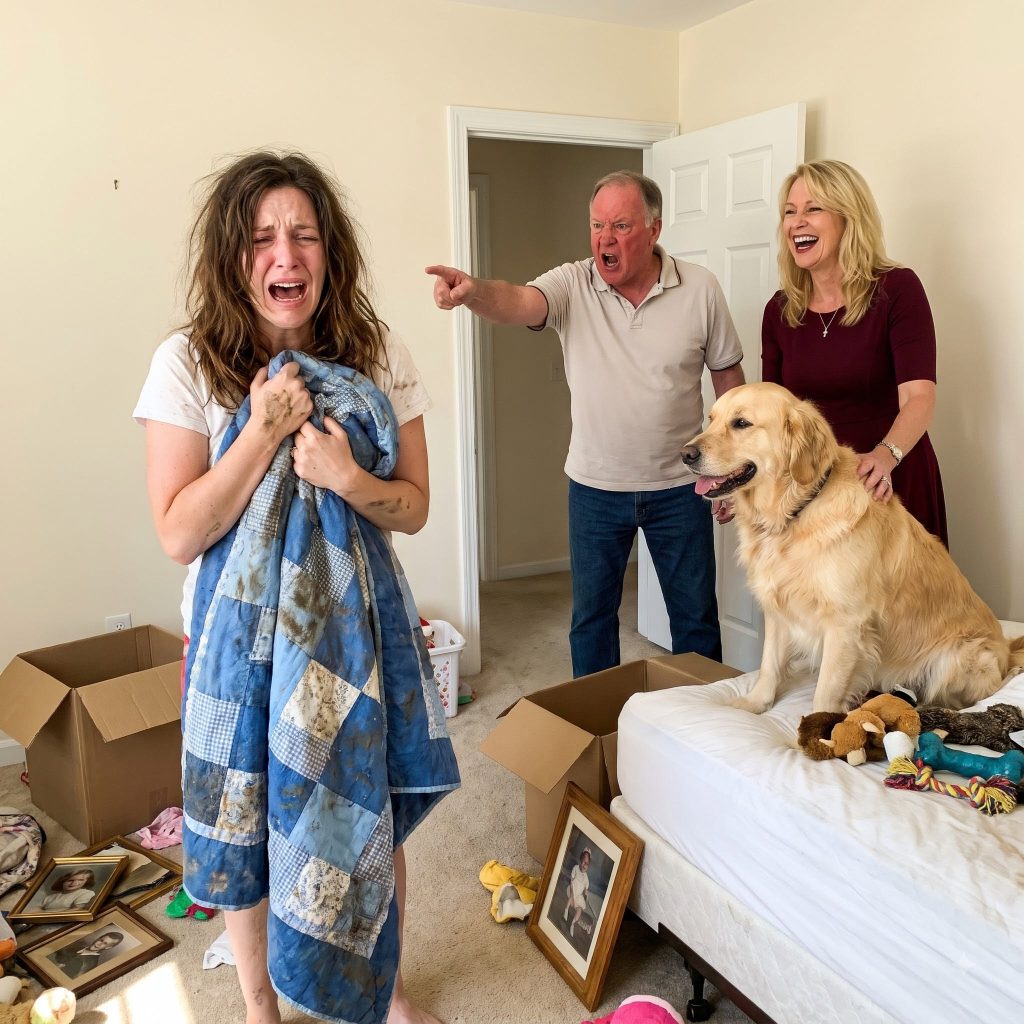
“GET OUT! THAT DOG BELONGS HERE MORE THAN YOU!”
My father screamed so loudly that the golden retriever jumped off my childhood bed.
I stood frozen in the doorway.
Six years. I’d been gone six years, and my bedroom was now a luxury dog suite.
A velvet dog bed sat beside my old dresser. My mother’s handmade quilt was covered in muddy paw prints.
“Dad, that’s Mom’s quilt!”
His new wife, Patricia, laughed.
“Oh, please. She’s been dead four years. It’s just fabric.”
I turned toward her.
“Don’t talk about my mother.”
Dad stepped between us.
“Watch your mouth, Emily. Patricia lives here. You don’t.”
I’d driven nine hours to Ohio because he’d called, saying he wanted to fix things.
Now I understood.
He wanted me to collect my belongings before Patricia renovated the room.
“Where are my things?” I asked.
“Garage,” she replied. “Whatever we didn’t donate.”
My stomach dropped.
“Mom’s sewing machine?”
“Gone.”
“Her photographs?”
“Probably trash.”
I looked at Dad.
He didn’t even blink.
“You always were dramatic,” he muttered.
I wanted to scream. Instead, I grabbed my suitcase and walked downstairs.
In the garage, my childhood belongings sat in three damp cardboard boxes.
Then I noticed something strange.
Behind an old workbench was Mom’s blue wooden keepsake box.
The one she’d never let anyone touch.
Its brass lock was broken.
Inside were birthday cards, photographs, and letters addressed to me.
Dozens of letters.
All unopened.
All written after I’d moved away.
My hands shook as I opened the first.
Emily, please call me. Your father says you don’t want to speak to me, but I can’t believe that.
I couldn’t breathe.
Dad had told me Mom didn’t want contact.
I opened another.
Then another.
Every letter ended the same way.
I love you. Please come home.
At the bottom lay a hospital envelope.
Across it, in Mom’s handwriting, were four words:
“If Emily ever returns…”
I pulled out the paper.
And saw my father’s signature.
But the hospital envelope held something worse than the letters. It explained why Dad had kept me away during Mom’s final months.
The document was a hospital discharge form dated seven months before Mom died.
Under Patient’s Emergency Contact, someone had written my name and phone number.
Then crossed them out.
Beside the correction was Dad’s signature.
Below it, a handwritten note read:
Family reports daughter is estranged. Do not contact.
I stared at those words.
My mother hadn’t abandoned me.
She’d been asking for me.
“WHAT ARE YOU DOING IN HERE?”
Dad stood in the garage doorway.
He saw the letters.
His face changed.
“Give me that box.”
“YOU TOLD ME SHE HATED ME!”
He rushed forward, but I pulled it away.
“Emily, you don’t understand!”
“Then explain why she wrote forty-three letters I never received!”
Patricia appeared behind him.
Her smile vanished.
“Richard,” she whispered. “You said you destroyed those.”
The garage went silent.
Dad turned toward her.
“SHUT UP!”
I felt sick.
“You both knew?”
Patricia folded her arms.
“Your mother was exhausting. Always crying about you.”
I stepped toward her.
“Say one more word about her.”
Dad grabbed my shoulder.
“Enough! Leave my house!”
I shook him off.
“Why didn’t anyone tell me she was dying?”
He looked away.
“Because you would’ve made everything harder.”
Something inside me shattered.
I remembered calling every birthday, every Christmas.
Dad always answered.
Your mother isn’t interested, Emily.
Eventually, I stopped trying.
And now she was gone.
I took the box to my car.
But before leaving, I found one more envelope tucked beneath its lining.
Inside was a photograph.
Mom sat in a wheelchair beside a woman wearing a home-care agency badge.
Patricia.
The photograph was dated eleven months before Mom’s death.
Dad had told me he’d met Patricia two years afterward.
I turned it over.
Mom had written:
Patricia says Emily won’t come. I don’t believe her.
My knees buckled.
Patricia hadn’t simply married my father.
She’d helped care for my mother.
I was still staring at the photograph when someone knocked on my car window.
An elderly woman stood outside.
I recognized her immediately.
Mrs. Bennett, our neighbor.
She glanced nervously toward Dad’s house.
“Emily, honey, I saw your car.”
“Did you know?”
Her eyes filled with tears.
“I tried to tell you.”
“Tell me what?”
She pulled a folded paper from her coat.
“Your mother asked me to keep this. She said your father couldn’t be trusted with it.”
It was a handwritten statement, dated three weeks before Mom died.
At the bottom were two signatures.
Mom’s.
And Mrs. Bennett’s.
I read the first paragraph.
Then looked up, shaking.
“Why didn’t you send this to me?”
Mrs. Bennett began crying.
“Because I sent a copy to the address your father gave me. He told me you’d signed for it.”



