I looked at the statement again.
Mom had written that Patricia repeatedly claimed I refused to visit.
But its final sentence stopped my heart:
“If Emily comes back, tell her to find the blue quilt. I put the truth where Richard would never think to look.”
I slowly turned toward the house.
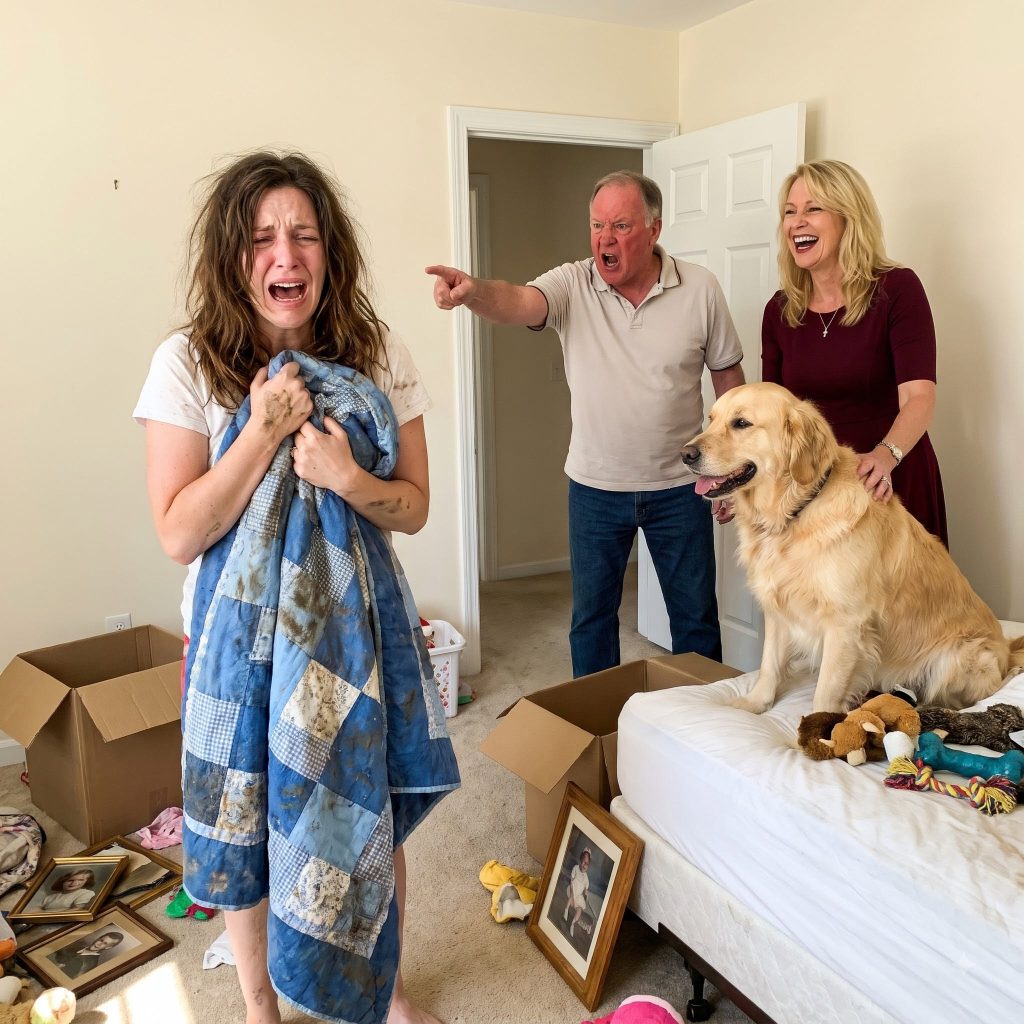
The quilt was still upstairs.
Under Patricia’s dog.
And Dad had just locked the front door.
“Emily, don’t go back inside alone.”
Mrs. Bennett caught my arm as I reached for the car door.
“Your father is frightened,” she said. “And frightened people do foolish things.”
“Why would he be frightened of a quilt?”
She looked toward the upstairs window.
“Because your mother stopped trusting him long before she died.”
I felt the blood drain from my face.
Mrs. Bennett explained that Mom had begun keeping records during her final year. She knew someone was keeping us apart, but her health was failing.
“Why didn’t you call me yourself?” I whispered.
“I tried, sweetheart. Your father gave me a number that didn’t work. Your mother finally wrote your real number down, but by then she could barely hold a pen.”
I looked at the house.
For six years, I’d blamed myself for leaving.
Now I wondered how much of that guilt had been carefully manufactured.
I called Dad.
“Put Mom’s quilt outside.”
“Absolutely not.”
“It’s covered in dog hair, Dad. Patricia clearly doesn’t want it.”
He laughed bitterly.
“You think you can show up and start making demands?”
“I’m asking for something that belonged to my mother.”
“Then ask nicely.”
I gripped the steering wheel.
“Please.”
He hung up.
Ten minutes later, the front door opened.
Patricia marched onto the porch carrying the quilt.
She hurled it onto the wet driveway.
“THERE! TAKE YOUR FILTHY BLANKET!”
Dad stood behind her.
He watched silently.
I ran toward the quilt, scooped it up, and held it against my chest.
It still smelled faintly of Mom’s lavender soap.
That was when I finally broke down.
I cried so hard Mrs. Bennett had to guide me back to my car.
At her kitchen table, we examined the quilt.
Mom had sewn it from pieces of old family clothing.
My childhood dresses.
Dad’s work shirts.
Her favorite blue apron.
Mrs. Bennett pointed toward a square near the bottom.
“That’s new.”
The stitching was uneven, unlike Mom’s usual careful work.
I gently opened the loose seam.
Inside was a small plastic pouch.
There were handwritten pages, a folded photograph, and a tiny flash drive.
My hands began trembling again.
The first page was dated nine months before Mom died.
Richard says Emily hates me. Patricia says she’s protecting me from disappointment. But I know my daughter.
I covered my mouth.
The next page was worse.
Patricia told the nurse Emily refused to visit. I heard her. I tried to speak, but Richard told everyone I was confused.
I read the entire diary through tears.
Mom described unanswered requests for telephone calls, missing letters, and repeated arguments with Dad.
Then I reached a page that changed everything.
Richard says Patricia cannot lose her job. He says if I complain, the agency will investigate. I don’t know what they’ve done.
I looked at Mrs. Bennett.
“What job?”
“Patricia worked for your mother’s home-care agency.”
I stared at her.
“Dad hired her?”
“No. The agency assigned her.”
And suddenly, the photograph made sense.
The flash drive contained scanned care schedules, visit records, and several short audio recordings Mom had made on an old digital recorder.
One recording captured a conversation.
Mom’s weak voice was unmistakable.
“I want Emily.”
Then Patricia.
“Richard already explained. She doesn’t want to see you.”
“You’re lying.”
“Stop upsetting yourself.”
A man’s voice entered.
Dad.
“Just leave it alone, Helen.”
My mother began crying.
“She’s my baby.”
I stopped the recording.
I couldn’t listen anymore.
Mrs. Bennett put her arm around me.
“Your mother loved you until her last breath.”
For the first time in six years, I believed it.
But the records also raised a troubling question.
Several home-care visits were marked completed on days Mom’s diary said nobody came.
Some forms carried Patricia’s initials.
Others carried Dad’s signature.
It wasn’t enough to prove wrongdoing.
But it was enough to demand answers.
The following Monday, I contacted the home-care agency.
I brought the documents, Mom’s diary, and the recordings.
The director listened carefully.
Then she said something unexpected.
“Emily, your mother filed a complaint before she died.”
My heart stopped.
“What happened to it?”
“We reviewed the information available then. We were told your mother withdrew it.”
“Who told you?”
She glanced at the file.
“Your father.”
I sat motionless.
The director continued.
“The matter may need further review.”
I left copies of everything with her.



