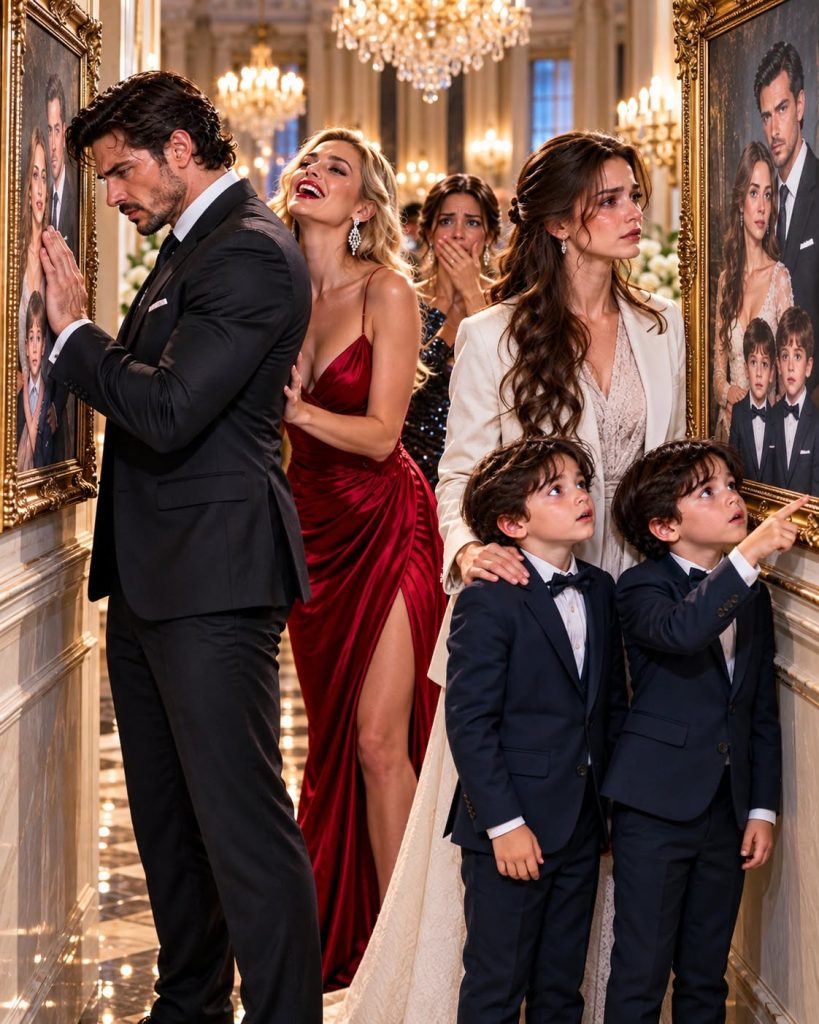
He stood tall on his small wooden step-stool, his dark eyes meeting Daniel Whitmore’s gaze with a calm, steady, seven-year-old clarity that was more devastating than any courtroom verdict could ever be.
“My father lives in Vermont,” Arthur said, his voice quiet, clear, and ringing through the vault like a church bell. “My father is the man who taught me how to clean the brushes, and he doesn’t leave his family when the winter comes.”
He reached out, took Beatrice’s hand in his, and looked up at me.
“Mommy,” Arthur asked softly. “Can we go home now? Barnaby needs his walk before the lake gets dark.”
I looked down at my two children—the two whole, beautiful, uncorrupted human beings who had been born out of a lie and had grown into the truth.
“Yes, my loves,” I whispered, smiling down at them with an incandescent, unshakeable joy that filled every corner of my soul. “We’re going home.”
I took their hands.
We walked past Daniel, still kneeling in the dust of his ruined empire; past Vanessa, sobbing in the corner; past Margaret Whitmore, whose ancient name was now nothing more than a footnote in an indictment of grand larceny.
We stepped through the heavy steel doors into the bright, clean afternoon sunlight of Boston.
The legal dismantling of the Whitmore dynasty concluded fourteen months later with the swift, crushing efficiency of an iron press.
Under the forensic evidence provided by my multi-spectral scans and the uncorrupted Quest Diagnostics laboratory records, the New York State Supreme Court declared the 1974 conveyance of the Whitmore estate void ab initio.
Whitmore Holdings was forced into court-ordered liquidation.
Donald Price was indicted by a federal grand jury for wire fraud, corporate forgery, and tax evasion, his hotel empire collapsing into bankruptcy before his trial even commenced.
Vanessa Price Whitmore was stripped of her claims to the family trust, her marriage to Daniel dissolved in a bitter, public annulment proceeding that left her with nothing more than her legal bills and an apartment in New Jersey.
Dr. Martin Shaw surrendered his medical license forty-eight hours before the state disciplinary board convened, spending his remaining years in disgraced obscurity in Florida.
Daniel Whitmore was removed from every corporate board in North America.
He was allowed to keep a small, court-supervised stipend from the remnants of his grandfather’s personal pension, living in a modest, rented cottage on the outskirts of Albany, spending his afternoons sitting on his porch, watching the traffic on the interstate, holding an old photograph of an art conservator who had once loved him before he learned to worship gold.
He was granted supervised visitation rights twice a year at a family center in Montpelier, but after the second meeting—where Arthur spent forty minutes reading a biology textbook and Beatrice politely declined his offer of a diamond bracelet, telling him that “metal doesn’t make things beautiful unless you work it yourself”—he stopped driving north.
The court awarded eighty percent of the restructured ancestral Whitmore land trust to Arthur Vance Whitmore and Beatrice Vance Whitmore, placed into an independent, irrevocable foundation managed exclusively by Dr. Evelyn Hayes and me until their twenty-fifth birthdays.
We did not keep the money for ourselves.
We used the capital to establish the Eleanor Vance Memorial Trust for Historical Restitution, funding independent forensic laboratories at museums across the world, ensuring that no wealthy family could ever again use a palette knife to erase the truth from a historical canvas.
And Eleanor in Rose and Silver?
We did not sell her to Zurich. We did not sell her to Abu Dhabi.
I spent seven months in my Church Street studio in Burlington, working with my micro-scalpels, my solvent gels, and my binocular loupes, systematically removing every millimeter of Donald Price’s synthetic acrylic overpaint.
I removed the false mahogany sill.
I removed the synthetic varnish.
I brought the little boy in the velvet tunic back into the sunlight.
Today, the canvas hangs in the grand rotunda of the National Gallery of Art in Washington, D.C., displayed under the title John Singer Sargent had written in his private diary in 1898:
THE TRUE HEIR: ELEANOR WHITMORE AND HER SON JULIAN.
On a golden afternoon in early June, eight years after the day I walked out of the Manhattan penthouse, the air in Burlington smelled of blooming lilacs, damp stone, and the clean, sweet water of Lake Champlain.
The studio was filled with music—a Bach cello suite playing softly from the old speakers on the windowsill.
Arthur, now eight and a half, was standing before an easel, expertly stretching a piece of Belgian linen over an ash frame, his movements steady, rhythmic, and masterly.
Beatrice was sitting cross-legged on the wide pine floorboards with Barnaby’s head resting in her lap, using a quill pen to sketch the contours of an apple in walnut ink.




