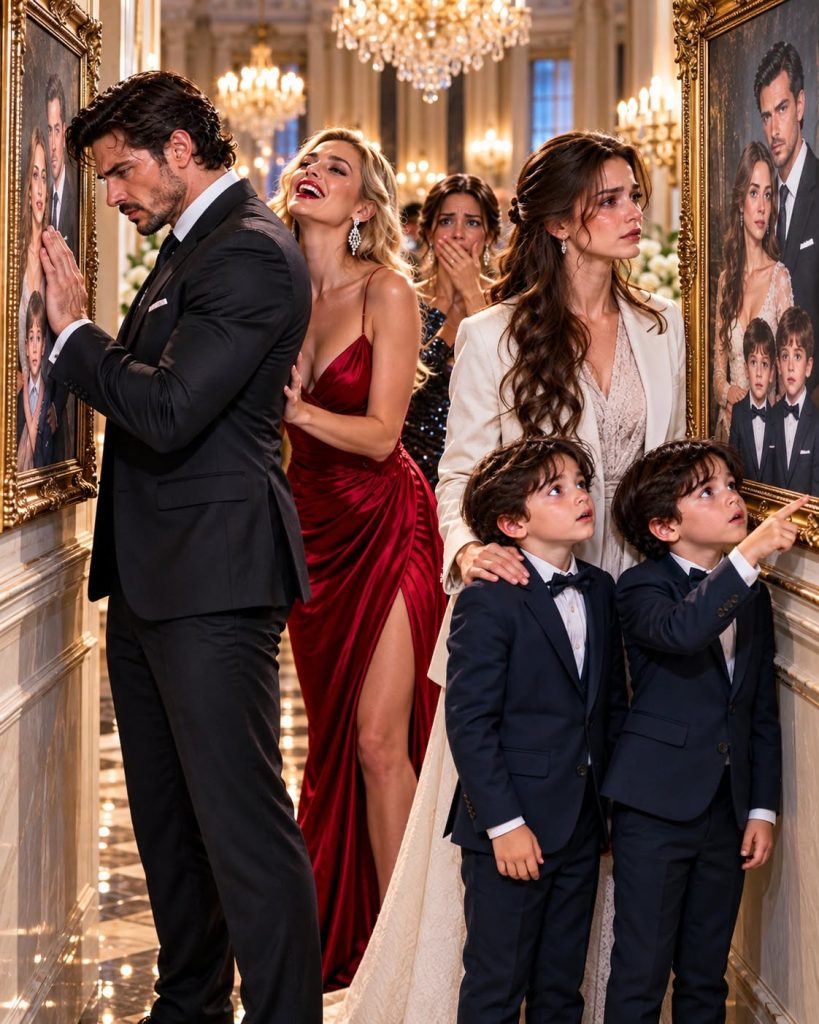
“No NDAs required, Claire. Only your eyes. An extraordinary consignment has just landed on our desk for the November marquee auction. A private estate sale. An unrecorded masterpiece by John Singer Sargent.”
My fingers tightened around the telephone receiver. “An unrecorded Sargent? That’s impossible. His catalogue raisonné has been closed for thirty years. Every canvas from his Paris and London periods has been accounted for.”
“Not this one,” Julian said, his voice dropping into a breathless, conspiratorial whisper. “It has been held in a private, single-family vault in Locust Valley since nineteen twenty-eight. It was commissioned directly from the artist by an industrialist during Sargent’s second visit to Boston. A full-length portrait of a matriarch standing beside an open casement window, holding a crystal locket.”
The room seemed to lose its oxygen in a single, freezing second.
Locust Valley.
A matriarch with a crystal locket.
“What is the title of the work, Julian?” I asked, my voice terrifyingly calm.
“On the gallery insurance manifest, it is listed as Portrait of Eleanor in Rose and Silver,” Julian replied. “Consigned by the estate holding company of Whitmore International. Specifically, by Mrs. Margaret Whitmore and her daughter-in-law, Mrs. Vanessa Price Whitmore.”
I looked across the studio.
Beatrice was laughing, using a damp sponge to wipe a stray smudge of raw sienna from her brother’s cheek, while Arthur methodically organized their colored pencils into neat rows of primary and secondary shades.
Eleanor in Rose and Silver.
I had heard Margaret Whitmore speak of that painting a hundred times.
It was the mythological centerpiece of the Whitmore family pride—the portrait of Daniel’s great-grandmother, Eleanor Whitmore, painted in London in 1898. According to family lore, Sargent had declared Eleanor the most exquisite aristocratic profile he had ever captured on American soil.
The painting had hung in the grand dining room of the Locust Valley manor for ninety years. When Daniel and I were married, Margaret had refused to allow our wedding photographs to be taken in front of it. “That canvas represents four generations of untainted Whitmore blood, Claire,” she had declared over a glass of dry sherry. “We don’t pose commoners beside our ancestors.”
“Why are they selling it, Julian?” I asked, my heart thudding a heavy, measured rhythm against my ribs. “The Whitmores would rather sell their kidneys than an ancestral Sargent.”
Julian sighed—a long, dry, theatrical sound. “Between us, Claire? Whitmore Holdings is bleeding capital. Their commercial office towers in Midtown are forty percent vacant. The merger with the Price Group didn’t produce the liquidity they anticipated because Donald Price’s hotel developments in Miami are tied up in federal environmental litigation. The board needs ninety million dollars in fresh cash before the fourth-quarter bond maturities in December, or the rating agencies will downgrade their debt to junk status.”
“And the Sargent?”
“Christie’s has guaranteed an opening estimate of thirty-five million dollars,” Julian said. “With private bidding from two sovereign wealth funds, it could clear sixty million. But there is a complication.”
“What complication?”
“The buyer’s consortium—a private museum trust in Zurich—has made the sale contingent upon a complete, forensic provenance and condition authentication. There are rumors in the market that the canvas underwent an undocumented restoration in the late nineteen-seventies after a chimney fire at the estate. The family claims the painting is entirely original and untouched. The Zurich group wants an independent X-ray fluorescence analysis, pigment chromatography, and micro-stratigraphy verification before they wire the deposit.”
Julian paused, clearing his throat.
“I need you, Claire. You are the only conservator on the Eastern Seaboard whose pigment dating on Sargent’s lead-tin yellow matrices has been accepted by the National Gallery. I have arranged for the canvas to be transported under private armored security to our specialized inspection facility in Boston next Monday. I want you to spend seventy-two hours with it. Give me an unimpeachable condition report, and Christie’s will write you a check for seventy-five thousand dollars.”
I stood up, walked to my casement window, and looked down at the cold, sparkling waters of Lake Champlain.
Seventy-five thousand dollars was five years of tuition for Arthur and Beatrice at the private laboratory school in Burlington.
It was absolute financial sovereignty.
But it was more than that.
A chimney fire in the nineteen-seventies.
I remembered something Daniel’s father, old Thomas Whitmore, had whispered to me on the terrace in Locust Valley when he was dying of Parkinson’s, his mind drifting between decades: “The fire didn’t start in the chimney, Claire. The fire started in the library. Margaret’s father brought the kerosene into the house because the truth was written under the oil.”
At the time, I had assumed it was the hallucination of an old man whose brain was being devoured by neurodegeneration.
Now, looking at the clear Vermont light, I knew it wasn’t.




