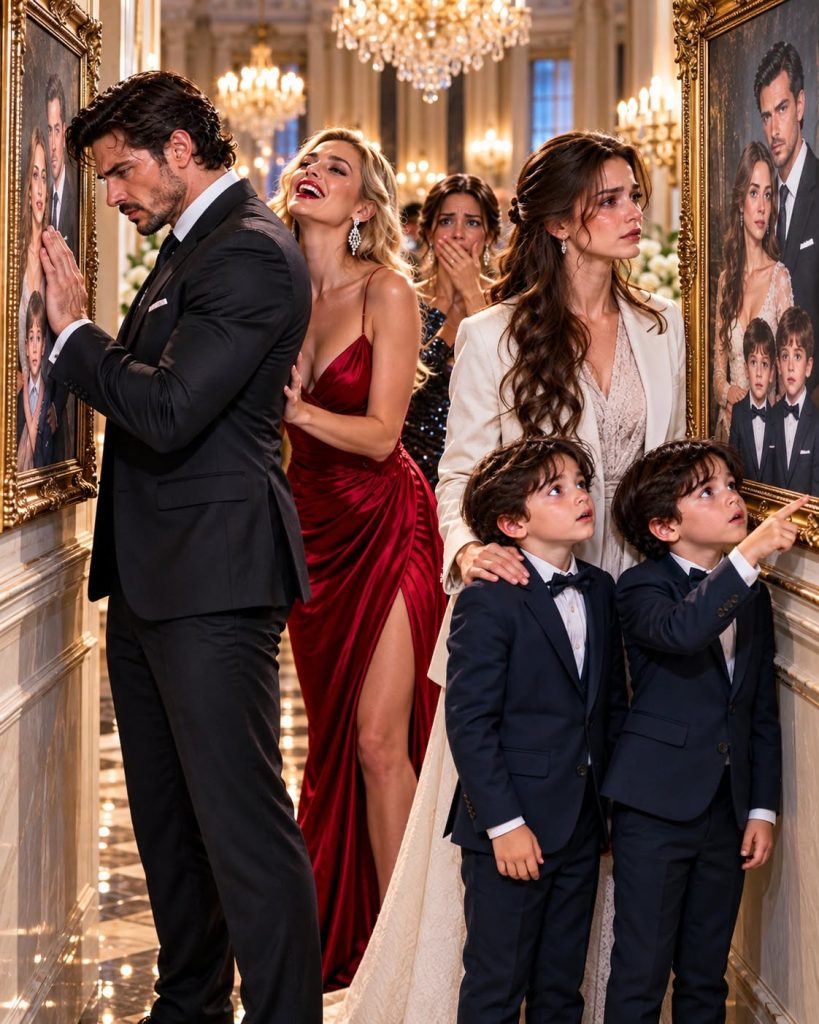
“There is an encrypted clinic in Burlington, Vermont,” Dr. Hayes said softly. “The director was my chief resident at Johns Hopkins. They operate outside the New York health exchange. If you go there, your prenatal records will never appear in any database accessible to a private investigator.”
I took the folder. The paper was warm against my ribs.
“Thank you, Evelyn.”
“What are you going to do, Claire?”
I stood up, pulling my wool coat tightly around my frame, feeling the two tiny, impossible lives thrumming beneath the fabric.
“I am going to let Daniel Whitmore believe he won,” I said. “I am going to let him marry Vanessa Price. I am going to let his mother celebrate her new billionaire daughter-in-law. And then, when the time is right, I am going to tear their entire kingdom down to the foundation stones.”
Chapter 2 – The Art of DisappearanceThe train ride north along the Hudson River was a transition between two different realities.
Outside the window of the Amtrak regional coach, Manhattan’s jagged limestone towers surrendered to the gray, winter-stripped bluffs of the Palisades, then to the wide, frozen expanse of the Tappan Zee, and finally to the dense, pine-covered ridges of the Green Mountains.
I had left my keys on the granite counter of my old apartment in Greenpoint.
I had closed my bank account at Chase, transferring my modest twelve thousand dollars of independent restoration savings into a credit union in Montpelier under my grandmother’s maiden name: Claire Vance.
I took my laptop, my precision micro-scalpels, my jars of rabbit-skin glue and gum arabic, and my father’s old cedar toolbox. Everything else—the couture dresses Daniel had bought for charity galas, the diamond watch Margaret had given me with the warning “try not to lose it, it belonged to a real Whitmore,” the monogrammed luggage—I left behind in the penthouse closets like the discarded skins of a past life.
In Burlington, winter was not a season; it was an architecture.
The snow sat four feet deep along the shores of Lake Champlain, the wind blowing straight down from the Canadian border smelling of frozen pine, woodsmoke, and cold iron.
I rented a small, second-floor apartment above an antique bookbinder’s shop on Church Street. It had uneven wide-plank pine floors that groaned whenever the wind picked up, a small cast-iron woodstove in the corner, and three tall sash windows that faced north, offering the pure, unshifting indirect daylight that every master conservator needs to match sixteenth-century tempera.
On July 14, seven months after I walked out of the Manhattan penthouse without a dollar of Whitmore money, my children arrived.
It was an uncharacteristically cool summer morning, the lake running in small, blue chop under a pale northern sky.
In the delivery suite of the University of Vermont Medical Center, with Dr. Hayes’s trusted colleague holding my left hand and an elderly midwife rubbing my lower back, they were born seventeen minutes apart.
First came Arthur.
Eight pounds, one ounce. He had his grandfather’s wide, thoughtful brow, thick dark hair that curled against his crown, and hands that were long-fingered and steady from the moment they uncurled in the sterile light.
Then came Beatrice.
Seven pounds, six ounces. She had my hazel eyes, but her jawline—sharp, stubborn, set with an innate, unyielding defiance—belonged unmistakably to the Whitmores. When the nurse laid her across my chest, she didn’t cry; she simply blinked twice, her tiny fingers locking onto the collar of my hospital gown with the grip of a miniature vice.
“Look at them, Claire,” the midwife whispered, wiping the sweat from my temples with a warm lavender cloth. “Two little fighters. What are their names?”
I looked down at the two small, red faces nestled against my collarbones.
“Arthur Vance,” I whispered, kissing the crown of my son’s head. “And Beatrice Vance.”
There was no father listed on the birth certificates.
Under the line marked Father’s Legal Name, I drew a single, clean black line with the hospital ballpoint pen. In the state of Vermont, an unmarried mother exercising her statutory privacy rights could leave the paternal registry blank. To the state of New York, to the board of Whitmore Holdings, and to the social columns of the Wall Street Journal, Daniel Whitmore had fathered only one child: Harrison Whitmore, born to Vanessa Price at New York-Presbyterian five months after their lavish, five-million-dollar wedding at Saint Thomas Church.
For the next seven years, the world forgot Claire Bennett existed.
I did not hide in the dark; I hid in the light of my work.
Conservation is an invisible profession. When an art conservator does her job with absolute, flawless mastery, nobody knows she has touched the canvas. Her brushstrokes do not exist; her varnishes are reversible; her restorations disappear beneath the original hand of the master.




