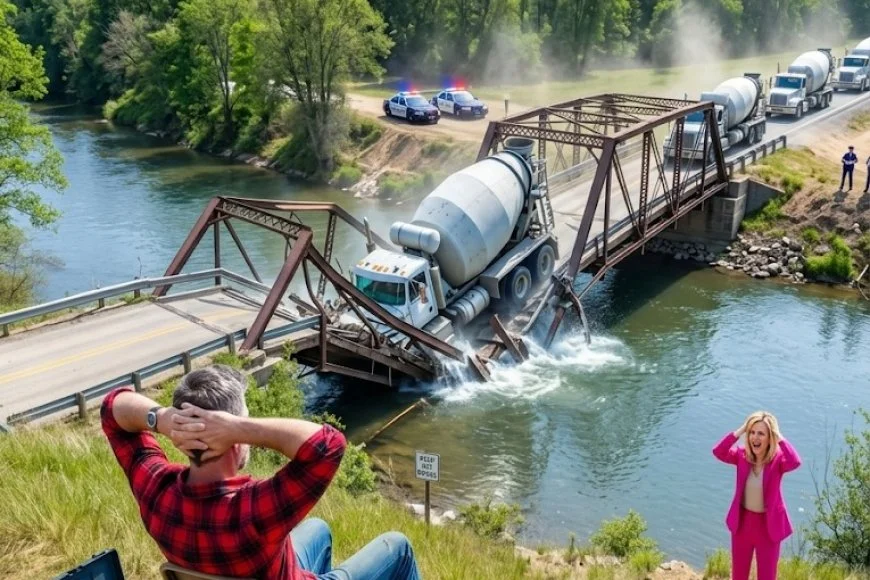
“Get those trucks moving. This bridge belongs to the community now.”
Vivian Pell shouted that from the north end of my bridge while the third concrete truck of the morning rolled onto a span my great-grandfather built in 1898.
I stood on my porch in slippers, holding coffee.
The truck weighed somewhere around forty tons.
The bridge was posted for six.
As the front axle reached the first panel point, I heard a metallic click beneath the timber deck.
Not loud.
Most people wouldn’t have noticed it.
I had spent thirty years as a bridge engineer for the State of New York.
I noticed.
The driver looked through his windshield and gave me an apologetic little wave.
Then he kept going.
Vivian smiled from beside her pearl-colored SUV.
That was when I decided not to argue.
I went inside and opened my data logger.
My name is Everett Ashford. I was fifty-eight, retired four years, and the bridge over Slate Creek had been in my family for four generations.
My great-grandfather Albert bought it from the Berlin Iron Bridge Company in 1898 for $640.
One hundred twelve feet.
Wrought-iron Pratt truss.
Pin-connected eyebars.
Timber deck.
He needed it to move hay between two sections of the farm without fording Slate Creek twice a day.
It carried wagons first.
Then tractors.
Then pickups.
My father once drove a Cadillac across it that had no business being on a farm.
The bridge survived all of them.
What it was never designed to carry was a parade of fully loaded concrete mixers feeding a 148-home luxury development.
That development was called Stonebrook Reserve.
Two years earlier, Pell Construction Group bought the old Garrison farm north of me.
The company belonged to Dalton Pell.
The new HOA president was Vivian Crane Pell.
His wife.
Vivian rarely mentioned that connection when speaking as HOA president.
She preferred “community liaison.”
The trucks began arriving in April.
The first one crossed before seven in the morning.
I called Pell Construction immediately.
“Your driver just crossed a private bridge posted at six tons.”
Vivian returned the call the next day.
“Mr. Ashford, we reviewed the easement.”
“What easement?”
“The 1902 right-of-way serving the property.”
I knew it better than she did.
My great-grandfather had granted his neighbor passage across Ashford Lane and the bridge for wagons, farm wagons, agricultural implements, and machinery used to improve the farm.
Vivian interpreted that to mean construction traffic.
“Our attorneys consider modern vehicles a reasonable evolution of the historic use.”
“Is that what they told you?”
“That is our legal position.”
“Then will the HOA accept responsibility for damage to the bridge?”
Her voice changed.
“We don’t need to become adversarial.”
Forty-seven heavy crossings happened that first week.
By the second, I was counting nearly twenty a day.
Concrete trucks.
Aggregate haulers.
Rebar flatbeds.
Then a lowboy carrying an articulated dump truck.
I watched that load enter the bridge and felt my stomach tighten.
The lower chord deflected visibly.
The deck complained.
When the truck cleared the north end, the wrought iron continued vibrating for several seconds.
That afternoon, I mounted cameras.
One at each approach.
One beneath the bridge.
I installed strain gauges at critical panel points and connected them to a data logger.
Every vehicle crossing created a signature.
Time.
Axle pattern.
Estimated gross load.
Structural response.
I had spent half my career teaching younger engineers that bridges talk.
You just have to know what language they use.
This one was screaming.
Most loaded Pell trucks were running between thirty-six and forty-two tons.
The lowboy was worse.
Then I found the first crack.
Three-quarters of an inch, beginning near a lower-chord pin hole.
Two days later, another appeared.
I called Foster Heath, the county highway superintendent and an old colleague.
He inspected the bridge for an hour.
Then he stood beneath the south truss and said, “Ev, I have to report this today.”
The state reduced the load posting and recommended closure to commercial vehicles pending evaluation.
We installed signs at both approaches.
CLOSED TO COMMERCIAL VEHICLES.
The next morning, Vivian drove around one of them.
By afternoon, her attorneys accused me of manipulating safety rules to interfere with Stonebrook’s construction.
Then the county received political pressure to “reconsider.”
The commercial closure was briefly suspended while an independent review was scheduled.
Pell used that window aggressively.
Twenty-one heavy trucks crossed in forty-eight hours.
My gauges recorded every one.
When Foster returned, two additional areas showed crack propagation.
The closure went back up.
This time, nobody at the county wanted their name attached to lifting it.
Vivian held a press event.
She called me anti-growth.
She called me a bitter retiree.
Then she suggested losing my wife had affected my judgment.
Lyla had been gone three years.
She taught American history for twenty-six.



