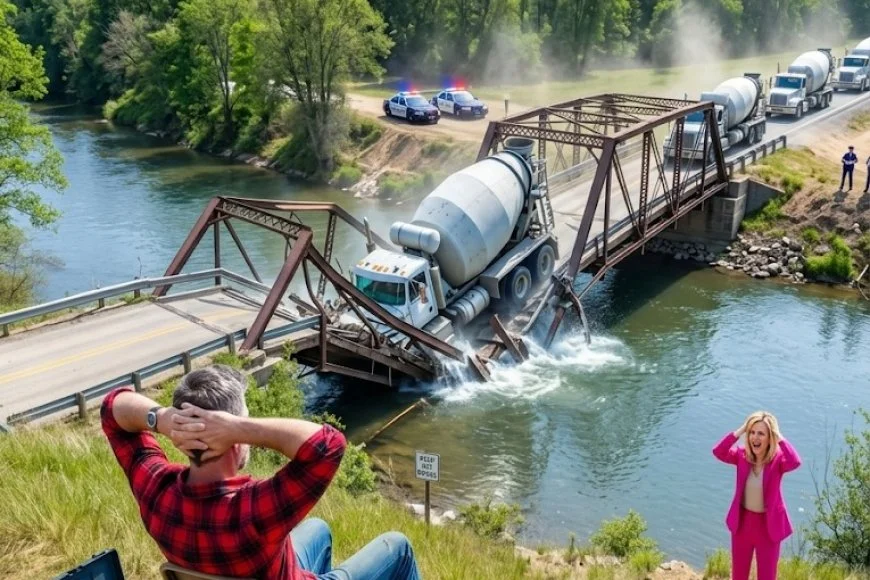
Then the attorney general’s investigator approached.
He asked Vivian to confirm her role as HOA president.
She did.
He asked whether Dalton Pell was her husband.
Her face tightened.
“Yes.”
He asked whether she had participated in HOA decisions selecting the route that financially benefited Pell Construction.
“That is more complicated.”
Hartley opened her folder.
“It really isn’t.”
Minutes from fourteen meetings were inside.
Votes.
Approvals.
Budget notes.
Conflict disclosures that had never been made.
One reporter on the investor tour had started recording.
Dalton Pell arrived from the line of vehicles and whispered something to Vivian.
She brushed him off.
Then she looked at me.
“You planned this.”
I finally came down from the porch.
“No.”
I stopped on my side of the barricade.
“You planned an investor tour over a bridge you had already been told could not safely carry your construction traffic.”
“That easement belongs to Stonebrook.”
“No. The easement benefits the old farm parcel.”
“Which we own.”
“For agricultural access.”
She laughed once.
“You think a court is going to limit a modern subdivision to horse carts?”
“No.”
I pointed toward the bridge.
“I think the court is going to read the deed.”
And that was exactly what happened.
Four months later, the Washington County Supreme Court ruled on the easement.
Stonebrook retained access rights appropriate to the historic grant, but the court found that sustained heavy construction hauling imposed a materially different burden from the agricultural use contemplated in 1902.
Commercial construction traffic was prohibited across the bridge.
Ordinary residential access had to use Stonebrook’s newly built public entrance from the county road.
Pell Construction also faced the damage claim.
Our strain records, video, independent inspections, and Foster’s reports showed that the worst crack growth occurred during the period of repeated overweight use.
The case settled before trial.
Pell funded the bridge restoration, paid my documented engineering and legal costs, and contributed to long-term structural monitoring.
The attorney general’s review produced a separate consent agreement involving Stonebrook’s governance.
Vivian resigned.
The board adopted conflict-of-interest rules.
Future contracts involving board members or relatives required disclosure and independent approval.
Dalton’s company lost the bridge as a haul route and had to bring construction traffic in from the public highway.
It cost him money.
A lot of it.
But nobody’s home disappeared.
No investors were ruined.
The development continued.
Just not across my bridge.
Restoration took fourteen months.
A preservation firm removed damaged pins, repaired the affected connections, replaced compromised components with historically appropriate work, and restored the truss under state review.
I visited almost every day.
Not because the contractors needed me.
Because Lyla should have been there.
When the work was finished, the town asked whether I wanted a plaque.
I said yes on one condition.
The bridge would carry her name.
The Lyla Ashford Memorial Bridge.
Restored 2025.
Below that, in smaller letters, we used the sentence she had written inside the bridge-evaluation manual she gave me for our twentieth anniversary.
FOR MY FAVORITE ENGINEER. MAY EVERY SPAN YOU LOVE OUTLIVE YOU.
At the rededication, my daughter Tess stood beside me while her six-year-old son ran across the deck with Pippin chasing him.
“Mom would have loved this,” Tess said.
I couldn’t answer immediately.
Below us, Slate Creek moved around the abutments exactly as it had for more than a century.
The repaired iron gave off that faint ringing sound when people crossed.
Not strain.
Not distress.
Just old metal carrying the kind of load it was meant to carry.
I used part of the settlement to establish a small preservation fund for rural bridges whose owners couldn’t afford professional inspections.
Nothing grand.
Just surveys.
Load ratings.
Emergency stabilization.
The boring things that keep beautiful structures standing.
A year after Vivian first sent those concrete trucks across my land, I sat on the porch with coffee and watched a tractor cross the bridge.
Six tons.
Maybe less.
Exactly the kind of machine my great-grandfather probably imagined when he signed the easement in 1902.
That was the irony Vivian never understood.
I wasn’t trying to freeze the world in 1902.
I knew better than anyone that structures adapt.
Loads change.
Materials age.
Uses evolve.
But engineering has limits.
So does property law.
And pretending those limits do not exist does not make them disappear.
Vivian thought confidence could carry more weight than wrought iron.
For a while, she kept adding load.
Concrete trucks.
Lawyers.
Press releases.
Board votes.
Investor promises.
Eventually, every structure tells you when it has had enough.
The bridge survived.
Her argument didn’t.
The end
Disclaimer: This content is entirely AI-generated for fictional and entertainment purposes only. Any resemblance to actual persons, living or dead, events, or locations is purely coincidental, and the creator assumes no liability for any interpretation of this content.



