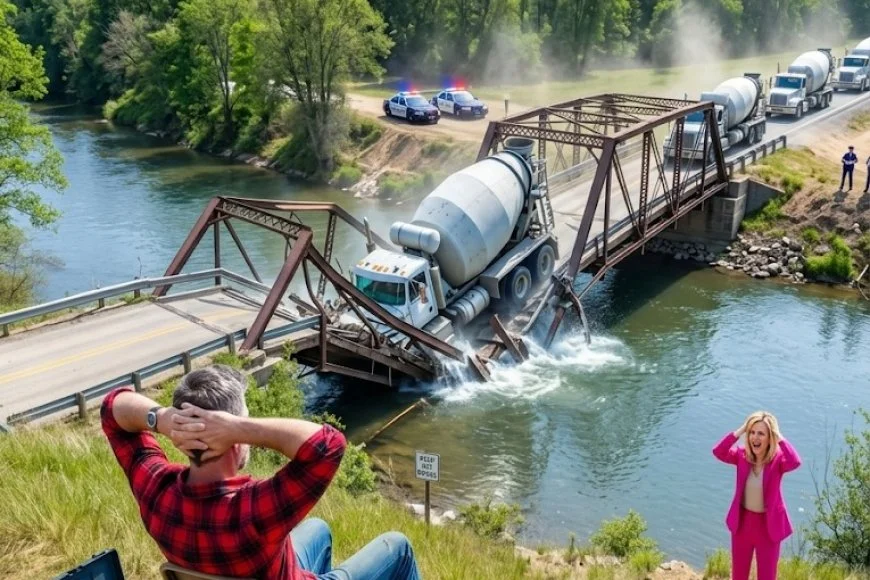
She also loved that bridge more than any sane person should love wrought iron.
Before she died, she made me promise I would finish the historic-preservation nomination we had started together.
I took Vivian’s press release to my attorney, Porter Lindgren.
He was seventy-one and specialized in old easements and historic properties.
He read the 1902 document.
Then he pulled an old New York easement case from his shelf.
“Everett, their problem isn’t whether a modern truck can replace a wagon.”
He tapped the deed.
“Their problem is scale and purpose.”
He explained that an easement created for agricultural access did not automatically become an industrial construction route simply because the dominant parcel had changed hands.
Then he opened another folder.
Inside was a letter from the state historic preservation office.
My bridge’s National Register nomination, dormant for years, had moved into final review after Porter submitted evidence that the structure was under threat.
“How close?” I asked.
“Very.”
He leaned back.
“And if Pell keeps damaging it after receiving formal safety notices, the historic designation won’t magically create criminal penalties by itself. But it will make every agency, lender, insurer, and judge involved ask a much uglier question.”
“What question?”
Porter smiled without humor.
“Why did they knowingly keep loading a documented historic structure after engineers told them it was failing?”
I looked at the strain data in my binder.
Then Porter turned one more page.
Stonebrook had announced its Memorial Day investor tour.
The printed route showed a charter bus crossing my bridge.
And the date of the tour was the same weekend the historic designation was expected to become official.
Vivian had just scheduled her biggest public event directly over the one structure every regulator in the case was now watching…
I spent the next three weeks doing what engineers do when everyone else is arguing: measuring. Additional sensors went onto the lower chord, cameras captured every plate and company logo, and an independent preservation engineer documented the cracks so nobody could later call my findings the work of an angry landowner.
Porter filed a quiet-title action asking the state court to define the 1902 easement. The state preservation office accelerated its review, while the attorney general began examining whether Vivian had used her HOA position to benefit her husband’s development company without proper disclosure.
Inside Stonebrook, Hartley Drummond became our unexpected witness. She was a retired bridge inspector who happened to own a home there. Her copies of HOA minutes showed Vivian repeatedly voting on haul-route decisions that directly benefited Pell Construction.
Then the intimidation started.
At three one morning, a Pell excavator crawled down my private lane, stopped beneath the commercial-closure sign, idled there for half a minute, and turned around.
My cameras captured the operator and equipment number.
I never confronted him.
I forwarded the footage.
Vivian’s final mistake arrived on glossy cardstock.
STONEBROOK RESERVE GRAND OPENING INVESTOR TOUR.
The brochure called my family bridge “Reserve Bridge” and showed a charter coach crossing it as the ceremonial entrance to the development.
The morning before the event, Porter called.
“The historic listing is final.”
I looked toward the bridge.
“And the court?”
“Emergency hearing completed. The commercial closure remains enforceable, and Pell has been formally served.”
“So they know?”
“They know.”
At 7:48 the next morning, the investor bus appeared through the fog.
Vivian’s SUV followed directly behind it.
The driver stopped thirty feet before the bridge.
Vivian drove around him.
Then she saw who was waiting on the other side…
The first person Vivian recognized was Foster Heath.
County highway jacket.
Clipboard.
No smile.
Beside him stood Porter.
Then Hartley.
Then two state preservation officials and an investigator from the attorney general’s office.
I stayed on my porch.
Vivian got out of her SUV and marched toward the barricade.
“We have investors waiting.”
Foster pointed toward the closure signs.
“The bridge is closed to commercial traffic.”
“We have an easement.”
Porter answered.
“You have an easement dispute pending before the court. You do not have permission to ignore a safety closure.”
She looked toward the bus.
The driver had already stepped outside and was reading the posted weight limit.
He shook his head.
“I’m not taking a forty-thousand-pound coach across that.”
Vivian turned on him.
“You were hired to follow the route.”
“I was hired to drive safely.”
That sentence killed the tour faster than any speech I could have made.
Investors began getting off the bus.
Then the state preservation officer introduced herself.
She handed Vivian a copy of the final determination listing the Slate Creek Pratt Truss on the National Register of Historic Places.
“This designation does not give Mr. Ashford magical control over every vehicle in the county,” she said. “What it does mean is that the bridge’s historic integrity, documented damage, and any government-connected approvals affecting it now require formal consideration. And you have been repeatedly warned about the structural condition.”



