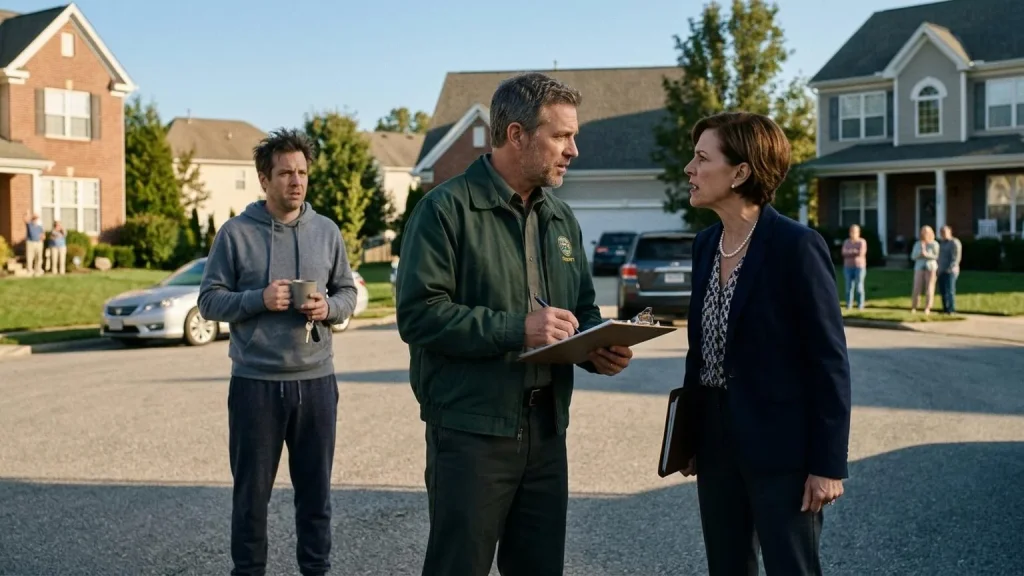
The tow truck was already backing across my driveway when I opened the front door.
Its reverse alarm beeped through the quiet Virginia morning while a steel wheel-lift dropped toward the pavement.
My truck was inside the garage.
My work van was behind it.
And standing at the curb with a clipboard tucked against her chest was HOA president Cynthia Bell.
“Leave it there,” she told the driver. “Nothing enters or exits until the board finishes its review.”
I stared at her.
“You’re blocking my property.”
“I’m restricting an unauthorized access point.”
“It’s my driveway.”
“That’s what we’re reviewing.”
My name is Owen Mercer. I was forty-one years old and made my living restoring old houses—doors, staircases, built-in cabinets, the kind of craftsmanship people notice only after somebody ruins it.
I bought my place in Ashford Glen five years earlier because it had something most suburban homes didn’t.
A detached workshop.
And a private driveway leading to it.
The house itself was older than the neighborhood.
Ashford Glen had been built around several original farm parcels during the early 2000s. My property predated the development by nearly thirty years.
So did the driveway.
When I bought the place, the title company showed me the recorded access easement.
Permanent private ingress and egress.
Filed in 1974.
Ashford Glen’s HOA wasn’t formed until 2003.
I knew that.
Cynthia apparently did not care.
The tow driver climbed down.
He was a heavyset man in a reflective jacket named Ron.
“Where exactly do you want me?”
“Across the entrance.”
Ron looked at the small metal plaque beside my driveway.
He walked over.
Read it.
Then turned around.
“Ma’am, this says recorded private easement.”
Cynthia barely glanced toward it.
“The HOA governs road access inside the community.”
Ron shook his head.
“I tow cars. I don’t close easements.”
“You were hired to perform a service.”
“And I’m not getting sued performing it.”
He raised the wheel-lift, climbed back into his cab, and drove away.
Two neighbors watching from across the street laughed.
Cynthia did not.
She looked at me.
“This is not finished.”
She was right.
The first letter had arrived six weeks earlier.
According to Cynthia, my driveway violated new “community circulation standards” because delivery vehicles occasionally used it to reach my workshop.
I restored architectural woodwork.
Maybe two trucks a week came down that drive.
Sometimes a client dropped off an antique door or picked up a table.
No crowds.
No employees parking on the street.
No machinery running at midnight.
Still, Cynthia claimed my driveway disrupted neighborhood traffic.
I emailed the HOA the easement.
The county map.
The original subdivision plat.
Her reply contained one sentence that told me everything.
Older access arrangements may be superseded by current community standards.
That was false.
But Cynthia repeated it until people began believing her.
Soon neighbors were asking whether my workshop was properly zoned.
Someone told me Cynthia had called my property “a grandfathered commercial problem.”
Then fines began.
Three hundred dollars.
Five hundred.
Seven hundred.
Each one built on the assumption that the HOA had authority over the driveway.
I called a property attorney named Laura Bennett.
She read the file and said, “Stop debating her.”
“What should I do?”
“Save everything.”
So I did.
Letters.
Emails.
Certified-mail receipts.
Photos.
Dates.
Then Cynthia placed orange cones near the driveway entrance.
Not blocking it entirely.
Just enough to suggest she could.
That was when Laura filed a complaint with Fairfax County’s land-use office asking for formal confirmation of the easement.
The county responded two weeks later.
The access was valid.
Permanent.
And outside the HOA’s power to extinguish.
We thought that would end it.
Instead, Cynthia called a special board meeting.
She presented photographs of delivery vans and described my driveway as a potential emergency-access hazard.
Then she persuaded the board to authorize “temporary access controls” while the matter remained under review.
That was how the tow truck arrived.
After Ron refused the job, Cynthia sent three more violation notices in four days.
Laura smiled when I showed her.
“She’s helping us.”
“How?”
“Every new notice proves she knows you dispute her authority and she’s continuing anyway.”
Then I learned something that made the fight feel different.
My neighbor Tom Reyes stopped by one evening while I was unloading walnut planks.
“You know three houses behind you sold this year?”
“I noticed.”
“Same buyer.”
He showed me county records on his phone.
A development company called North River Residential had purchased four older parcels along the western edge of Ashford Glen.
All four had unusual access rights or oversized lots left over from before the subdivision.
My house sat directly between those parcels and the main road.
Tom lowered his voice.
“My sister works in commercial lending. North River’s been talking about a townhouse project.”



