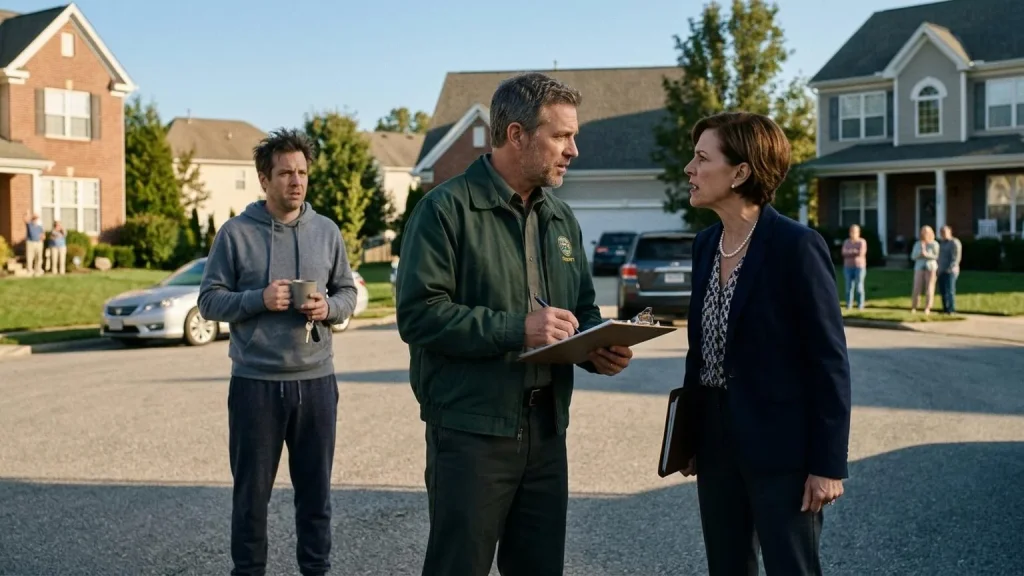
Entirely outside my driveway.
I had no objection.
That surprised some neighbors.
Tom asked me about it one afternoon.
“You fought them for a year, and now you don’t care if they build?”
“I never cared.”
He laughed.
“You absolutely cared.”
“I cared when they wanted my property without asking.”
That was the difference.
The HOA changed too.
Sandra became interim president.
The first policy she introduced required conflict disclosures for any board member whose family or business interests overlapped with HOA decisions.
The second required independent legal review before enforcement could interfere with access rights, easements, utilities, or recorded property interests.
The third required every enforcement vote to appear clearly in the minutes before any fine could be issued.
Boring rules.
Necessary rules.
The board also reviewed the fines issued against me.
Every one was withdrawn.
The HOA reimbursed my documented legal costs through its insurer and a settlement.
I did not receive millions.
I did not want millions.
I wanted the ledger cleared.
The driveway left alone.
My attorney paid.
And a written statement acknowledging that the HOA had no right to obstruct the easement.
I framed that statement.
Not in my living room.
In the workshop bathroom.
Laura said that was disrespectful.
I told her it was where I did my most serious reading.
She laughed.
The neighborhood took longer to recover.
A few residents apologized.
Some never did.
Most had simply believed the HOA president when she said my driveway was a safety problem.
I understood that.
People are busy.
They assume someone quoting section numbers has read the sections.
They assume a board vote happened because a letter says it happened.
They assume a tow truck would never be sent unless somebody checked whether blocking the driveway was legal.
That assumption is what made Cynthia powerful.
Not the title.
Not the clipboard.
The assumption.
One Saturday morning, an older neighbor named George brought me a broken rocking chair.
It had belonged to his mother.
One spindle was split.
The seat sagged.
“I heard you fix these.”
“That’s what the dangerous commercial operation does.”
He laughed.
“Yeah. Sorry about that.”
I looked at him.
“For what?”
“I believed her.”
“You weren’t the only one.”
“I told my wife maybe the workshop really was a zoning issue.”
I shrugged.
“You still want the chair fixed?”
“If you’ll do it.”
“I charge HOA members double.”
His face fell.
Then he saw me smiling.
“Son of a—”
“Leave it there.”
That chair became one of my favorite projects.
Maybe because repairing old furniture is the opposite of what Cynthia tried to do.
You don’t force old construction to behave like something new.
You study how it was built.
You respect the joints that already exist.
Then you strengthen what works.
The same was true of my property.
The driveway looked odd compared with newer houses because it belonged to an older layout.
That did not make it wrong.
It made it older.
There is a difference.
Six months after the recall, Cynthia put her house up for sale.
I heard she and Daniel moved closer to another project outside Richmond.
We never spoke again.
I expected to feel satisfaction when the moving truck arrived.
Instead, I felt almost nothing.
The fight had already ended.
Her leaving was just geography.
What stayed with me happened one evening a year later.
I had finished restoring a walnut dining table for a family in Arlington.
Heavy thing.
Six leaves.
Solid pedestal.
The delivery required my box truck.
I backed it out of the workshop and rolled slowly down the driveway.
At the road, I stopped.
The metal easement plaque remained on the post.
Beside it was the county notice.
I had never removed it.
Maybe I should have.
There was no reason to keep it anymore.
No cones.
No tow trucks.
No fines.
No president standing at the curb.
Just pavement leading from my garage to the street.
Tom was walking his dog.
He waved.
I waved back.
Then I pulled onto the road.
That ordinary movement felt better than winning the meeting.
Better than reading Cynthia’s emails.
Better than watching the board suspend her.
Because rights are most valuable when you don’t have to think about them.
A driveway should be boring.
A property line should be boring.
An easement should sit in a records office for forty years without anybody needing to read it.
The trouble starts when someone decides boring rights are obstacles to an exciting plan.
The original easement document is still in my safe.
Typed on paper thin enough to see through.
The people who signed it are probably dead.
The surveyor who marked it may be dead too.
But the line they created survived all of them.
That impressed me.
Cynthia had a title.



