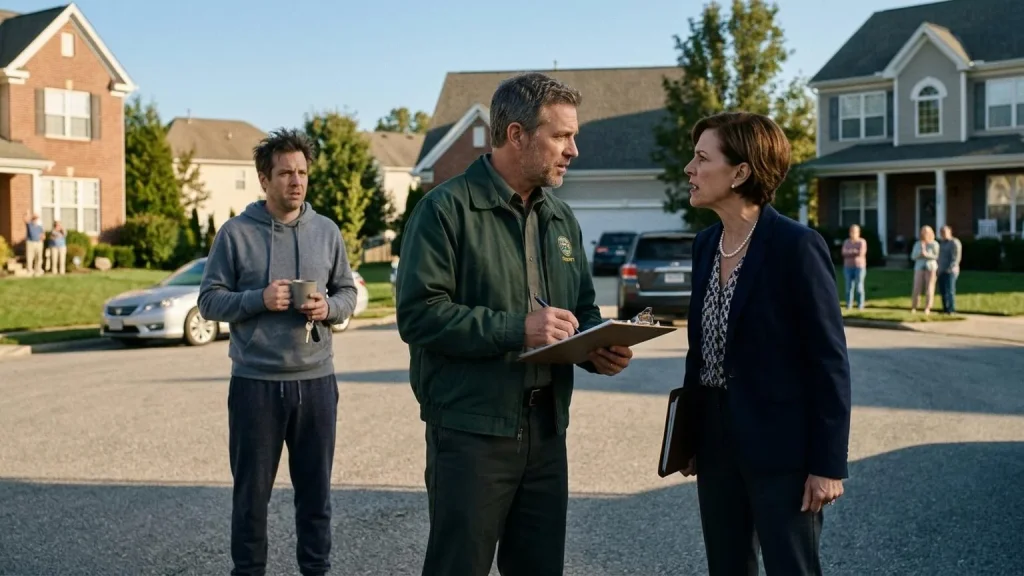
I looked down my driveway.
If someone assembled enough land, my easement became inconvenient.
It cut directly through the only practical access corridor from the proposed redevelopment area to the road.
“Who owns North River?”
Tom turned his phone toward me.
The company manager was listed as Daniel Bell.
Cynthia’s husband.
I felt the whole dispute rearrange itself in my head.
This wasn’t proof of conspiracy.
But it explained why an ordinary driveway had suddenly become an obsession.
Laura told me not to accuse anyone.
“Facts first.”
So we requested HOA board communications involving my property, North River, traffic planning, and western-edge redevelopment.
The HOA resisted.
Then a county official called.
They had reviewed Cynthia’s latest enforcement action.
Not only was the easement valid, but county staff found no traffic order allowing the HOA to physically restrict it.
They planned to send a written warning.
The notice arrived Friday.
I laminated a copy and mounted it beside the metal easement plaque.
Three mornings later, at 6:12 a.m., another tow truck entered the cul-de-sac.
Cynthia was already waiting.
This driver was younger.
He walked straight to the driveway.
Read the metal plaque.
Then read the county notice.
“You didn’t mention this,” he said.
Cynthia folded her arms.
“It doesn’t change HOA authority.”
“It says right here not to obstruct access.”
“That’s an administrative opinion.”
The driver stared at her.
“I’m not blocking this driveway.”
Cynthia stepped closer.
“I am instructing you as the association president.”
“And I’m telling you no.”
By then, half a dozen neighbors had come outside.
Someone was filming.
Cynthia looked furious.
Then a white county SUV turned onto our street.
The land-use officer parked behind the tow truck.
He approached slowly.
“Who requested the obstruction?”
Cynthia raised her hand.
“I did.”
The officer looked at the posted notice.
Then at the tow truck.
Then at Cynthia.
“Ms. Bell, your association has already been advised that this driveway is protected.”
“It is under HOA enforcement review.”
“The HOA cannot review away a recorded easement.”
Her face tightened.
“Our board believes—”
“Your board’s belief doesn’t supersede the land record.”
The neighbors went silent.
The officer explained that another physical obstruction attempt could trigger enforcement action and potential civil liability.
Cynthia said nothing.
The tow truck left.
The county officer left.
Then Tom walked over holding his phone.
“Owen.”
“What?”
He showed me an email.
It had been forwarded anonymously from inside the HOA.
Subject line:
WESTERN ACCESS RECONFIGURATION
The message was from Cynthia to three board members.
It was dated two months before my first violation.
One sentence was highlighted.
If Mercer can be compelled to abandon or relocate the legacy driveway, North River’s assembled parcels become substantially more viable for redevelopment.
Below that was another line.
Daniel believes pressure through compliance enforcement may be cleaner than negotiating directly.
I read it twice.
Laura had told me not to accuse anyone without proof.
Now the proof was sitting in my hand.
But the email contained one more attachment.
A preliminary site plan.
I opened it.
North River’s proposed townhouse entrance ran directly across my driveway.
And stamped in the lower corner of the plan was the name of the HOA consultant who had declared my access a “community safety problem.”
That was when I realized Cynthia had never been trying to enforce a rule.
She had been trying to erase a road…
Laura immediately told me not to post the email online. Instead, she preserved the original file, requested metadata, and sent a formal records demand to the HOA board. Within forty-eight hours, two board members hired their own attorney.
That told us everything.
One of them, Michael Grant, called me privately. Cynthia had never told the full board that her husband controlled North River Residential. When she presented my driveway as a safety issue, she described the redevelopment company only as “a neighboring landowner.”
Michael also confirmed something worse.
The board had voted on my enforcement case using a traffic memo prepared by a consultant North River was paying separately.
The same consultant appeared on the townhouse site plan.
The county suspended all HOA-related access restrictions while it reviewed the conflict.
Then the association’s insurance carrier requested documents.
Cynthia responded by calling another emergency meeting.
She told residents I was trying to bankrupt the HOA and claimed the redevelopment plan was “completely unrelated” to my driveway.
Laura and I arrived carrying certified property records, the county warning, the North River ownership filing, and Cynthia’s email.
But before the meeting started, Michael handed Laura a USB drive.
“What’s on this?” she asked.
“Board emails.”
“All of them?”
“The ones Cynthia told us to delete.”
Laura stopped moving.
“Delete?”
Michael nodded.
“She said they were informal communications and didn’t belong in the official HOA record.”
I looked toward the front of the clubhouse.



