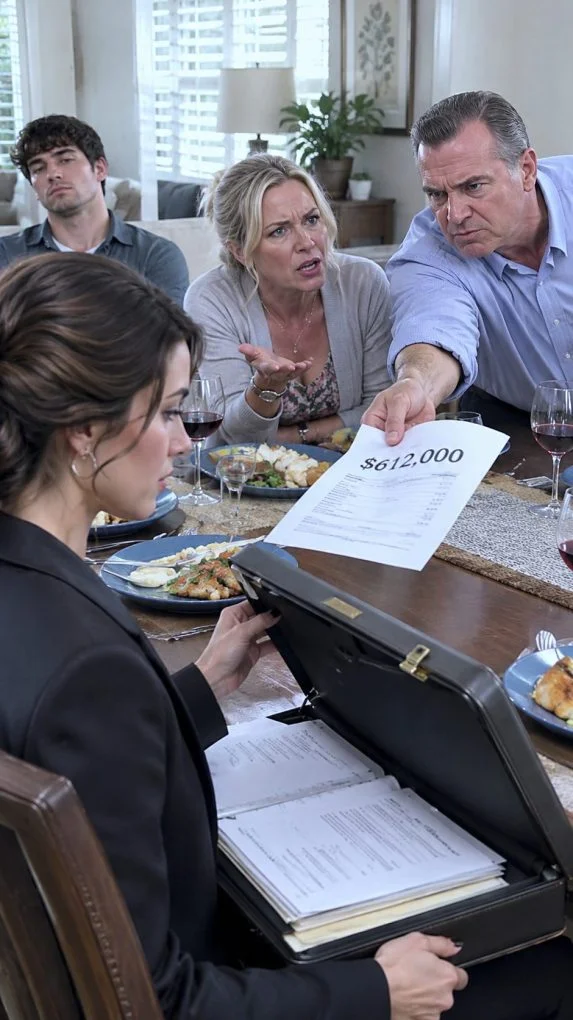
My father slid an invoice across the Thanksgiving dinner table as casually as if he were passing the mashed potatoes. My mother watched me over the rim of her wineglass, while my older brother, Brandon, sat beside her wearing the expensive watch I’d bought him for his thirtieth birthday.
I was twenty-nine, and three years earlier, I’d bought my own apartment in Cincinnati and built Wren & Oak, a home-fragrance brand generating more than a million dollars in annual sales. My parents hadn’t contributed a penny to its creation, but somehow they believed my success had become a family savings account.
“What exactly am I looking at?” I asked, turning the invoice toward the light.
Dad tapped the total with his finger. “Food, clothes, housing, school expenses, medical bills. Everything we invested in you until you turned eighteen.”
I stared at the line charging me $38,400 for childhood groceries, remembering the evenings I’d eaten cereal alone while Mom drove Brandon to baseball tournaments. By sixteen, I’d been working weekend shifts at a bakery to buy my own school clothes, while Brandon’s first car appeared in our driveway with a red bow across its hood.
“Brandon’s equipment business is struggling,” Mom explained. “You have money, and he has responsibilities. Don’t make us beg.”
Brandon wouldn’t meet my eyes. Six months earlier, he’d called me selfish for refusing to guarantee a commercial loan, and now he’d apparently decided my childhood was an outstanding debt.
“I won’t pay this,” I said, folding the invoice once.
Dad’s chair scraped backward. “We have a repayment agreement you signed when you graduated high school, and if you force us to involve lawyers, we’ll do it.”
I remembered signing a college emergency-contact form at eighteen, but nothing resembling a loan agreement. Still, Dad seemed unusually confident, and Mom kept glancing at the leather folder beside his plate.
“Your accounts won’t be much use to you once we take action,” she said.
I left without finishing dinner, carrying the invoice in my purse like something contaminated. The next morning, my bank declined a transfer from two old personal accounts I’d opened as a teenager, and the branch manager explained that Mom, still listed as a joint owner, had reported a disputed transaction.
My business accounts remained untouched, but $31,700 of my personal savings was temporarily inaccessible.
Then my accountant, Natalie, called about the forensic review we’d started two weeks earlier after discovering unexplained vendor payments.
“Emily,” she said, her voice unusually quiet, “we’ve traced $194,000 to a company registered under your father’s name.”
I gripped the edge of my desk.
“And every payment was approved by your mother.”
I asked Natalie to repeat the amount because my mind refused to connect those numbers with the woman who used to braid my hair before elementary school. She turned her monitor toward me, and there it was: twenty-three payments totaling exactly $194,000, all marked as packaging and distribution expenses.
Two years earlier, after my company was already successful, I’d hired Mom as a part-time accounts-payable contractor because she said she needed extra income. I paid her the same hourly rate as our previous contractor, gave her limited access to approved vendors, and trusted her to help keep the business organized.
She had never invested in Wren & Oak.
But she’d been able to approve invoices and schedule payments below our internal review threshold, a weakness I’d corrected as soon as Natalie began questioning our distribution costs. The suspicious invoices came from a company called Rockwell Supply Services, supposedly providing custom boxes, labels, and warehouse handling.
We couldn’t find evidence that those shipments existed.
“Your father registered Rockwell eighteen months ago,” Natalie explained. “And the payment dates line up with the months Brandon was falling behind on his equipment leases.”
I remembered Mom calling during those months, telling me how proud she was of my success. Once, she’d even brought homemade soup to my office while I worked late, asking whether I’d been eating properly.
Now I wondered whether she’d spent that afternoon approving another fraudulent invoice.
I hired attorney Sarah Collins and authorized a full independent review, preserving the original invoices, approval logs, and bank records. Sarah explained that the evidence supported pursuing a civil claim against those responsible, but we needed complete documentation before accusing anyone of theft.
Meanwhile, Dad’s attorney sent a formal demand for $612,000, attaching a supposed repayment agreement bearing my signature. It claimed I’d voluntarily promised to reimburse my parents for childhood expenses once my income exceeded $100,000 a year.
I knew immediately that I hadn’t signed it.
The document included my old handwritten signature from a high school emergency form, even preserving an unusual capital letter I’d stopped using years earlier. Sarah arranged for the original records to be obtained and compared, while I gathered photographs, school documents, and financial records showing how I’d supported myself from my teenage years onward.



