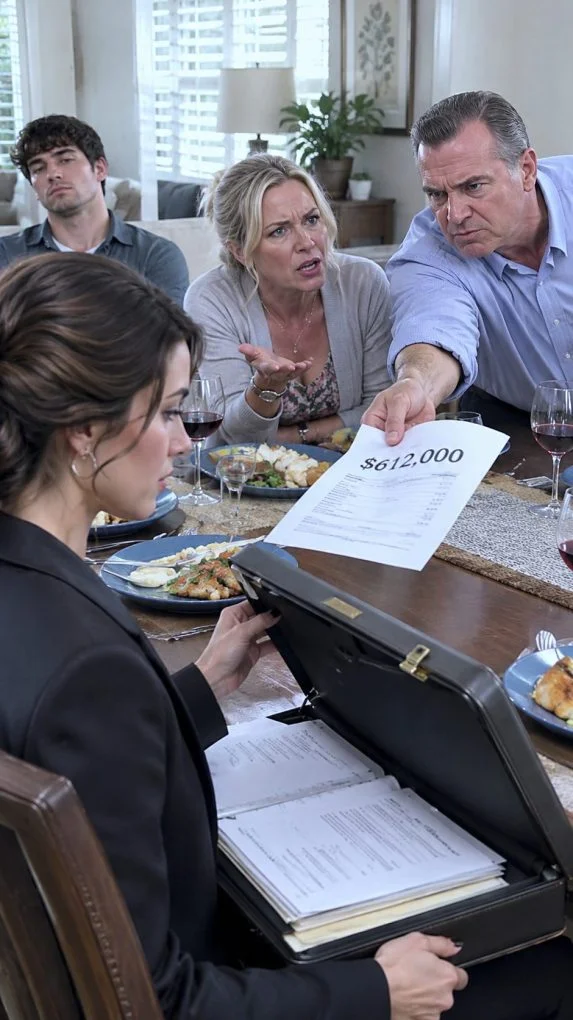
Four days after the bank restriction began, the bank completed its review and restored access to my personal accounts. I moved my funds into accounts held solely in my name, documented every transfer, and ended the joint arrangements I’d been foolish enough to leave in place.
But Dad followed through on his threat.
He filed a civil lawsuit, alleging I’d breached the supposed repayment agreement, and demanded the full $612,000. Sarah responded by challenging the document’s authenticity and filing counterclaims concerning the $194,000 taken from my business.
Brandon called that evening.
“Emily, you’re going to destroy Mom and Dad over bookkeeping mistakes?”
I closed my eyes, remembering how often I’d rescued him from consequences he considered unfair. I’d paid $8,000 toward his business equipment three years earlier after he promised to repay me, and he still hadn’t returned a dollar.
“Did you know where Rockwell’s money was going?” I asked.
He stayed silent.
“Brandon?”
“Dad said it was family money. He said you wouldn’t miss it.”
Something inside me finally became still.
“I paid people to pack orders, answer customers, and ship products,” I said. “That money belonged to the company, not to you.”
He hung up.
Over the next several months, court-authorized discovery produced Rockwell’s bank records, showing that most of the $194,000 had been transferred to cover Brandon’s overdue business expenses. Dad had controlled the receiving account, while Mom’s approval logs connected every payment to my company’s books.
Then Sarah received an email from the documents Dad’s attorney had produced.
It had been sent by Mom three weeks before Thanksgiving.
If Emily finds out about Rockwell, remind her what we spent raising her. She’ll pay to keep this out of court, especially if we threaten her accounts.
Dad had replied less than an hour later.
“Make the bill big enough that she’ll agree to drop the missing-money issue.”
I read those words until my eyes blurred.
They hadn’t demanded $612,000 because they believed I owed them.
They’d invented a debt to frighten me into forgiving the money they’d stolen.
Eight months after Thanksgiving, I walked into the Hamilton County courthouse wearing the navy dress I’d bought for my first major business presentation. Mom and Dad were already seated beside their attorney, and Brandon sat behind them, avoiding my eyes just as he’d done at the dinner table.
Dad looked at me with the same expression he’d worn when I was little and refused to apologize for something Brandon had done. I recognized it immediately: the expectation that I’d surrender because keeping the peace had always been my responsibility.
But this time, I had a lawyer, a forensic accountant, and thousands of pages of evidence.
During the civil trial, Dad’s attorney presented the $612,000 childhood invoice and the supposed repayment agreement. He argued that my parents had made extraordinary sacrifices to raise me and that I’d voluntarily promised to compensate them after becoming financially successful.
Sarah stood and asked Dad one question.
“Mr. Hayes, did you prepare this invoice before or after learning your daughter was investigating missing company funds?”
Dad shifted in his chair.
“I don’t recall the exact date.”
Sarah displayed his email to Mom.
Make the bill big enough that she’ll agree to drop the missing-money issue.
The courtroom went quiet.
Mom stared at her hands, and Brandon leaned forward as though he could somehow stop the words from being read aloud. Sarah then introduced records showing that the alleged repayment agreement had been created years after my eighteenth birthday, with my signature copied from an unrelated school document.
The court had already permitted Wren & Oak, the company that actually owned the missing funds, to join the case. Natalie explained the twenty-three false invoices, the absence of corresponding deliveries, and the bank records tracing $194,000 from my company through Dad’s business to Brandon’s struggling operation.
When Mom testified, Sarah asked why she’d approved invoices for products we never received.
Mom’s voice cracked.
“We were trying to save our son.”
I felt tears gather behind my eyes, but I kept my hands folded in my lap.
“You have two children,” I whispered.
The judge instructed me to wait until I was asked to speak, and I nodded. Mom hadn’t looked at me when she said our son, as though I’d spent my entire life sitting outside the family she considered worth protecting.
When I testified, Sarah asked whether my parents had financed my business.
“No,” I answered. “I worked two jobs, saved my earnings, and borrowed against my own credit. I hired my mother because I thought helping her earn money would make things easier for everyone.”
I glanced toward Dad.
“I never imagined I’d need to protect my company from my own parents.”



