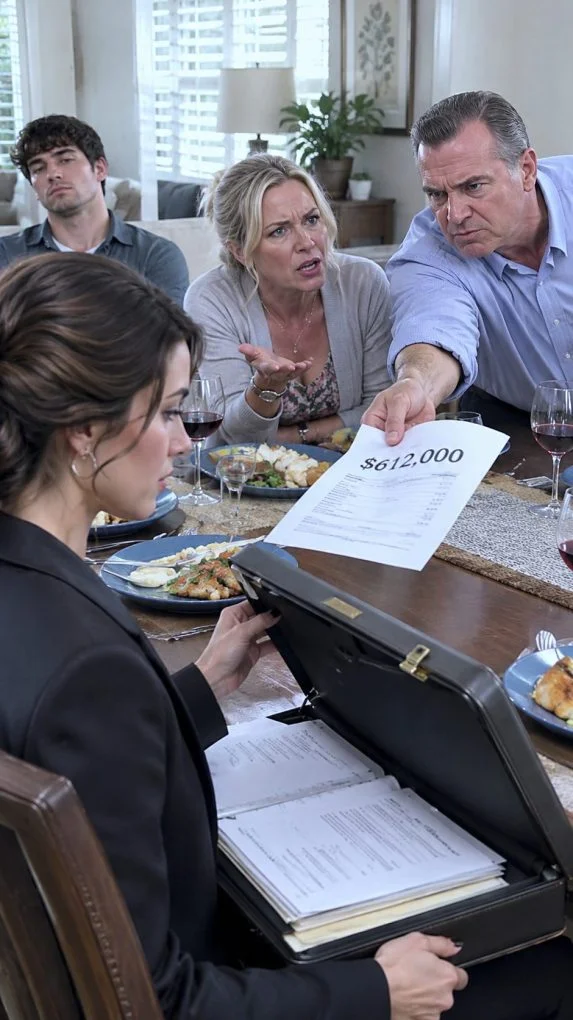
After considering the evidence, the judge ruled that my parents had failed to establish an enforceable repayment agreement. Their $612,000 claim was dismissed, and judgment was entered for Wren & Oak on its civil claims arising from the fraudulent payments.
My parents were held liable for the $194,000, plus applicable interest and costs.
Dad’s face drained of color.
Outside the courtroom, he caught up with me beside the elevators.
“Emily, you know we can’t afford that kind of judgment.”
I turned toward him.
“You sent me a bill for $612,000 because you thought I could afford it. You never once asked what losing $194,000 might have done to my employees.”
He looked away.
“Brandon was desperate.”
“So was I when I started my company. Nobody handed me somebody else’s money.”
Over the following months, Mom and Dad sold a rental property they’d planned to leave Brandon, using the proceeds to satisfy the judgment. The payment restored the money to Wren & Oak, and my company completed its accounting corrections without laying off a single employee.
The criminal investigation proceeded separately. Mom eventually pleaded guilty to a theft-related offense and received probation with restitution conditions, while Dad remained responsible under the civil judgment; neither the court nor the investigators treated their parental status as permission to take company funds.
Brandon’s equipment business closed, and he went back to working for another company. He never apologized for knowing about the payments, although he sent me one message asking whether we could eventually be a family again.
I didn’t answer.
A year after the trial, Wren & Oak opened its first permanent showroom in Cincinnati. My employees surprised me with a small framed photograph from our earliest days, when our products had been stacked on folding tables in a rented warehouse.
On the back, Natalie had written, You built something worth protecting.
I placed it beside my desk, where the afternoon light caught the edges of the frame. For years, I’d mistaken financial success for proof that I was finally worthy of my parents’ pride.
Now I understood that no amount of money would have made them treat me the way they treated Brandon.
They’d calculated the cost of my childhood down to the last dollar, then expected me to pay for the privilege of being their daughter.
The judge erased their $612,000 demand and ordered them to repay the $194,000 they’d taken.
But the greatest victory wasn’t watching them lose their case.
It was realizing that I no longer needed to purchase a place in a family that had never made room for me.
I had built a life of my own.
And this time, nobody else could send me the bill.



