The young waitress was halfway through filling my water glass when I noticed the little dent in her chin.
My mother’s chin.
Mine, too.
Then she turned her wrist, and I saw a thin white scar just below her watch. I remembered cleaning gravel out of that cut while a nine-year-old Sutton cried because she thought she’d never ride her bike again.
I hadn’t seen my daughter in seven years.
Now she was standing beside my chair at a private dinner outside Jackson Hole, wearing a black apron and a name tag that said SUTTON.
And I was sitting at the table as a guest of honor.
“Would you like some more water, ma’am?”
Her voice was different. Tired, maybe. But I knew it.
I looked up.
She looked down.
For a second, neither of us moved.
“Mom?”
The pitcher knocked against my glass.
I opened my mouth, but nothing came out.
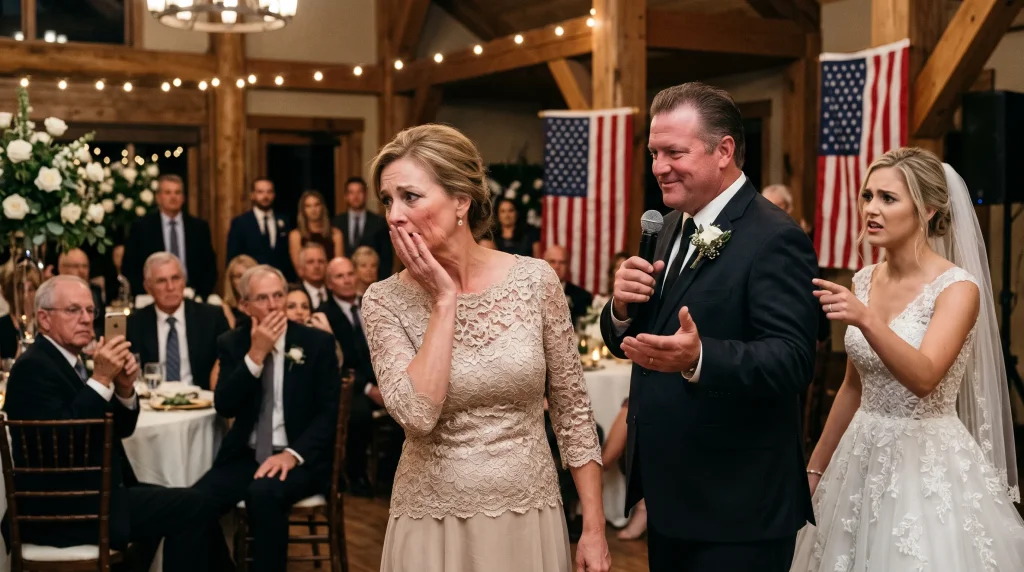
Seven years earlier, that same daughter had stood in a ballroom outside Boise, wearing a wedding dress I’d helped her choose, and told me to apologize to the man who had just slapped me.
Her father.
My husband of twenty-six years.
There were nearly two hundred guests at Sutton’s wedding. A band from Portland. White roses everywhere. I remember those stupid roses because I’d spent the whole morning worrying whether the florist had delivered enough.
Imagine worrying about flowers when your marriage is coming apart.
Three weeks before the wedding, I’d discovered that Leland had borrowed $640,000 against my late mother’s house in Nampa.
Without telling me.
The loan documents carried my signature, but I hadn’t signed them.
I knew because of one tiny detail. My capital T has a loop at the top. I’ve written it that way since elementary school, copying my mother’s handwriting.
The forged signature had the loop backward.
I kept quiet until the wedding. That was my mistake.
During the reception, I approached Leland while he was standing near a live microphone.
“I know about the house,” I whispered. “We need to talk.”
He heard me.
So did half the ballroom.
He set down his drink, turned toward me, and slapped me hard enough to knock an earring loose.
Then he smiled at our guests.
“Tony’s been under a lot of stress lately. Please excuse her.”
I was still holding my cheek when Sutton came over.
For one foolish second, I thought she’d put her arms around me.
Instead, she stood beside him.
“Mom, apologize to Dad. You’re ruining my wedding.”
I looked at my little girl, the one whose hair I’d braided before school, whose science projects I’d stayed up finishing, whose wedding dress I’d paid to have altered twice.
“Sutton, he hit me.”
She wouldn’t meet my eyes.
“Please just leave.”
So I did.
By sunrise, I was driving toward North Dakota with two suitcases, eleven thousand dollars, and a thumb drive containing years of my husband’s business records.
I didn’t know what I was going to do with those records yet.
I only knew I couldn’t go back.
What happened over the following seven years is why I was sitting among billionaires that October evening instead of beside Leland at another dealership banquet.
But Sutton didn’t know any of that.
She was still staring at me.
Her eyes filled with tears.
“I’m sorry,” she whispered.
Then her fingers loosened.
The heavy glass pitcher struck the stone floor and shattered.
Every conversation at the table stopped.
Sutton flinched and immediately crouched to gather the pieces, apologizing to people who weren’t even looking at the broken glass anymore.
I reached for her hand.
“Don’t touch that. You’ll cut yourself.”
She froze.
It was such an ordinary thing to say. Something I’d probably told her a hundred times growing up.
She looked at me, and her face crumpled.
“Mom, please. I need to tell you what Dad did.”
Before I could answer, the woman seated beside me leaned close.
“Tony,” she murmured, “you need to know something.”
She glanced toward the ballroom entrance.
“Leland is here tonight. And he’s about to ask this room for twelve million dollars.”
Then Sutton grabbed my wrist.
“Mom, there’s something else. He didn’t just steal from you.”
I looked at my daughter’s hand around my wrist.
Her fingernails were trimmed short. There was a little patch of irritated skin near her thumb, the kind you get from washing dishes too often. I wanted to ask whether she was eating enough, whether she had somewhere warm to sleep, whether the shadows beneath her eyes were from working too many shifts.
Instead, I asked, “What did he do?”
Sutton glanced toward the entrance.
“Not here.”
The woman beside me stood.



